
Best Creatine for Gaining Weight and Bulking Up
Posted by Maximus
on

Let’s cut to the chase: you wanna get bigger, and you’re looking for a shortcut. The absolute best creatine for gaining weight is, and has always been, good old creatine monohydrate. It's the most studied, battle-tested, and budget-friendly supplement on the planet for anyone trying to pack on serious size and strength. In the world of bulking, it’s the undisputed king.
So, you're looking to get bigger, and you've heard creatine is the ticket. You're right, but let's be crystal clear on how it works its magic. Gaining weight with creatine isn't about slapping on fat; it's about adding quality mass to your frame. It's a killer one-two punch: first, a rapid surge of water weight, then the real prize—genuine muscle growth.
The first thing you'll notice is the number on the scale jumping up pretty quickly. This is because creatine is a master at pulling water directly into your muscle cells. This process, called cell volumization, makes your muscles look and feel fuller almost overnight. Picture your muscles as tiny balloons; creatine literally helps inflate them, giving you a bigger, more powerful look right out of the gate.
But here’s the crucial part: this isn't "water weight" in the puffy, bloated sense. It's functional weight. Research backs this up, showing this initial gain is almost entirely from water inside your muscles, not a shred of new fat. One study, for example, found that after just four weeks, participants packed on an average of 1.7 kg (that's about 3.7 lbs) in body weight, all tracked back to increased body water with zero change in body fat. You can read up on the science behind these findings yourself.
This initial water-fueled pump sets the stage for what’s to come. It’s the foundation for long-term, rock-solid muscle gain. To make it simple, let's break down the most common forms you'll see on the shelves.
This table gives you a rapid-fire look at the different creatine forms and how they stack up for bulking.
| Creatine Type | Primary Mechanism for Weight Gain | Best For |
|---|---|---|
| Creatine Monohydrate | Floods muscle cells with water (cell volumization) and fuels ATP for massive strength gains, which drives long-term muscle growth. | Anyone who is serious about gaining size and strength. It's the gold standard for a reason: proven results and incredible value. |
| Creatine HCl | Marketed for being more soluble, meaning you might get away with a smaller dose. Still powers muscle hydration and performance. | Lifters who sometimes get an upset stomach or feel bloated from monohydrate. |
| Creatine Blends | Combines multiple forms of creatine (like in our Three-Atine) to hit different absorption pathways and often includes extras for energy. | Athletes looking for an all-in-one formula that gives them a performance edge beyond what standard creatine offers. |
Think of each type as a different tool in the toolbox, but for most guys just wanting to get bigger, monohydrate is the trusty hammer you'll use 99% of the time.
Key Takeaway: The first few pounds you gain on creatine are "good" weight. It’s water stored right where you want it—in your muscles—making them fuller and priming them for serious growth. This is worlds away from fat gain or feeling bloated.
This cell volumization does way more than just stretch your shirt sleeves; it sends a powerful signal to your muscles to get stronger. By supercharging your energy reserves, creatine lets you grind out more reps and lift heavier weight. That extra work in the gym is the ultimate trigger for building new, dense muscle.
So, while the journey starts with water, it ends with real, hard-earned gains. If you’re ready to start building that bigger frame, check out our creatine options on Amazon and get ready to transform.
Alright, let's get into the nitty-gritty. When your mission is to pack on serious size, not all creatine is created equal. It's time for the great creatine showdown.
In one corner, we have the reigning, defending, undisputed champion of the supplement world: Creatine Monohydrate. In the other corners, we have the slick, fast-talking contenders vying for the title: Creatine HCl, Buffered Creatine, and the mysterious blended formulas.
This isn't about just reading the back of a label. It’s about understanding what actually works in the trenches—when you're under the bar, grinding out that last rep, and need every advantage you can get. Let's break down which one is truly your best bet for gaining weight.
Let’s be real: creatine monohydrate is the OG. It's the most researched sports supplement on the planet, with hundreds upon hundreds of studies backing its ability to build muscle and raw strength. When you think of creatine, you’re thinking of this stuff.
Its game plan is simple but brutally effective. It floods your muscle cells with creatine phosphate, which is the high-octane fuel for explosive energy (ATP). This means you can lift heavier, for more reps, which forces your muscles to grow. Period. It's also the undisputed king of cell volumization, pulling water directly into the muscle for that full, pumped look that signals the start of serious gains.
The Bottom Line: For 99% of people looking to get bigger, creatine monohydrate is the answer. It's proven, it's cheap, and it flat-out works. There's a reason it has been the gold standard for decades—it simply hasn't been beaten.
Next up is Creatine Hydrochloride, or HCl. The big selling point here is its superior solubility—it dissolves in water like a dream. The theory goes that because it dissolves so well, your body absorbs it more easily, allowing you to get away with a smaller dose (sometimes called "micro-dosing") and potentially skip the stomach issues or bloating some people report with monohydrate.
But does that fancy solubility actually translate to more muscle mass? Honestly, the jury is still out. While it sounds great on paper, there's a serious lack of head-to-head research proving HCl builds more muscle than good old monohydrate when taken at effective doses. Plus, it’s almost always more expensive per serving, so you’re paying a premium for a benefit that might not even impact your gains.
Think of it this way: Monohydrate is a sledgehammer; it gets the job done every single time. HCl is a laser-guided missile; it’s more precise and technologically advanced, but we’re not entirely sure it hits the target any harder when it comes to building size.
Buffered creatine, often sold under the brand name Kre-Alkalyn, enters the ring with a defensive strategy. It’s essentially creatine monohydrate mixed with an alkaline powder, which raises its pH level. The claim is that this protects the creatine from being broken down into a useless byproduct called creatinine by your stomach acid, leading to better absorption and fewer side effects.
Just like with HCl, the science backing its superiority over monohydrate for muscle gain is pretty thin. It might be a solid option for the small percentage of lifters who genuinely get an upset stomach from monohydrate, but for most of us, it’s a solution to a problem that doesn’t really exist.
Picking the right tool often comes down to what you're trying to build. Are you chasing pure, quality muscle, or do you just want to see the number on the scale jump up?
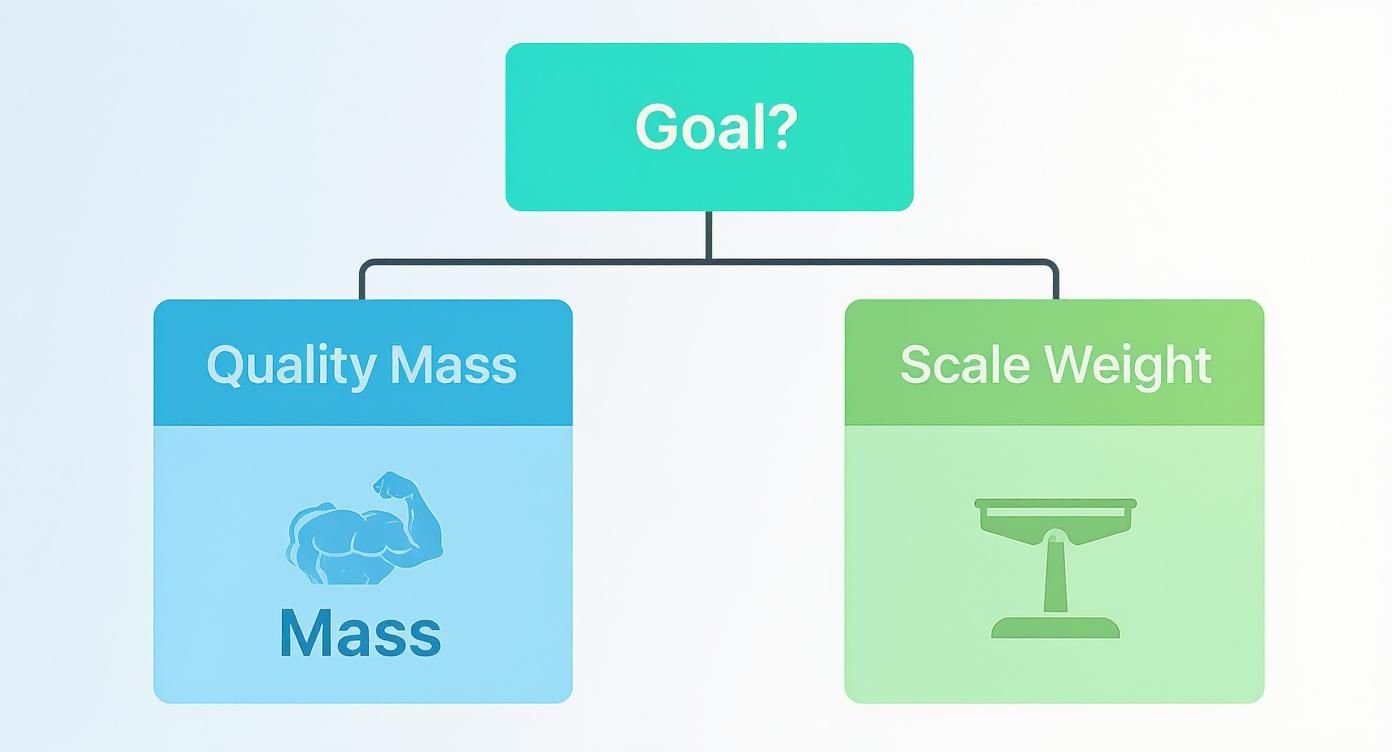
This flowchart nails it. While both paths lead to getting bigger, your strategy shifts depending on whether your focus is on long-term, high-quality muscle or just immediate scale weight.
Finally, we have creatine blends. These are the mixed martial artists of the supplement world, combining several forms of creatine into a single, powerhouse formula. A well-designed blend might pack monohydrate for its proven power, a dash of HCl for rapid absorption, and maybe other forms like creatine pyruvate for an extra energy kick.
This is where things get interesting. The goal of a blend is to give you the best of all worlds. By combining different forms, you can potentially hit multiple absorption pathways, maximizing muscle saturation and performance from every angle. It’s a synergistic approach built for athletes who refuse to settle for the basics.
For instance, our Three-Atine formula is engineered with three distinct types of creatine to cover all your bases. It's built for those who don't want to choose just one but demand a complete solution for power, absorption, and endurance.
To help you decide, here’s a quick breakdown of how these forms stack up when bulking is the main objective.
| Feature | Creatine Monohydrate | Creatine HCl | Buffered Creatine (Kre-Alkalyn) | Creatine Blends |
|---|---|---|---|---|
| Muscle Saturation | The undisputed king. Backed by decades of research showing it effectively saturates muscles. | Good, but requires less to supposedly saturate due to higher solubility. Evidence is weaker. | Similar to monohydrate, with claims of better absorption. Lacks strong scientific proof. | Aims for maximum saturation by combining different forms and absorption rates. Very effective. |
| Water Retention | Causes intracellular water retention (in the muscle), which is exactly what you want for size and performance. | Marketed as causing less water retention, which might be a downside if "weight gain" is the goal. | Similar to monohydrate, as it's the same base molecule. Claims of less bloating are common. | Varies by formula, but generally designed to maximize muscle fullness (intracellular water). |
| Digestion | Can cause bloating or GI issues in a very small percentage of users, often due to poor quality or not mixing well. | Excellent. Its high solubility makes it very gentle on the stomach. A great choice for sensitive users. | Designed specifically to be easy on the stomach by neutralizing acid. Good for sensitive individuals. | Usually well-tolerated, as they often include highly soluble forms like HCl alongside monohydrate. |
| Cost-Effectiveness | The cheapest and most effective option available. Wins by a landslide. | Significantly more expensive per gram. You pay a premium for the solubility and smaller dose. | Pricier than monohydrate. You're paying for the "buffered" technology. | Typically the most expensive option, but you get multiple forms in one product for a synergistic effect. |
So, what's the verdict?
For pure, unadulterated mass gain, all roads lead back to creatine monohydrate. It is the core ingredient responsible for the gains in almost every study that matters. However, for the serious athlete looking for an edge, a high-quality blend offers a compelling, multi-pronged attack on muscle growth.
The choice is yours. Are you a purist who trusts the tried-and-true champion? Or are you looking for a modern edge that combines multiple strengths into one? For a reliable, powerful option that covers all the bases, check out the full range of creatine products on our Amazon store.
So, you've heard the gym-floor whispers: take creatine, get bigger. But how does this simple white powder actually make the number on the scale—and the reflection in the mirror—so much more impressive? It’s not magic; it’s a brilliant one-two punch happening inside your muscles. First, you get the rapid inflation, and then you build the rock-solid foundation.
Let's unpack how creatine works its mass-building magic.
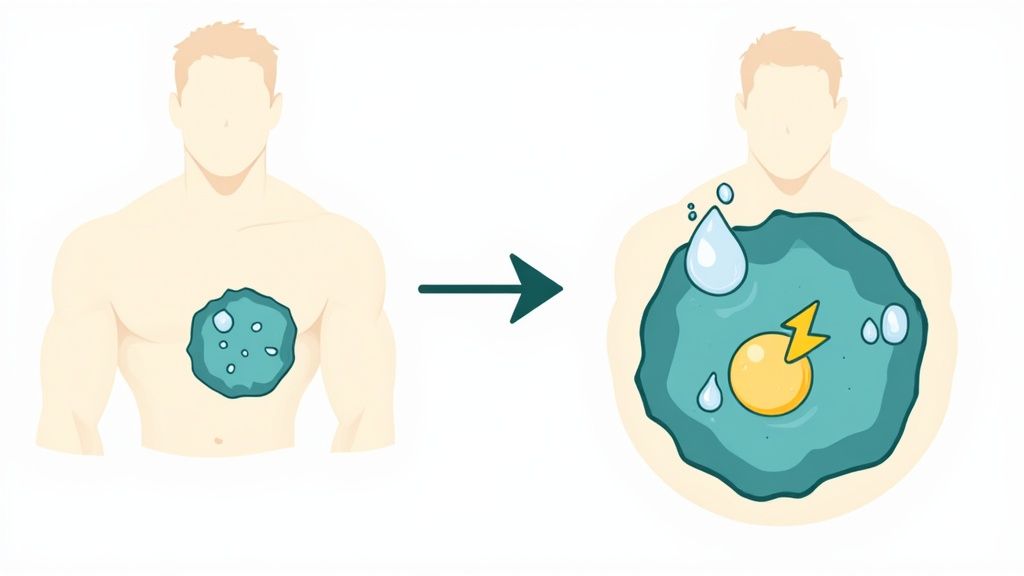
The first thing you’ll probably notice is the scale jumping up within the first week. Don't panic—this isn't fat. It's not the soft, squishy water weight you get from a weekend of pizza and beer. This is functional, performance-boosting weight.
In scientific terms, creatine is "osmotically active." In gym-speak, that means it’s a water magnet. When you start taking creatine, it floods your muscle cells, and like a sponge, it pulls water from your bloodstream right into the muscle tissue.
This process is called cell volumization, and it’s your fast-pass to looking and feeling bigger almost overnight. Picture your muscle fibers as tiny balloons. Creatine starts inflating them, giving you a fuller, harder look that stretches the sleeves of your t-shirt. This isn’t just for show, either. That cellular swelling actually kicks off anabolic (muscle-building) signals in your body.
The Real Scoop on "Water Weight": The initial 2-5 pounds you gain is almost all water, but it's pulled inside your muscle cells, not stored under your skin. This makes you look hard and dense, not puffy. It's the best kind of water weight you can ask for.
This super-hydrated state creates the perfect environment for what comes next: real, lasting muscle growth.
The initial water pump is a nice ego boost, but the main event is how creatine fuels actual, hard-earned muscle. Your muscles' primary fuel for explosive movements is a molecule called adenosine triphosphate, or ATP. The problem is, when you're lifting heavy, you burn through your ATP stores in just a few seconds.
This is where creatine swoops in like the cavalry. It works to rapidly regenerate your ATP, essentially reloading your muscles' energy supply in real-time. What does that mean for your workout? Instead of grinding out six reps and hitting a wall, you can power through eight, nine, or even ten. You can finally add that extra plate to the bar and still crush your set.
That extra work—those two more reps, that extra 10 pounds on the bar—is the direct trigger for hypertrophy (the fancy term for muscle growth). You’re forcing your body to adapt to a greater challenge by building bigger, stronger muscle fibers to handle the new load.
This isn't just bro-science, either. The research is rock-solid. One massive scientific review found that lifters who combined creatine with training gained an average of 1.21 kg (that's about 2.67 lbs) more muscle mass than those who didn’t.
So, let's trace the journey from the scoop to your biceps:
This awesome cycle—from water to work to genuine muscle—is what makes creatine such a powerhouse for gaining weight. To get an even deeper look at the science, check out our guide on how creatine works its magic in your body.
You’ve picked your weapon, now it’s time to learn how to wield it. Having the best creatine for gaining weight is only half the battle; knowing exactly how much to take—and when—is what separates the amateurs from the guys who pack on serious mass. This is your playbook for turning that white powder into monstrous results.
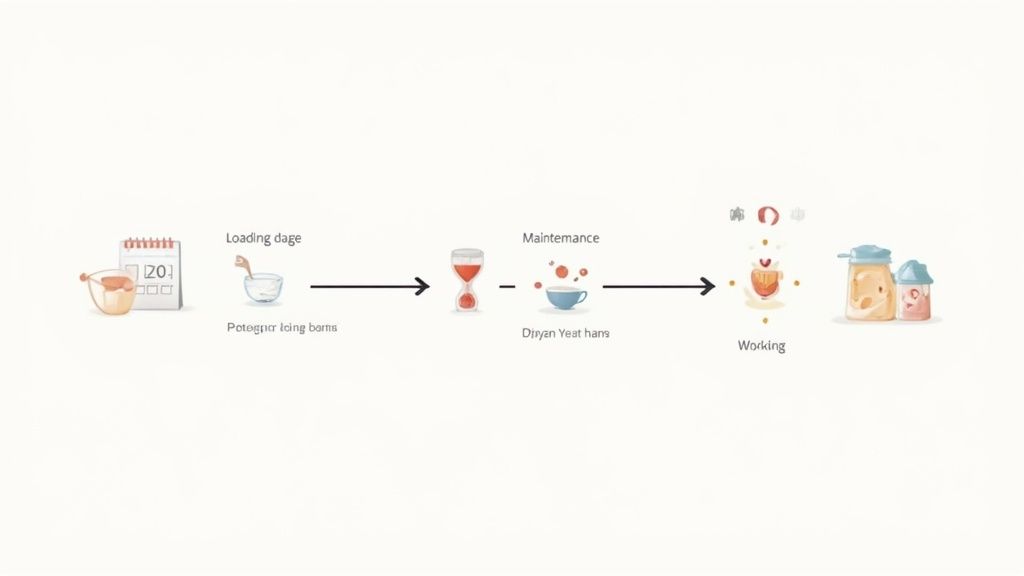
Let's dive right into the most debated topic in the creatine world: the infamous "loading phase." Is it a mandatory rite of passage or just an optional shortcut?
The loading phase is an aggressive strategy designed to saturate your muscles with creatine as quickly as humanly possible. Think of it like flooring the gas pedal to get up to speed on the highway. Instead of a slow build-up, you bombard your muscles with a high dose to fill their creatine stores in record time.
Here’s the standard protocol:
The main advantage here is pure speed. You'll feel that muscle fullness and notice a jump in strength and performance much faster, usually within the first week. The science backs this up, too; a proper loading phase can boost your muscle creatine stores by about 20% in just a week, setting you up for rapid gains.
If downing 20 grams a day sounds like overkill, don’t sweat it. You can skip the loading phase entirely and go straight to a standard maintenance dose. This approach is like merging onto the highway smoothly—it takes a bit longer to get up to speed, but you’ll absolutely get there.
With this method, your muscles will reach full saturation in about three to four weeks. The end result is exactly the same as loading; you just take the more scenic route. This is the perfect play for anyone with a sensitive stomach or who just prefers a simpler, one-scoop-a-day routine.
So, Load or Not? Loading gets you results faster. Maintenance is simpler and just as effective in the long run. The choice is yours—neither is wrong. It all boils down to how patient you are.
Now for the million-dollar question: pre-workout, post-workout, or does it even matter? The truth is, taking it any time is far better than skipping it. But if you want every last ounce of benefit, smart timing can give you a slight edge.
The science leans heavily toward the post-workout window as the prime time. After you’ve thrashed your muscles in the gym, they are screaming for nutrients. Your body’s insulin sensitivity is jacked up, which basically unlocks your muscle cells so they can suck up nutrients—including creatine—way more efficiently.
For the ultimate power move, mix your creatine into a post-workout shake with fast-digesting carbs and protein. The carbs trigger an insulin spike, which acts as a high-speed transport system, shuttling that creatine and protein straight into your recovering muscles. This one-two punch not only maximizes creatine uptake but also kick-starts the muscle repair and growth process immediately.
If you really want to get granular with dosing, our guide on how much creatine you should take breaks it down even further.
https://www.youtube.com/embed/gygPB6RN-Rc
Creatine is an absolute beast—the undisputed heavyweight champion of the supplement world. But let's be real, even Mike Tyson needed a solid corner crew to win the title. If you really want to skyrocket your weight gain, you have to think beyond just the scoop of powder and build a killer team around your creatine.
It’s time to turn your body into a 24/7 muscle-building factory.
Let's get one thing straight: you can't build a brick house without bricks. Supplements are the crew, but food is the raw material. Taking creatine without eating enough is like hiring the world's best construction team and handing them a single 2x4. It’s just not going to happen.
First things first: you need a caloric surplus. This is non-negotiable. It just means you have to eat more calories than your body burns each day. It’s simple math, really. Without that extra energy, your body has nothing to build new muscle tissue with.
Aim for a modest surplus of 300-500 calories above your daily maintenance level. This sweet spot helps promote lean gains without you just packing on a bunch of unwanted fluff.
Next up is the king of all macros for muscle: protein. Creatine gives you the juice to tear down muscle fibers in the gym, but protein is what rebuilds them bigger and stronger than before. Think of creatine as the demolition crew and protein as the construction team that erects a skyscraper where a tiny shed used to be.
Your target should be at least 1 gram of protein per pound of body weight, every single day. No excuses.
Bulking Truth Bomb: All the creatine in the world won't add a single pound of quality muscle if you aren't eating enough food. A caloric surplus and high protein intake are the fuel for the fire that creatine starts.
Once your nutrition is locked in, you can bring in some key teammates to work alongside your creatine. These aren't magic pills, but when you stack them correctly, they create a powerful synergistic effect that can seriously accelerate your results.
For more ideas on how to assemble your perfect muscle-building arsenal, you can explore our detailed guide on the best supplement stacks for bulking and find a combination that fits your specific goals.
Look, you can have the perfect diet and the ultimate supplement stack, but if your training is lazy, you're just spinning your wheels. Your workouts are the signal that tells your body to actually use all those resources to build muscle. Without the right stimulus, those extra calories and supplements have nowhere to go.
To truly maximize your gains, you have to consistently challenge your muscles. This is where understanding progressive overload comes in—it’s what separates temporary gains from a permanent transformation. You have to progressively lift heavier weights, bang out more reps, or crank up the intensity over time. This forces your body to adapt by growing bigger and stronger.
Building the ultimate bulking stack is a three-pronged attack: hard training, smart nutrition, and strategic supplementation. Nail all three, and you won’t just be gaining weight—you'll be building a masterpiece.
Look, nobody's knocking creatine monohydrate. It's the old-school, grizzled veteran of the supplement world for a reason—it flat-out works. But what if "good enough" isn't in your vocabulary? If you're serious about gaining real weight and want to squeeze every last ounce of growth from your training, you need something smarter. That's exactly why we built Three-Atine.
This isn't just another tub of white powder with a cool label. Three-Atine is a precision-engineered blend for people who demand more from their supplements and their bodies. We didn’t just toss a few ingredients in a bucket and hope for the best; we strategically combined three unique forms of creatine to create a formula that attacks muscle growth from every possible angle.
Why bring a knife to a gunfight when you can have a whole arsenal? Each type of creatine in our blend plays a very specific, tactical role in your mission to get bigger.
This isn't a random mix; it's a synergistic onslaught. You get the time-tested muscle-filling power of monohydrate, the souped-up delivery from AKG, and the extra gas in the tank from Pyruvate.
By combining these three forms, Three-Atine is designed to maximize not just raw strength but also absorption and endurance. It’s a complete system for anyone who's dead serious about their gains.
While plain old monohydrate is a fantastic starting point, a well-designed blend like Three-Atine offers a more holistic strategy. It’s built for the person who understands that gaining quality weight isn’t about just one thing—it’s about optimizing the entire process. You’re not just dumping fuel into your muscles; you’re making sure it gets there fast and that you have the stamina to burn it all.
This multi-pronged approach helps guarantee your muscles are locked, loaded, and ready to perform, set after grueling set. And we all know that more productive work in the gym translates directly to more muscle on your frame. It’s the ultimate formula for anyone looking for the best creatine for gaining weight because it covers the whole performance cycle, not just one part of it.
Ready to stop messing around and start packing on serious mass with a formula built for peak performance? It's time to level up. Grab your supply of Three-Atine right here on our Amazon store and feel the difference for yourself.
We’ve covered a ton of ground, but I know you’ve probably still got a few questions bouncing around in your head. Let's tackle them right now with some straight-up answers so you can get on with your mass-gaining mission.
This is the million-dollar question, right? In that first week, get ready for a quick jump on the scale—anywhere from 2 to 5 pounds. Don't freak out; this is mostly that awesome muscle-filling water we talked about earlier.
Over the long haul, say a few months of consistent training and solid nutrition, it’s totally realistic for guys to pack on an additional 5 to 10 pounds of actual, hard-earned muscle on top of that initial water weight.
You bet it is. Creatine is probably the most-researched supplement on the planet, and the verdict is in: it's incredibly safe for long-term daily use for healthy people.
Just stick to the proven maintenance dose of 3-5 grams a day, make sure you're drinking plenty of water, and you’re golden. Some guys worry about myths they've heard, like if creatine causes gynecomastia, but the science just doesn't back that up.
The Bottom Line: The weight you gain from creatine is quality weight. First comes the water that makes your muscles look full and powerful, then comes the real muscle tissue. It's not fat, and the supplement itself is as safe as they come.
Let's be real: you’ll lose the extra water weight, for sure. Your muscles might look a bit "flatter" once they aren't super-saturated anymore.
But here’s the good news—the actual muscle fiber you built in the gym? That’s yours to keep, as long as you keep hitting the weights and eating like you mean it.
You now have the complete playbook for using the best creatine to gain weight. The only thing left to do is put in the sweat. When you're ready to stop reading and start building, Crazy Muscle has the fuel you need to get the job done.
Explore our full range of high-quality creatine and bulking supplements on Amazon today!

Sign up and save 10% off your next order