
Finding the Best Creatine Monohydrate: Your No-BS Guide to Real Gains
Posted by Maximus
on

Let's be real. The secret to finding the best creatine monohydrate isn’t about chasing some unicorn supplement with a flashy label. It’s about one thing: what actually works. For decades, this simple, badass supplement has been the undisputed king of strength and muscle growth for a very good reason—it flat-out delivers. It's the most studied, most effective, and most affordable weapon in your gym bag. Period.
Alright, let's cut through the gym-floor garbage you've been hearing. You've heard the whispers and the locker-room legends about creatine—the stuff that supposedly gives you god-tier power and sleeve-stretching muscle. But what’s the real deal?
Forget the confusing science jargon for a second. Think of it like this: creatine is basically a nitrous boost for your muscles.
When you're grinding out a heavy set or sprinting like a maniac, your body burns through its high-octane fuel, a molecule called ATP. The problem? You only have enough for a few seconds of all-out war with the weights. Creatine swoops in like a one-man pit crew to rapidly refuel those ATP stores, giving you the juice to blast through those extra, growth-triggering reps that were just out of reach before.
In the supplement world, there's always a new "revolutionary" powder hitting the shelves, promising to be the next big thing. Yet, through all the hype and shiny packaging, creatine monohydrate remains the undefeated, undisputed champion. Why? Because it’s backed by a literal mountain of scientific studies and decades of proof from athletes who stake their careers on it.
This isn’t just bro-science; the numbers are staggering. Creatine monohydrate absolutely dominates the market with a massive 71.3% global market share. That kind of loyalty doesn't happen by accident—it’s earned through relentless, reliable performance.
The magic of creatine monohydrate is in its brutal simplicity. It’s not a miracle powder. It’s a scientifically-validated tool that multiplies the blood, sweat, and tears you’re already putting in.
Of course, creatine is just one piece of the puzzle. It works best when it’s part of a smart supplement strategy. To really hit your peak, you need to see how it fits with other key nutrients. For a bigger picture, checking out a guide on the best supplements for athletes can help you build the ultimate performance stack.
So, are you ready to stop wondering and start seeing the results you’ve been busting your ass for? Let’s break down exactly what you need to find the absolute best creatine monohydrate for your goals.
Let's be real—not all white powders are created equal. When you’re staring at a wall of supplements, every tub of creatine monohydrate starts to look the same. But choosing the best creatine monohydrate isn’t about falling for the coolest-looking label; it's about knowing what separates the pure, muscle-fueling champions from the gritty, ineffective chalk dust.
Think of yourself as a detective. Your mission? To find the clues on the label and in the product details that scream "high quality." This checklist is your magnifying glass, arming you with the knowledge to spot the good stuff and sidestep the junk.
First things first: purity is the absolute, number one, most critical checkpoint. You're buying creatine to build muscle, not to chug a cocktail of mystery chemicals. The goal should always be to get as close to 100% pure creatine monohydrate as possible.
A reputable brand will be upfront about their sourcing and manufacturing. They won't hide where their ingredients come from. Be very suspicious of any brand that uses a "proprietary blend" for a simple ingredient like creatine—that's often a sneaky way to mask low-quality sources or unwanted fillers.
A top-tier creatine supplement should have one primary ingredient: creatine monohydrate. Anything else on that list deserves a healthy dose of side-eye.
Ever had a creatine shake that felt like you were drinking sand? That gritty, clumpy texture is the signature of poorly processed creatine. This is exactly why the word micronized should be your new best friend.
Micronization is a fancy term for a simple process: breaking down the creatine particles into smaller, much finer pieces. This dramatically increases the surface area, allowing it to dissolve almost instantly in water, protein shakes, or whatever you mix it with. It’s not just about a smoother drink; it's about better absorption and way less potential for stomach cramps.
If a brand doesn't bother to mention that its creatine is micronized, you're basically rolling the dice on mixability. Why settle for a chunky, unpleasant experience when you can have a smooth, effective one?
Here’s a little secret about the supplement industry: it’s not always tightly regulated. A flashy label can make all sorts of promises, but without independent verification, those are just words. This is precisely why third-party testing is absolutely non-negotiable.
When a product is third-party tested, it means an independent lab has verified that what's on the label is what's actually in the tub. They check for two crucial things:
Seeing a seal from a reputable lab like NSF, Informed-Choice, or USP is your ultimate seal of approval. It’s solid proof that the company is confident enough in its product to put it under a microscope. Choosing a non-tested supplement is like buying a car without looking under the hood—a risk you just don’t need to take. For a deeper dive into what makes a top-tier product, you can explore our guide on finding what is the best creatine supplement.
Before we wrap up, here’s a handy table to keep you on track while you shop.
Use this quick-reference guide to evaluate creatine supplements based on key quality criteria.
| Quality Factor | What to Look For (The Good Stuff) | Red Flags to Avoid (The Junk) |
|---|---|---|
| Purity | 100% Creatine Monohydrate | Proprietary blends, unnamed sources |
| Form | Micronized for better mixability | Not specified, gritty texture |
| Testing | Third-party tested (NSF, USP, etc.) | No independent lab verification |
| Ingredients | Single ingredient, unflavored | Fillers, artificial sweeteners, additives |
This little cheat sheet makes it easy to spot a winner from a dud in seconds.
Finally, flip that tub around and take a hard look at the "Other Ingredients" section. The best creatine monohydrate supplements will have a very short, very boring list. Ideally, it should contain nothing but creatine monohydrate.
Be wary of products loaded with unnecessary extras you don't need:
Your goal is pure, unadulterated fuel for your muscles. Every extra ingredient is just a potential distraction from that mission. Stick to the basics, and your body will thank you for it. With this checklist in hand, you're ready to confidently pick a winner that delivers pure power, not empty promises.
The supplement industry absolutely loves to reinvent the wheel, especially when it can slap a higher price tag on a "new and improved" formula. You’ve probably seen them: Creatine HCL, Ethyl Ester, and even buffered Kre-Alkalyn, all screaming about faster absorption and fewer side effects.
But here’s the thing: after decades of rigorous, independent research, good old-fashioned creatine monohydrate is still the undisputed champ.
When Creatine HCL first hit the shelves, the big promise was less bloating and instant solubility. Then came Ethyl Ester, which claimed it was absorbed better, though the actual data to back that up is surprisingly thin. Kre-Alkalyn jumped into the ring with its special alkaline buffer, supposedly designed to cut down on side effects.
The one thing they all have in common? They cost more per scoop. It's a classic case of mixing marketing hype with a premium price, but that rarely adds up to real value for you.
Let’s break it down:
"Despite all the marketing noise, no fancy creatine variant has ever outperformed pure creatine monohydrate in high-quality, peer-reviewed trials."
Marketers are brilliant at making bold claims, especially about things like absorption speeds. But when you look at the actual scientific trials, there's no meaningful advantage to these expensive alternatives. Monohydrate remains the gold standard, the one form that has been proven to work time and time again for building strength and performance.
So, what actually defines a quality creatine? It really boils down to purity, mixability, and proper testing.
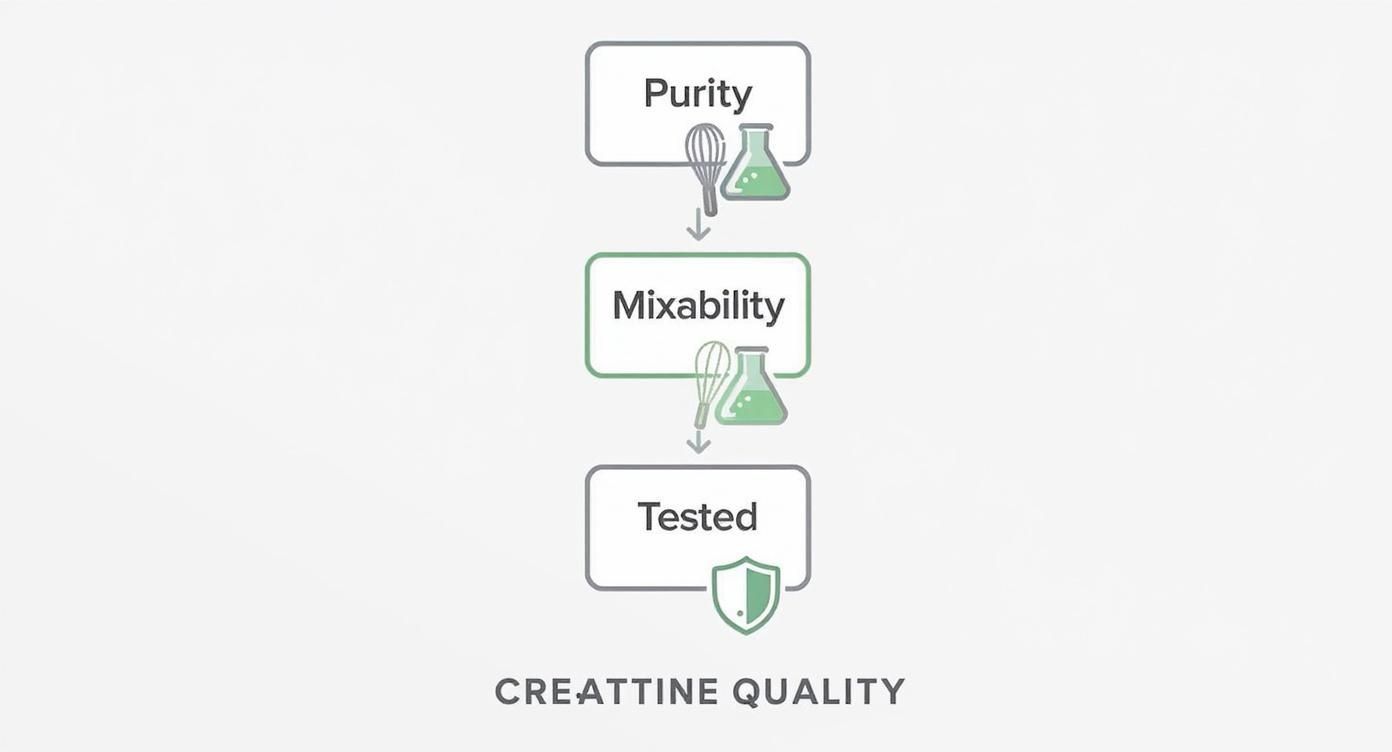
This chart drives the point home: the best creatine monohydrate shines because it's pure and it mixes well, no frills needed.
The creatine market is absolutely exploding. Right now, it's a USD 1.13 billion industry, and experts project it will skyrocket to nearly USD 10.78 billion by 2034.
Even with all the new kids on the block, monohydrate continues to be the most popular form. Why? Because it delivers proven results at a fantastic value. You can dive deeper into the creatine supplement market outlook on statifacts.com if you love the numbers.
When you’re picking a supplement, sometimes the best tool is simple cost-per-gram math.
A typical serving of monohydrate can cost as little as $0.03. Meanwhile, the alternatives can easily run you $0.05–$0.08 for a single scoop.
| Form | Approx Cost Per Serving | Trials Supporting Uptake |
|---|---|---|
| Monohydrate | $0.03 | Multiple meta-analyses |
| HCL | $0.05 | Limited small studies |
| Ethyl Ester | $0.07 | Lackluster results |
| Kre-Alkalyn | $0.08 | No clear benefit |
The numbers don't lie. It's up to you to decide if a fancy name is worth the extra cash. For top-tier performance, safety, and value, monohydrate wins every single time.
Stick with the proven winner and keep your hard-earned money. You can grab your supply of the gold standard from Crazy Muscle right here:
Get Best Creatine Monohydrate on Amazon
I see it all the time: gym newbies get mesmerized by flashy labels and end up overpaying. A smart, cost-conscious lifter knows pure monohydrate offers the best bang for their buck. Even elite athletes, who could use anything they want, almost always stick with monohydrate for its consistent, reliable results.
Here’s a simple way to think about it:
There’s just no need to overspend on unproven alternatives when monohydrate ticks every single box. A standard 300-gram tub of monohydrate gives you 60 servings for a grand total of around $1.80. That same size container of HCL? You're looking at $4.20 on average. Ethyl Ester and Kre-Alkalyn often cost more than $5 for the same amount.
"I switched back to monohydrate from a 'fancier' form and saved over $80 a year without losing a single ounce of gains." – Real user
And what about those claims of fewer side effects? They’re mostly marketing fluff. A high-quality, third-party tested monohydrate—especially a micronized version—is incredibly gentle on the stomach and minimizes any chance of bloating.
When you cut through all the noise and flashy marketing, pure creatine monohydrate stands tall.
Choosing monohydrate means you're putting your trust in decades of science, not a few months of speculation.
Ready to fuel your performance without draining your wallet?
Get Best Creatine Monohydrate on Amazon Now
Go get 'em, hero
https://www.youtube.com/embed/IbLIyA6AlS4
So, you've got your hands on the white gold of the supplement world. That tub of creatine powder is promising bigger lifts and fuller muscles, but how do you actually make it work? It's not just about randomly scooping and chugging.
Let's get this right from the start. Whether you're a gym veteran or just finding your footing, mastering your creatine strategy is the key to unlocking its real power. We'll break down the loading phase, nail down your daily dose, and settle the timing debate once and for all.
Think of the loading phase as a kick-starter for your muscles. The idea is simple: you front-load your system to saturate your muscles with creatine as fast as humanly possible. This usually means taking around 20 grams a day for about a week, typically split into four 5-gram servings.
Why bother? Because you'll see and feel the results—fast. We're talking noticeable muscle fullness and a jump in strength, often within that first week. It’s a huge motivational boost.
Of course, it's not mandatory. If you have a sensitive stomach or just want to take it slow, you can skip the loading and just stick to a daily maintenance dose of 3-5 grams. You'll get to the same destination; it'll just take about three or four weeks instead of one.
Here’s a rookie mistake that can sabotage your results: not drinking enough water. Creatine pulls water into your muscle cells (that's part of how it works!), so you absolutely have to up your fluid intake, especially during the loading phase.
Skimp on water, and you’re just asking for dehydration, fatigue, and cramping. You’re also short-changing the very process you’re trying to optimize.
Here are a few simple rules to live by:
Once your muscles are saturated (either from loading or a few weeks of consistent use), it's time to switch to a maintenance dose. This keeps your creatine stores topped off without overdoing it.
A solid rule of thumb is to take 0.03 grams per kilogram of body weight. It’s simple math.
For a 70kg (154lb) person, that’s about 2.1 grams a day. If you're a 90kg (198lb) lifter, you're looking at around 2.7 grams. Most people just round up and stick with a simple 3-5 gram scoop to keep things easy, which works perfectly fine.
Ah, the age-old question: when is the best time to take creatine? People love to argue about this one, but the science is pretty clear: consistency trumps timing.
Taking it every single day is far more important than stressing over the exact minute you take it.
That said, if you want to squeeze out every last drop of benefit, some research suggests that taking creatine post-workout with some carbs and protein can slightly improve its uptake into your muscles. It makes sense—your muscles are like sponges after a tough session, ready to soak up nutrients.
But honestly, the difference is marginal over the long run. If taking it pre-workout helps you remember to do it, then do that.
"Whether you sip before your first set or gulp it down after your last, the single most important factor is never, ever missing a daily dose."
On your rest days, just take your maintenance dose whenever it’s convenient. With breakfast, with your lunch... it doesn't matter. Just get it in to keep those muscle stores full and ready for your next workout.
The best supplement routine is the one you can stick to without thinking. The beauty of unflavored creatine monohydrate is that it's tasteless and dissolves easily. Mix it into anything: your protein shake, a glass of juice, or just plain water. It’s foolproof.
Of course, creatine is a powerful teammate, but it can't build muscle on its own. You still need the building blocks, and that means plenty of protein. If you're following a vegan or vegetarian diet, you'll want to be extra diligent about your protein sources. Check out these tips on plant-based protein for muscle building to make sure you're covering all your bases.
Want to dial in your dosage even more? We've got a whole guide that digs deeper into personalizing your intake. Check out our article on how much creatine you should take.
Let's cut to the chase. We looked at the creatine shelf and saw a bunch of tubs that all looked the same. They all promised the world but were pretty quiet on how they’d get you there. We got tired of it. So, we decided to make something we'd actually be excited to use ourselves.
That's how Three-Atine was born. It’s our answer to all the gritty, generic, and questionable powders out there. This isn’t just a sales pitch; it's a look behind the curtain from a team of fitness nuts who obsessed over every last detail. We didn't just want to sell creatine—we wanted to perfect it.
You know what I'm talking about: that last gritty sip of your shake that feels like you're drinking sand. It's gross. That residue at the bottom of your shaker isn’t just unpleasant; it’s a sign of cheap, poorly milled creatine that your body isn’t even absorbing.
We knew our creatine had to dissolve perfectly. No exceptions. That’s why we only use micronized creatine monohydrate. We mill the particles down to be incredibly fine, creating a powder that disappears into your drink almost instantly. The result? A smooth, grit-free shake every single time, so every gram you scoop actually gets put to work.
The difference is night and day. Micronized creatine isn't just about a better drinking experience; it’s about superior absorption and less of the stomach trouble some people get from standard creatine.
In a supplement world where labels can sometimes feel like suggestions, trust is everything. We knew we had to go the extra mile to prove that what's on our label is exactly what's in your tub. That’s why every single batch of Three-Atine goes through rigorous third-party testing.
This isn't some marketing gimmick for us; it’s our non-negotiable standard. An independent lab verifies two critical things:
This guarantees you’re getting pure, unadulterated fuel for your muscles. No fillers, no contaminants, no nasty surprises. It’s our promise of quality, backed by real science. The creatine market hit roughly USD 530 million in 2023 and is projected to skyrocket to USD 890 million by 2032. With that many products flooding the shelves, verified quality is what truly separates the best creatine monohydrate from the rest. You can learn more about the creatine market growth here.
Three-Atine isn't just another product. It’s the result of our obsession with making the kind of supplement we'd want to take day in and day out. It's built to help you hit new PRs in the gym and recover faster between sessions. This is our standard.
Ready to feel the difference? Stop settling for gritty, questionable powders and fuel your gains with a creatine you can finally count on.
Experience the Crazy Muscle difference. Order your Three-Atine Creatine Monohydrate today!
Got questions about the best creatine monohydrate? Good. You're in the right place. Let's tackle the biggest myths and most common queries about this legendary supplement so you can start stacking with confidence.
If you want the full deep-dive on what it does and the potential downsides, check out our complete guide on creatine benefits and side effects.
Let's start by clearing the air on a few things. You’ve probably heard some wild stories, so it's time to separate fact from fiction.
Will Creatine Make Me Bloated or Gain Water Weight?
This is the big one, isn't it? The old "creatine bloat" myth. Here's the deal: creatine pulls water into your muscle cells. This process is called cell volumization, and it’s a good thing. It makes your muscles look fuller and more pumped, and it directly contributes to better performance.
This is not the same as the soft, puffy look you get from subcutaneous water retention. Think of a firm, energetic pump after a great workout, not uncomfortable swelling. A quality micronized creatine also minimizes any potential digestive issues, so you get all the functional hydration without the gut-ache.
Functional water weight inside your muscle fibers drives power, not puffiness.
Another persistent rumor is that you need to cycle on and off creatine. This advice is seriously outdated.
Do I Need to Cycle Off Creatine?
Nope. The science is pretty clear on this one. Continuous, long-term supplementation with a maintenance dose of 3–5 grams per day is the way to go. You don't need to take a break.
Your body's natural creatine production bounces back within a few days if you ever decide to stop. Staying consistent is what keeps your muscle creatine stores topped off and ready for every single rep. Cycling off just hits the brakes on your momentum.
We get this question a lot, especially from women who are worried about getting "bulky." Let's set the record straight.
Is Creatine Monohydrate Safe for Women?
The answer is a massive "yes." Creatine is one of the most researched supplements on the planet, and it works just as well for women as it does for men. It supports strength, helps with endurance, and speeds up recovery.
Creatine itself won't make you bulky—that comes from your training and nutrition. I’ve personally seen female powerlifters smash their squat PRs without a hint of unwanted bulk, all thanks to smart training paired with consistent creatine use.
Adding creatine to your routine shouldn't feel like a science experiment. Keep it simple.
Can I Mix Creatine With My Protein Shake?
Absolutely. In fact, it's one of the easiest ways to stay consistent. A good unflavored creatine monohydrate mixes perfectly into protein shakes, juice, or even just plain water.
Since the long-term goal is just to keep your muscles saturated, the exact timing isn't mission-critical. Tossing it in with whatever you're already drinking—pre-workout, post-workout, whatever—is the best way to build the habit and never miss a day.
While consistency is king, you can get a slight edge by being a little strategic with your timing.
| Use Case | Timing | Pro Tip |
|---|---|---|
| Strength | Post-workout | Pair it with 30g of carbs to get a gentle insulin spike for better absorption. |
| Endurance | Pre-workout | Mix it with cold water to help it dissolve quickly. |
| Recovery | Anytime | Take it with a main meal to make it an unbreakable habit. |
Here are a few simple pointers to get the most out of every scoop.
Consistency and product quality are the ultimate performance boosters.
Creatine is a powerhouse on its own, but a few small tweaks can amplify your results. Adding some simple carbs (like a piece of fruit or dextrose) with your post-workout creatine can enhance uptake. Tossing in a scoop of whey protein creates the ultimate muscle-building and recovery shake.
Don't be afraid to experiment to see what works for you. These little adjustments can be the difference between a good workout and a great one. With this straightforward advice, you can walk down the supplement aisle like a pro, pick a high-grade creatine, and start seeing real results without any of the guesswork.
Your next PR is just a scoop away.
Maximize strength and recovery with Crazy Muscle Three-Atine Creatine Monohydrate. Order Now On Amazon

Sign up and save 10% off your next order