
Creatine Ethyl Ester vs Monohydrate The Ultimate Showdown
Posted by Maximus
on

Welcome to the main event, folks. When it comes to the creatine ethyl ester vs monohydrate debate, this isn’t a close call. It's a first-round knockout. Spoiler alert: creatine monohydrate is the undisputed, heavyweight champion of the world, backed by decades of science and real-world results. Creatine ethyl ester (CEE)? Let's just say it talked a big game but couldn't back it up in the ring. Your choice here determines whether you build legendary strength or just flush your money down the toilet.
Step right up for the supplement showdown of the century! In one corner, weighing in with over 500 clinical studies, we have the reigning, defending, undefeated champion: Creatine Monohydrate. This is the reliable, no-nonsense powerhouse that has been fueling gains for generations. And in the other corner, the flashy challenger that promised to revolutionize the game: Creatine Ethyl Ester, or CEE.
Think of us as your ringside commentators. We’re here to cut through the marketing B.S. and confusing jargon to give you the unvarnished, no-holds-barred truth about which creatine will actually help you demolish your personal records.
Let's give the challenger its due. Creatine Ethyl Ester was born from a clever idea: what if we could make creatine even better? The theory was that by attaching a chemical "ester" group, the creatine could sneak past cell membranes like a secret agent, leading to better absorption and none of the dreaded "bloat."
It sounded incredible. A more efficient, high-tech creatine? Sign me up! The problem? When science actually stepped in to check the receipts, the whole story fell apart. In the real world, that fancy ester attachment made the creatine molecule about as stable as a house of cards in a hurricane. It broke down into a useless byproduct called creatinine in the stomach's acid bath before it ever had a chance to reach your muscles. Ouch.
Look, you're busy. You've got weights to lift. So before we dive deep, here’s the lightning-round summary. This table breaks down the core differences between our two contenders at a glance.
| Factor | Creatine Monohydrate (The Champion) | Creatine Ethyl Ester (The Challenger) |
|---|---|---|
| Scientific Backing | Overwhelming; hundreds of studies prove it’s the king of effectiveness and safety. | Almost none; the research that exists shows it's a massive underperformer. |
| Muscle Saturation | The gold standard; floods your muscle tissue with power-generating creatine. | Pathetic; degrades into a useless waste product before it can do its job. |
| Performance Gains | Consistently delivers beast-mode improvements in strength, power, and reps. | Fails to produce the same level of enhancement. Not even in the same league. |
| Value for Money | Unbeatable; you get world-class results for pennies a day. The smartest buy in fitness. | A total rip-off. You pay more for a product that is scientifically proven to be inferior. |
As you can see, this isn't even a fair fight. The OG champ stands tall for a reason.
This infographic lays out the key differences in research, muscle gain potential, and cost between the two.
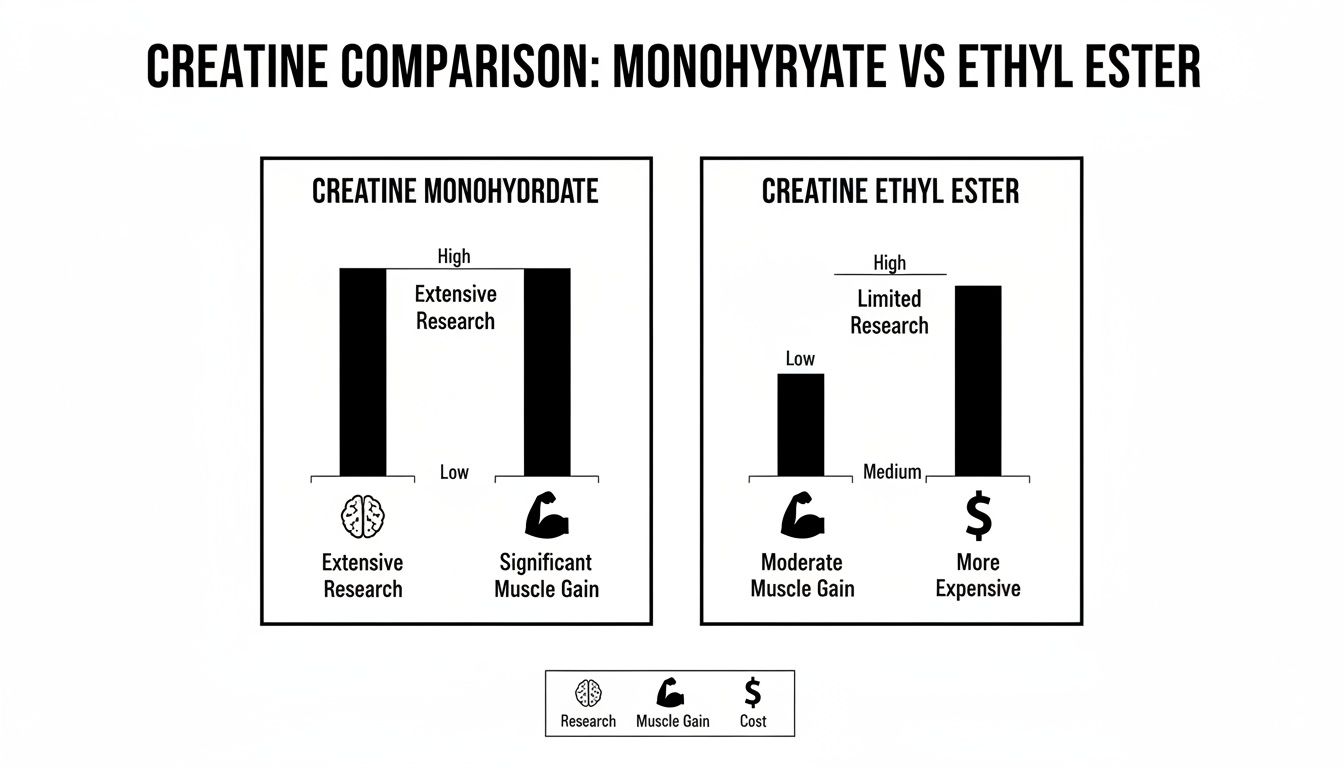
The chart makes it painfully clear: monohydrate absolutely demolishes CEE across every metric that matters. Ready to find out why the original is still the greatest of all time? Let’s get into it.
Long before any of these flashy new contenders showed up, there was creatine monohydrate. It's not just another supplement; it's a legend. Think of it as the Michael Jordan of sports nutrition—so dominant, so effective, and so heavily researched that it's the benchmark every other form of creatine gets measured against (and fails).
And we're not just hyping it up; we're talking about decades of hard science. With over 30 years of clinical trials and hundreds upon hundreds of studies, creatine monohydrate has proven its greatness time and time again. Its reputation is built on one simple, powerful promise: it flat-out works. No questions, no excuses.
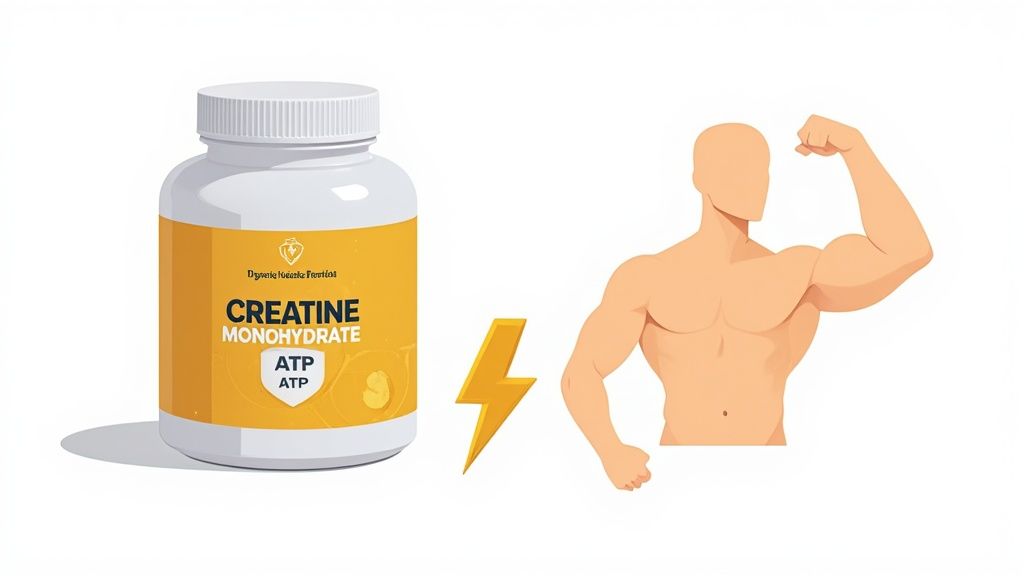
So, how does this simple white powder translate to more plates on the bar? The science is refreshingly badass. Your muscles run on a high-octane fuel called adenosine triphosphate (ATP). When you're crushing a heavy set of squats or sprinting, your body burns through ATP like a souped-up muscle car burns through gas.
Creatine monohydrate acts as your personal pit crew. It swoops in to rapidly regenerate your ATP stores, essentially recharging your muscle cells in real-time. This lets you grind out those extra, muscle-building reps, add more weight to the bar, and recover faster between sets. More work in the gym directly translates to more muscle and strength. It's the most beautiful and simple equation in fitness.
This is exactly why countless athletes swear by it. When you can consistently operate at a higher intensity, your body has no choice but to adapt by getting bigger, stronger, and more awesome.
The Undisputed King: Creatine monohydrate isn't just popular; it’s widely considered the most effective ergogenic (performance-enhancing) supplement legally available for cranking up high-intensity exercise capacity and packing on lean muscle.
The proof is also in the numbers. By 2023, the global creatine market was valued at a staggering USD 478.75 million, and it's still growing. Within this booming industry, creatine monohydrate sits on the throne, commanding the largest share because of its undeniable results and budget-friendly price.
That’s a huge part of its legend. You don't have to break the bank to get elite, science-backed results. While other flashy, overpriced supplements come and go, monohydrate consistently delivers the goods at a fraction of the cost.
At the end of the day, creatine monohydrate remains the gold standard because it gives athletes everything they want without the gimmicks. It's a foundational tool for anyone serious about their training. Want to learn more about what it can do for you? Check out our complete guide on the benefits and side effects of creatine monohydrate.
Let's fire up the DeLorean and travel back to the mid-2000s. The supplement world was the Wild West, and a flashy new gunslinger swaggered into town to challenge the champ. It was called Creatine Ethyl Ester—CEE for short—and it hit the market with a marketing blitz that sounded almost too good to be true.
This wasn't just another creatine. Oh no. This was billed as a complete reinvention, a "scientifically advanced" version designed to fix every tiny complaint people had about old-school monohydrate. The sales pitch was seductive: CEE was the key to unlocking creatine's true, untapped potential.
So, what was the secret sauce? It all came down to a clever bit of chemistry: tacking on an ester. In layman's terms, an ester is a type of organic compound that can, in theory, help molecules slip through cell membranes like a VIP guest strolling past the bouncer at an exclusive club.
Supplement brands ran wild with this idea, claiming this ester attachment would shuttle creatine directly into your muscle cells, making it far more potent than its predecessor.
The marketing machine went into overdrive, pushing some seriously tempting claims:
These claims were a knockout punch for anyone who felt monohydrate wasn't quite perfect. CEE was positioned as the slick, high-tech upgrade, and it convinced a ton of lifters to make the switch. It was a masterclass in marketing that set the stage for a dramatic showdown between the old guard and the new kid on the block.
The fitness industry loves a good story about a game-changing new product. This cycle keeps things exciting, but it also means we have to get good at telling the real deals from the short-lived fads. If you want to sharpen your B.S. detector, check out these common fads and trends in fitness and what to trust.
CEE’s narrative was powerful. It used just enough scientific-sounding language to paint a picture of a revolutionary formula. But the billion-dollar question remained: would the lab results and real-world gym experiences actually back up the hype?
The Theory vs. Reality: The whole premise of Creatine Ethyl Ester was that the attached ester would give it an express pass into your muscles. It was a slick theory, but it hung on one massive, make-or-break assumption: that the CEE molecule would survive the journey.
This assumption was about to face the ultimate test in labs and gyms everywhere. The hype was built, the battle lines were drawn, and the entire fitness community was waiting for the final verdict. Was CEE the future, or just another pretender to the throne?
This is where CEE's slick marketing campaign slammed head-first into the cold, hard wall of science. The theory behind CEE was clever, we'll give it that. But when researchers actually put it under the microscope, the results weren’t just disappointing—they were a total demolition. CEE was left on the mat.
The big promises of superior absorption and fewer side effects were about to get a brutal reality check in controlled, clinical settings. Spoiler alert: CEE didn't just fail to beat the champ; it barely landed a punch.
The entire case for CEE hinged on its supposed ability to get creatine into your muscles more efficiently. The problem? Scientists quickly discovered a catastrophic design flaw. That brilliant ester attachment, the one meant to be its VIP pass, turned out to be its Achilles' heel.
When CEE hits the acidic warzone of your stomach, the ester bond doesn't protect the creatine—it makes it incredibly unstable. Instead of safely escorting the good stuff to your muscles, the molecule rapidly self-destructs.
The result? A huge chunk of the creatine you just paid extra for gets converted into creatinine, a useless waste product your body just flushes down the toilet. It was like buying a Ferrari only to watch it rust into a pile of dust before you even got the keys.
When the lab coats came out, the marketing hype ran for the hills. A landmark 2009 study put CEE and monohydrate in a direct, head-to-head fight, and the results completely obliterated the CEE myth. This wasn't about fancy claims anymore; it was about what actually happens inside the human body.
Let's lay out the tale of the tape.
| Metric | Creatine Monohydrate | Creatine Ethyl Ester |
|---|---|---|
| Bioavailability | High. Effectively saturates muscle cells to fuel raw power. | Awful. Rapidly degrades into creatinine in the stomach, leading to way less available creatine. |
| Performance | 8-12% greater improvements in one-rep max squats in clinical trials. A certified beast. | Significantly less effective, showing inferior performance gains. Didn't even belong in the same ring. |
| Side Effects | Minimal. Some users report mild water retention, which is actually a sign it's working (more on that later). | Higher potential for stomach discomfort due to it turning into a waste product. |
| Cost | The most affordable and cost-effective form of creatine on the market. Smart gains. | Way more expensive for a product that is scientifically proven to be a dud. |
The evidence is overwhelming. The study showed that while CEE did manage to raise blood creatine levels, it delivered only 60% of monohydrate's muscle saturation because of that rapid breakdown. It wasn't just a loss; it was a beatdown.
The Verdict Was In: Not only was CEE not superior, but it was proven to be significantly less effective than the old-school, tried-and-true monohydrate. The challenger was officially exposed as all sizzle and no steak.
This epic failure in the creatine ethyl ester vs monohydrate debate is a perfect lesson in supplement science. Fancy chemical names and clever marketing mean absolutely nothing if the product doesn't deliver results where it counts: in the gym. Creatine monohydrate works so well because it's stable, pure, and has a direct, proven pathway to your muscles. To dig deeper into the mechanics, our guide on how creatine works breaks it all down.
The science is crystal clear:
CEE, on the other hand, was a chemistry experiment gone horribly wrong. The idea was interesting, but the real-world application was a total flop, leaving users with weaker muscles and lighter wallets. The evidence piled up, and the verdict became undeniable.
So, after all the scientific smackdowns and busted marketing myths, why does creatine monohydrate still sit on the throne? The answer is beautifully simple: it just works. It delivers proven, undeniable results safely, effectively, and without setting your wallet on fire.
It's the dependable, V8-powered muscle car in a world full of flashy, unproven electric scooters. This isn't about being old-school; it’s about respecting a formula that has been validated by over 500 studies and decades of real-world use in gyms just like yours. When you choose monohydrate, you're not just buying a supplement; you're investing in a guarantee backed by a mountain of evidence.
Forget complicated protocols. Using the king of supplements is as easy as it gets.
Let's tackle the elephant in the room: the dreaded "bloat." Some people worry that monohydrate will make them puffy. Honestly, this is one of the biggest myths in fitness, mostly cooked up by marketing teams for inferior products like CEE.
The "water weight" from creatine is primarily intramuscular, meaning it gets pulled inside your muscle cells. This is a great thing! It makes your muscles look fuller and more pumped, creates an environment that signals muscle growth, and even helps you lift more. It's not the same as the soft, puffy water retention you get from a weekend of pizza and beer.
The Power of Hydration: Properly hydrated muscle cells are stronger and more anabolic. The water creatine pulls into the muscle is functional, contributing directly to a more powerful physique.
Here’s the bottom line: in the creatine ethyl ester vs monohydrate showdown, monohydrate delivers objectively superior results at a fraction of the cost. You get a more effective, safer, and more researched product while keeping more of your hard-earned cash. It's the smartest investment you can make for your gains.
The data backs this up overwhelmingly. A 2022 survey found that 92% of bodybuilders prefer monohydrate, citing 5-10% better recovery. As the creatine market explodes—projected to hit $4.178 billion by 2035—monohydrate's affordability and deep well of data ensure it remains the top choice for smart athletes who demand results, not excuses.
While creatine fine-tunes your internal engine, don't forget that your external gear matters too. Having the right apparel can make a huge difference, so finding optimal gym attire for performance is another key part of your plan.
For undeniable strength, power, and muscle gains, there is simply no substitute for the king. Ready to fuel your workouts with the proven winner? Stop wondering and start lifting with the best. Grab your supply of Crazy Muscle’s premium Creatine Monohydrate on Amazon and feel the difference for yourself.
Well, the final bell has rung, the judges' scorecards are in, and this one is a unanimous knockout. In the head-to-head battle of creatine ethyl ester vs monohydrate, it’s not even a contest. Creatine monohydrate stands tall as the undisputed, undefeated champion of the supplement world.
We’ve seen the evidence. Creatine Ethyl Ester (CEE) walked into the ring with slick marketing and a boatload of promises, but science quickly unmasked it as a pretender. Its fatal flaw? It breaks down into the useless waste product creatinine in your stomach, meaning you’re paying a premium for a supplement that barely shows up to the fight.
Look, this isn't just about picking a side in an internet debate. This is about making a smart investment in your strength, your health, and your wallet. Creatine monohydrate is the gold standard for a reason. It’s backed by decades of relentless research, proven to be insanely effective for building muscle and strength, and has a safety record as solid as a rock.
Why would you ever gamble on a debunked formula when the champion is right here, ready to fuel your workouts? Don’t waste your time or money on the ghosts of supplements past. Your journey to a stronger, more powerful you deserves a training partner with a flawless track record.
The science has spoken, and it's screaming: Creatine Monohydrate is not only more effective but also way more cost-efficient than CEE. Choosing monohydrate means choosing guaranteed results.
You're here because you want results. You train hard, you eat right, and you need a supplement that works as hard as you do. The choice couldn't be simpler. It's time to arm your supplement stack with the most trusted performance-enhancer on the planet.
Stop wondering and start building real, measurable strength. Elevate your training, crush your PRs, and unlock the potential you know is in there with a supplement that delivers on its promises, every single time.
Ready to feel what real power feels like? Grab your supply of Crazy Muscle’s premium Creatine Monohydrate on Amazon and join the thousands of athletes who trust the champion.
Still scratching your head about the whole creatine ethyl ester vs. monohydrate thing? Good. A little skepticism is healthy in the wild world of supplements. Let's tackle the questions probably bouncing around in your brain.
We’ve all been there—suckered in by slick marketing only to get a case of buyer's remorse. So, is that tub of CEE completely worthless? Let's just say it's on life support.
The science is brutal: CEE breaks down into the waste product creatinine almost immediately in your gut. While a microscopic amount of creatine might survive the journey, you're getting a massively watered-down effect for a premium price.
Think of it this way: Using CEE is like trying to carry water in a net. A few drops might make it through, but most of what you paid for is just leaking away. You're far better off switching to a solid bucket—creatine monohydrate.
Oh, CEE's rise to fame was a textbook case of genius marketing trumping garbage science. The concept was brilliant, you have to admit. "Esterification for superior absorption!" It sounded so high-tech and futuristic.
The ads targeted the one minor complaint some people had with early monohydrate formulas: potential bloating. CEE was pitched as the "next-gen" solution, the creatine 2.0 that solved all the old problems. The hype train left the station at full speed, but unfortunately, the science never even bought a ticket.
This was CEE’s killer sales pitch, but it’s built on a total misunderstanding of how creatine actually works. That "bloat" people talk about with monohydrate isn't stomach bloating; it's intramuscular water retention. And trust us, that's the good stuff.
Creatine monohydrate works by pulling water into your muscle cells, making them look fuller, feel stronger, and perform better. CEE doesn't cause this effect because it fails to get enough creatine into the muscle in the first place. So yeah, CEE avoids the "bloat," but that's a symptom of its failure, not a feature of its success.
The science has spoken, the gym-goers have voted, and creatine monohydrate remains the undisputed champ. If you're ready to stop messing around and start using a supplement that’s proven, potent, and ridiculously effective, Crazy Muscle is your answer.
Grab our pure, no-nonsense creatine monohydrate and see what real results feel like. Check out our top-rated Creatine on Amazon now and start building some serious strength!

Sign up and save 10% off your next order