
Creatine HCL vs Monohydrate: Which One Will Actually Build Muscle?
Posted by Maximus
on

Let’s get one thing straight: you’re here because you want to get stronger, bigger, and faster. Period. And when it comes to supplements that actually work, creatine is king. But now you’re staring down two bottles: Creatine Monohydrate, the grizzled, old-school champion with a mountain of scientific knockouts, and Creatine HCL, the sleek, modern challenger claiming to be faster, cleaner, and easier on your system.
So, who wins the belt? It all boils down to how they're built, how your body uses them, and most importantly, which one will get you the results you’re busting your ass for in the gym. Let's cut the crap and find out.
Welcome to the main event! In one corner, weighing in with thousands of clinical studies and a legacy of raw power, we have the undisputed champ: Creatine Monohydrate. In the other corner, boasting superior technology and a leaner profile, is the challenger: Creatine HCL.
You've heard the locker room gossip and seen the flashy ads. Now it's time to figure out which one is actually going to help you smash PRs. We're slicing through the marketing fluff to give you the straight-up facts on what works, what dissolves, what might make you bloated, and what it’s going to cost you.
This isn’t about hype. It’s a no-BS guide to help you pick the right fuel for your muscles so you can get back to what matters—moving serious iron.
Here’s a quick-reference tale of the tape. See how the classic champion and the modern challenger stack up before we dive into the bloody details.
| Feature | Creatine Monohydrate (The Champ) | Creatine HCL (The Challenger) |
|---|---|---|
| Research Backing | The most heavily researched sports supplement on Earth. It's not an opinion; it's a fact. | A handful of studies and a whole lot of hype. Promising, but unproven. |
| Dosing Protocol | A simple 3-5 grams a day. Optional "loading phase" if you're impatient. | Marketed for "micro-dosing" at a tiny 1-2 grams daily. |
| Solubility | Can leave some grit at the bottom of your shaker. A minor annoyance for major gains. | Dissolves like a ghost. If you hate grit, this is your guy. |
| Side Effects | Some people report bloating, especially if they go crazy with a loading phase. | Touted as the bloat-free option for those with sensitive stomachs. |
| Cost | Dirt cheap. The most bang for your buck in the entire supplement industry. | More expensive per gram. You pay a premium for the fancy science. |
This table gives you the 30,000-foot view, but the real story is in the trenches. Is HCL's easy mixing a game-changer, or is Monohydrate's mountain of evidence just too damn big to ignore? Let's dig in.
There's a simple reason creatine monohydrate is still the king: it just flat-out works. It's not a trend; it's a foundation. It absolutely dominates the global supplement market, and it's not even a fair fight.
As of early 2022, creatine monohydrate accounted for a whopping 82.3% of all creatine products on major online stores. HCL? A distant, barely-in-the-rankings second at just 10.9%. That’s not marketing; that’s a testament to its rock-solid reputation built on decades of research and real-world results. You can discover more insights about the creatine supplement market and see the numbers for yourself.
Monohydrate is the reliable V8 engine in a world of flashy electric motors. It’s not new or sexy, but it has been proven to deliver raw power, strength, and muscle growth, time and time again.
Its simplicity is its greatest strength. It’s just a creatine molecule hanging out with a water molecule—that's it. This bulletproof structure has powered countless workouts and helped athletes at every level smash their personal bests.
Ready to fuel your gains with a proven winner? Stop messing around and grab the good stuff. You can find top-tier creatine and other essentials on our Crazy Muscle Amazon store. Your muscles will thank you.
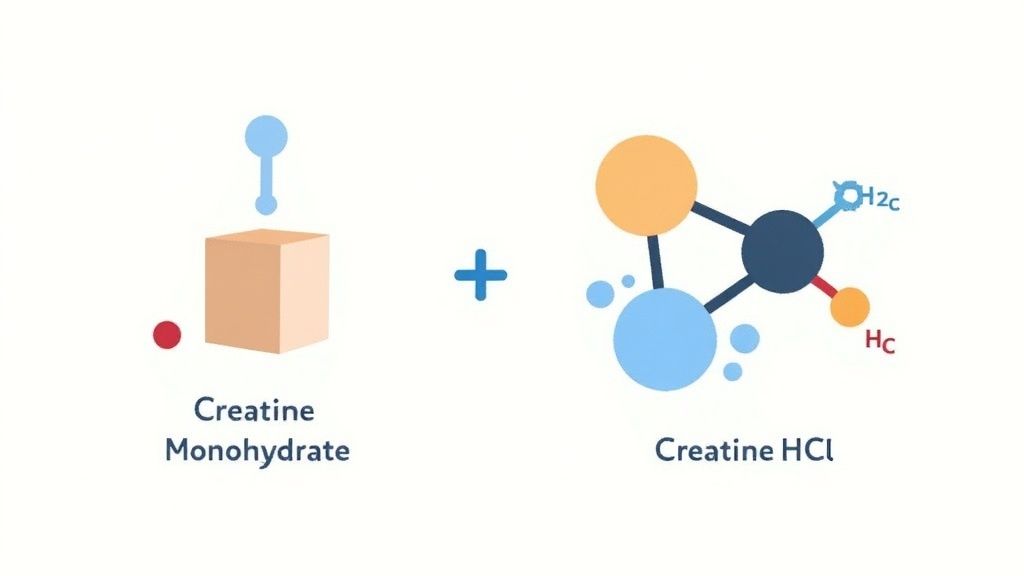
Alright, let's get a little nerdy for a second. To really settle the creatine HCl vs monohydrate debate, you’ve got to pop the hood and see what makes these two beasts roar. Don't worry, I'll skip the lab coat jargon and keep it simple.
At its core, creatine is something your body already makes. It’s the juice that fuels those quick, explosive muscle contractions—think of the final, grinding rep of a heavy squat or a flat-out sprint. Both monohydrate and HCl are just different armored trucks delivering the exact same payload to your muscles.
The real difference lies in the "plus-one" each one brings to the party.
Creatine Monohydrate is the OG. The Godfather. The one your dad probably used to get jacked. Its structure is as straightforward as a barbell: one creatine molecule is bonded to one water molecule. That’s where the name comes from—"mono" for one, "hydrate" for water. It's tough, reliable, and has powered champions for decades for one reason: it works.
This simple, stable bond is why it's been the star of literally hundreds of scientific studies. It’s the gold standard that every other form of creatine is judged against, and its effectiveness is undeniable.
When you drink it, your body's job is to split the creatine from its water buddy. The pure creatine then gets shuttled into your muscles and stored as phosphocreatine, which is basically rocket fuel for your workouts. If you want the full play-by-play, check out our guide on how creatine works.
Now, let's talk about the new kid on the block: Creatine Hydrochloride (HCl). This version kicked the water molecule to the curb and paired up with a hydrochloride group instead. It might sound like a tiny tweak, but it gives the supplement a totally different personality.
That hydrochloride attachment gives creatine HCl a major superpower: insane solubility.
Think about dropping a sugar cube (monohydrate) versus a spoonful of salt (HCl) into a glass of water. The salt vanishes almost instantly. The sugar cube just sits there, looking dumb. That's the difference you see in your shaker cup.
This incredible ability to dissolve is HCl's main claim to fame. The theory is that because it dissolves so easily, your body absorbs it much more efficiently. This, in turn, supposedly means you can get away with a smaller dose to achieve the same results, and it's also why fans of HCl swear it helps them sidestep the bloating some people get with monohydrate.
We've got one creatine bonded to water and another bonded to a hydrochloride. What does this chemistry lesson actually mean for your gains?
The whole argument boils down to one critical question: Does being more soluble automatically mean it’s better?
While the logic behind HCl is slick, the science is still playing catch-up. Monohydrate has a library's worth of research proving it works. HCl, while promising, has a pamphlet.
At the end of the day, both are designed to do the same thing: load your muscles with creatine. The route they take from your shaker cup to your bicep is just a little different.
Alright, enough with the chemistry lesson. This is the main event—the part you actually care about. Which one of these bad boys is going to help you squeeze out more reps, pack on more muscle, and give you that explosive power you're chasing?
Let’s be brutally honest: talk is cheap. A supplement can have the coolest science in the world, but if it doesn't translate to real-world results in the gym, it's just expensive dust.
So, let's put the theories aside and look at what actually happens when the iron meets the floor.
When it comes to building muscle and boosting strength, creatine monohydrate isn't just a contender; it's the undisputed, heavyweight champion of the world. It’s backed by a literal mountain of research collected over decades. We're talking hundreds of human studies confirming its ability to turn your body into a high-performance machine.
The science is rock-solid. Monohydrate works by cramming your muscles full of phosphocreatine, your body's go-to source for quick, explosive energy (ATP). More ATP means you can crank out those last few grueling reps that actually trigger muscle growth.
Think of it like this: your muscles have a small fuel tank for intense effort. Monohydrate gives you a bigger tank and a supercharger.
Studies have consistently shown that athletes supplementing with monohydrate see significant improvements in:
Monohydrate isn't a "maybe"; it's a guarantee. The sheer volume of evidence makes it the most reliable tool in your arsenal for getting stronger.
Now for the challenger, Creatine HCL. The theory is slick: better solubility should lead to better absorption, which could mean the same (or better) results with a smaller dose. But does the evidence back up the hype?
Here’s where things get shaky. The library of human performance studies on HCL is a fraction of the size of monohydrate's. It's like comparing a PhD thesis to a napkin sketch.
Some studies suggest HCL can produce similar strength and body composition improvements to monohydrate. However, others show no significant difference between the two when it comes to raw performance. The jury is still very much out on whether HCL's "micro-dosing" can truly match the muscle-saturating power of a standard monohydrate protocol.
The bottom line is that while HCL should work based on chemistry, it lacks the overwhelming proof that monohydrate has earned in the trenches for decades. To dig deeper into this, check out our detailed guide on creatine for athletic performance.
So, who wins the performance round? If your goal is maximum strength and muscle gain, backed by the most scientific certainty possible, creatine monohydrate is the hands-down winner. It's the gold standard for a reason—it has proven its worth in countless gyms and labs.
Creatine HCL remains an interesting alternative, especially if monohydrate messes with your stomach. But in a head-to-head battle for pure, evidence-backed results, the old champ still holds the title belt.
If you want a formula that ends the debate and just gives you results, consider a blend. Our Three-Atine on Amazon combines multiple forms of creatine to give you the proven power of monohydrate with the benefits of other advanced types. It’s the best of all worlds, designed so you can stop guessing and start growing.
You know that gritty, sandy sludge at the bottom of your shaker cup? The stuff you have to choke down at the end? That’s the number one complaint about creatine monohydrate. This is where Creatine HCl strolls onto the stage, flashes a confident grin, and takes a bow.
When you're weighing creatine HCl vs monohydrate, this is a surprisingly big deal. In the world of dissolving, HCl is the undisputed champ. It vanishes into water almost instantly, leaving you with a smooth, clear drink—no grit, no sludge, no shaking it like you're trying to start a lawnmower.
But this isn't just about texture. Proponents of HCl argue that its incredible solubility is the secret to better absorption and, most importantly, fewer stomach issues. Let's see if that claim actually holds water.
Creatine monohydrate is a legend for results, but it's also infamous for a potential dark side: bloating and stomach cramps. These issues usually pop up during the optional "loading phase," where you're slamming back 20 grams a day to saturate your muscles fast.
Why does this happen? Creatine is "osmotically active," a fancy way of saying it pulls water into your muscle cells. That’s a good thing—it's how it works! But if the creatine doesn't dissolve and absorb properly, it can sit in your gut, pulling water there instead. The result? That uncomfortable, bloated feeling that makes you look and feel like you swallowed a small beach ball.
For most people, sticking to a standard 3-5 gram daily dose avoids this problem. But if you have a sensitive stomach, that discomfort can be a real workout-killer.
This is HCl's biggest selling point. The logic is simple: because HCl dissolves completely, it gets absorbed into your bloodstream and delivered to your muscles way faster. This means less undissolved creatine is left hanging around in your intestines to cause trouble.
The result? A much smoother experience. Countless users report that switching to HCl completely wiped out the bloating and cramps they used to get with monohydrate.
Creatine hydrochloride (HCl) is chemically distinct from creatine monohydrate; it is the hydrochloride salt form of creatine, characterized by its much higher solubility in water. While creatine monohydrate is approximately 90% creatine by mass and requires a typical effective dosage of 3–5 grams per day, creatine HCl provides about 78% creatine by mass, but with a lower effective daily dosage of 1–2 grams due to improved absorption.
This improved efficiency is why you can get away with a much smaller dose of HCl, which also contributes to its gentler nature. Less powder going in means less potential for digestive drama.
Let's break down how these two really stack up when it comes to how they feel in your gut.
| Comfort Factor | Creatine Monohydrate | Creatine HCL |
|---|---|---|
| Solubility | Low. Often leaves that gritty residue that forces you to keep shaking. | Sky-high. Dissolves instantly and stays mixed. No grit, no problem. |
| Bloating | A common complaint, especially if you're loading or have a sensitive gut. | Minimal to no bloating. This is its main advantage for many users. |
| GI Distress | Can cause stomach discomfort or cramps for some people. | Generally considered very easy on the digestive system. |
| Taste | Mostly tasteless, but that sandy texture can be a real turn-off. | Can have a slightly tart or sour taste, but it's usually easy to drink. |
While the potential for side effects with monohydrate is real, it's also often manageable. If you want to learn more about how to get the most out of this classic supplement, check out our guide on creatine monohydrate benefits and side effects.
So, is paying extra for HCl worth it? If you've struggled with monohydrate's side effects or you just know you have a sensitive gut, the answer is a resounding yes. For you, the comfort and convenience of HCl could be the game-changer that keeps you consistent and on track to crushing your goals.
Alright, we've waded through the science, the gains, and the gut-level reactions. Now it’s time to talk about what really matters to most of us: how much to take and how much it’ll drain your wallet. Dosing and cost are where the rubber truly meets the road in the creatine HCl vs. monohydrate showdown.
This isn't just about the price on the tub. It’s about the cost per effective serving. Let's get into the nitty-gritty and help you make a smart call for your muscles and your bank account.
This is a key battleground. Creatine monohydrate has a protocol that’s been battle-tested for decades. It just works.
Creatine Monohydrate: The undisputed gold standard is a daily maintenance dose of 3-5 grams. Some people like to kickstart things with an optional "loading phase"—blasting 20g a day for a week—to saturate their muscles faster. It works, but it’s definitely not required to get the full benefits.
Creatine HCl: This is where things get a bit more... theoretical. HCl’s entire sales pitch hangs on "micro-dosing." The claim is that because it's absorbed better, you only need a tiny 1-2 grams per day to get the same results as a full 5-gram scoop of monohydrate.
The million-dollar question is whether that tiny dose really delivers the same muscle-saturating punch. While the theory is slick, the overwhelming body of scientific evidence still rallies behind the proven 3-5 gram protocol established by monohydrate.
Walk down the supplement aisle, and a tub of creatine HCl might look cheaper at first glance. But you have to think like a seasoned lifter and look at the cost-per-serving.
Monohydrate is a victim of its own success—it’s produced in such massive quantities that it's ridiculously cheap. Seriously, you can often grab a year's supply for less than a couple of tubs of protein. Creatine HCl, on the other hand, is a more specialized form, making it way more expensive gram-for-gram.
Even if you're taking a smaller "micro-dose" of HCl, the much higher cost per gram often means you'll spend more money over a month than you would with a standard dose of monohydrate.
Always do the math. Don't just look at the number of "servings" on the label. Divide the total price by the number of grams in the container to find the true cost. Nine times out of ten, monohydrate wins the value game by a knockout.
So, after all the science, testimonials, and number-crunching, which creatine should you toss in your shaker cup? Honestly, it all boils down to your own body and your priorities.
This flowchart makes the decision dead simple, breaking it down to one key question.
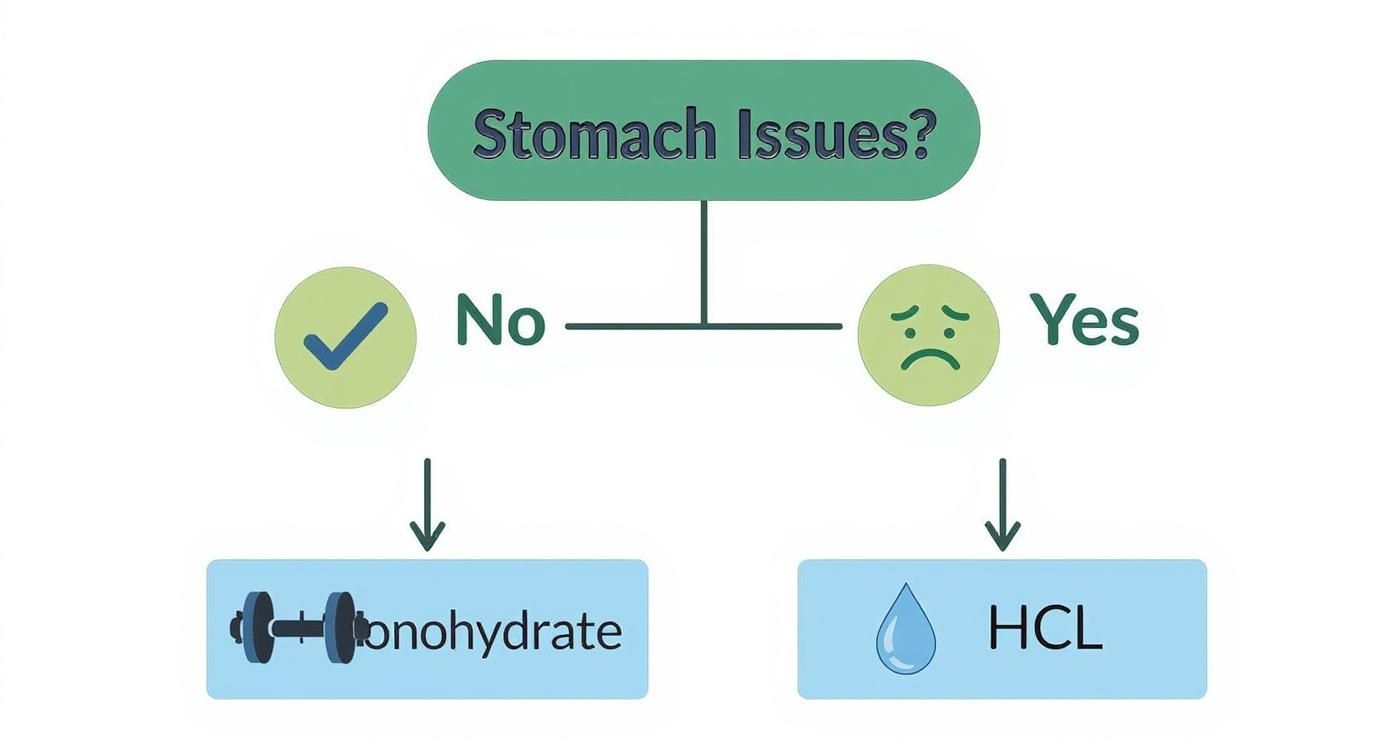
The big takeaway here is that your digestive system is the ultimate referee in the battle between these two fantastic forms of creatine.
Here's the final breakdown in plain English:
Choose Creatine Monohydrate if: You want the most researched, proven, and budget-friendly supplement in fitness history. If your stomach is solid and you want guaranteed results without breaking the bank, this is your champion.
Choose Creatine HCl if: You’ve tried monohydrate and it left you feeling bloated or running for the bathroom. For anyone with a sensitive gut, the extra cost of HCl is a worthwhile trade-off for comfort and consistency.
But what if you don’t want to pick a side? What if you want the proven power of monohydrate plus the unique benefits of other advanced forms? That’s where a smart blend muscles its way in.
Our Three-Atine on Amazon was created for exactly this reason. It gives you a powerful, multi-form blend for maximum results without compromise. It’s the perfect way to stop guessing and start growing.
Still hung up on which creatine to choose? I get it. The whole creatine HCl vs. monohydrate debate can get pretty heated online. Let's cut through the gym-bro nonsense and marketing hype to give you the straight scoop so you can make a call and get back to lifting.
Ah, the classic "loading" question. Let's kill this myth once and for all. A loading phase is when you slam 20 grams of creatine monohydrate every day for a week to super-saturate your muscles. Does it work faster? Yep. Is it necessary? Absolutely not.
You can reach the exact same saturation point by just taking a standard 3-5 gram daily dose. It’ll just take a little longer—about three or four weeks instead of one. Loading is the express train to Gainsville. The scenic route (your daily dose) gets you to the same destination, just without the rush (or potential stomach issues).
As for Creatine HCl? Forget about loading. Its whole sales pitch is built on better absorption from a smaller dose, so megadosing it is pointless.
The real takeaway: Loading is just a shortcut for monohydrate if you're impatient. For either form, the real magic is consistency. Stick to your daily dose, and you'll get the results.
And if you’re using a smart formula like our Three-Atine, just follow the label. No guesswork, no hassle, just steady gains.
Hell yeah! In fact, you probably should. Creatine is one of the easiest supplements to stack. The classic move is to dump it in a post-workout protein shake, and for good reason. The insulin spike from the carbs and protein in your shake can help shuttle that creatine straight into your muscle cells more efficiently.
While it’s true that Creatine HCl dissolves like a dream, you won't notice a spec of grittiness from modern monohydrate once your blender has had its way with it. You can also toss it in your pre-workout, but check the label first—some pre-workouts already pack a full serving of creatine, and you don’t need to double up.
At the end of the day, consistency is king. Before your workout, after, or on your off days—it doesn't really matter. Just take it every single day. That’s how you keep your creatine stores topped off and ready to perform. If you need some ideas for what to stack it with, check out the full lineup at the Crazy Muscle Amazon store.
When it comes to safety, Creatine Monohydrate isn't just in the game; it’s a hall-of-famer. We're talking about one of the most heavily researched sports supplements on the planet. Decades of hardcore scientific studies have proven time and again that it’s incredibly safe for long-term use in healthy people.
The "side effects" you hear about, like bloating or an upset stomach, are almost always overblown. They’re usually just a result of a heavy-handed loading phase or not drinking enough water.
Creatine HCl is considered perfectly safe, too. After all, it’s the same active molecule. But let’s be real—it just doesn't have the mountain of evidence that monohydrate has spent decades earning. The long-term data just isn't there yet.
So, if you want to bet on the horse with the most documented wins, creatine monohydrate is the undisputed champ.
The whole idea of "cycling" creatine—taking it for a few weeks, then stopping—is a fossil from the bodybuilding dark ages. Modern science shows there’s zero good reason to do it. In fact, it's a step backward.
The entire point of taking creatine is to keep your muscles saturated. When you stop, your levels drop, and you lose those hard-earned performance boosts. Then you have to build them all the way back up again. Why would you do that to yourself?
Modern sports science is clear: continuous daily use is the way to go. The International Society of Sports Nutrition confirms that consistent use is both safe and the most effective way to maintain benefits.
Think of it like the gas in your car. You don't drive until the tank is empty, let it sit for two weeks, and then fill it up. You top it off so it’s always ready to go. Treat your muscles the same way. Keep it simple: a daily 3-5 gram dose will keep you primed for peak performance all year long.
Ready to stop overthinking and start building? For a killer formula that blends the proven power of monohydrate with other advanced forms for maximum impact, Crazy Muscle has your back. Grab our Three-Atine creatine blend on Amazon and give your muscles the high-grade fuel they’ve been screaming for.

Sign up and save 10% off your next order