
Creatine Loading Phase Side Effects: Your Unfiltered Guide to Gains Without the Groans
Posted by Maximus
on

You've heard the whispers in the locker room, right? That the creatine loading phase is the express lane to bigger muscles and shattered PRs. But what's the catch everyone seems to be talking about? While creatine is one of the safest, most-studied supplements on the planet, that initial high-dose week can sometimes feel like a wild ride for your gut.
Think temporary water retention, maybe a little bloating, or an unhappy stomach. But don't sweat it. We’re about to give you the cheat codes to get all the epic benefits without any of the B.S.
Alright, let's get into it. You’re ready to hit the afterburners on your training, and you want results, like, yesterday. Think of the creatine loading phase like cramming for an exam—it’s intense, it’s fast, and yeah, it can get a little uncomfortable if you don't know the right strategy. The whole point is to jam-pack your muscle cells with creatine as quickly as possible, so you start seeing those insane performance benefits in days, not weeks.
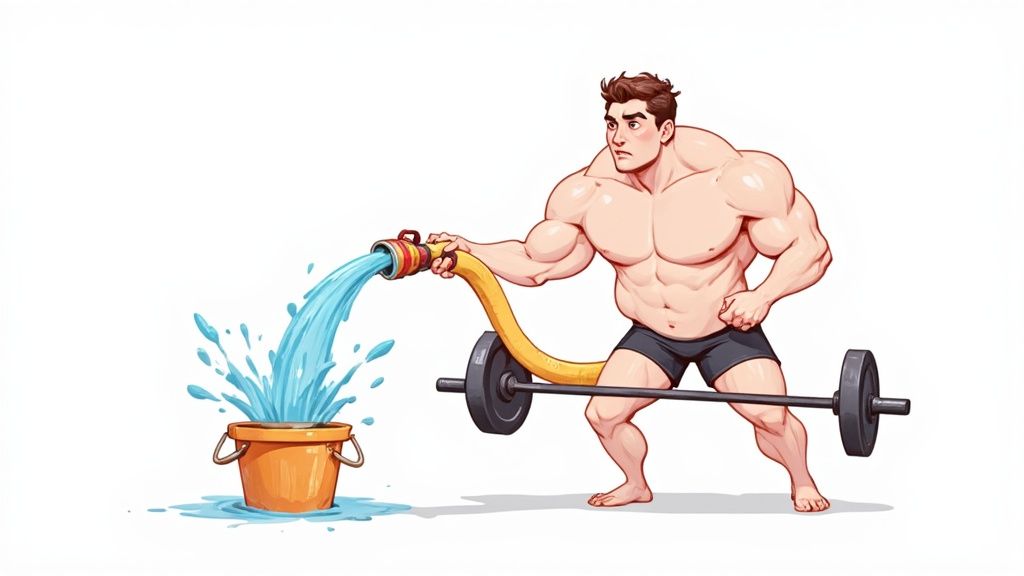
The standard playbook involves taking a hefty dose—usually 20 grams a day for about 5-7 days—before dropping down to a chill daily maintenance dose. Picture trying to fill a bucket with a firehose. It's ridiculously effective at getting the job done fast, but it can get a little messy if you're just pointing it everywhere.
This guide is your no-fluff, no-nonsense look at what creatine loading is really like. We're not here to scare you off. We're here to arm you with the real-world knowledge to handle this process like a seasoned pro so you can laugh in the face of side effects. We're going to tackle that notorious trio head-on:
Getting a handle on how creatine works is your first step to mastering the loading phase. For a deeper dive into the science, you can check out our complete guide on how creatine works in your body.
Here's the secret: these side effects are almost always temporary, manageable, and a sign that you're just not doing it right. They're your body's way of telling you to adjust your strategy as it pulls more water into your muscles—which, by the way, is exactly what you want for Hulk-level performance.
By the end of this, you won't just know why you might feel a little off; you'll have a clear, actionable plan to get all the gains while keeping those pesky side effects on the sidelines. We'll show you how to aim that firehose perfectly so you fill that bucket with zero mess.
Alright, let's get into the part you've probably been nervously Googling at 2 a.m. You're hyped for the gains, but you've also heard the whispers—the horror stories about what the creatine loading phase can do to your digestive system. We’re talking about those sudden, ominous stomach rumbles, the mad dashes to the bathroom, and that special feeling of being a walking water balloon.
So, what's really going on here?
Think of your gut like a nightclub bouncer with a very strict "one in, one out" policy. During the loading phase, you're not just sending one well-behaved guest to the door. You're sending a 20-gram mob of creatine trying to bum-rush the entrance all at once. The result is pure chaos, and that's when the trouble starts.
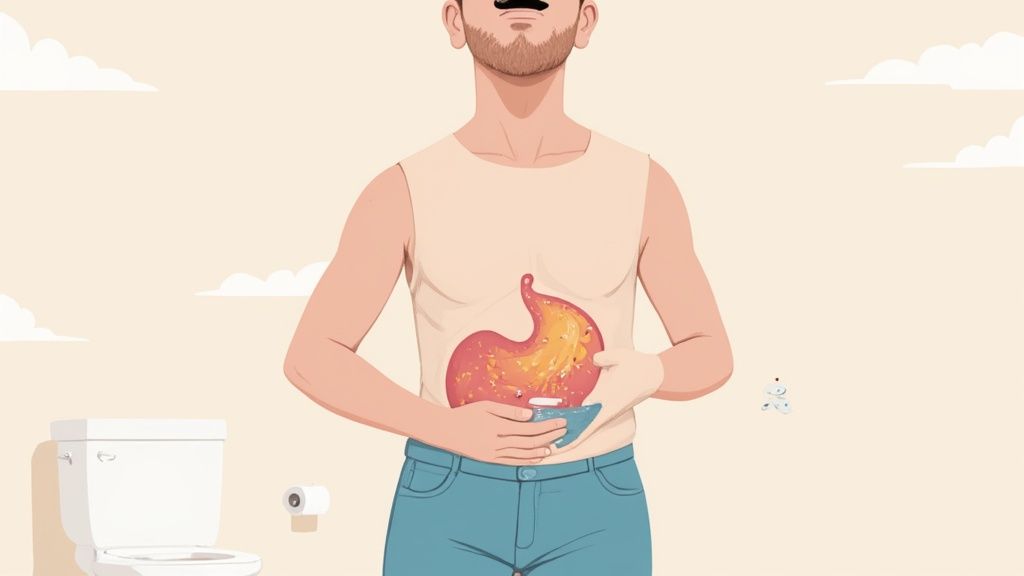
When you dump a huge, poorly-dissolved dose of creatine into your system, your body just can't absorb it all efficiently. The undissolved creatine particles end up sitting in your intestines, and through a neat little process called osmosis, they start pulling water from all over your body right into your gut.
This sudden flood of water is the main culprit behind the most infamous GI complaints:
Now, if you're worried about that initial water weight making you look soft, relax. Our team broke this down in detail in our guide, "Does Creatine Make You Bloated?". The key thing to remember is this water is pulled into your muscle cells—which is exactly what you want!
Picture it: Day one of your loading phase. You're amped. You toss the full 20 grams into a tiny bit of water, slam it back like a tequila shot, and march off to the gym. An hour later, you're not chasing a new PR; you're just praying you make it to the bathroom in time.
That, my friend, is the classic rookie mistake. You're treating creatine like a pre-workout, not a supplement that needs time and fluid to be absorbed properly. Taking it all at once is like trying to pour a gallon of water into a shot glass. It's just going to make a mess.
Here's the good news: these side effects are almost completely avoidable. They aren't caused by the creatine itself, but by how you're taking it. The fix is beautifully simple: stop carpet-bombing your gut.
The science backs this up, too. A study on elite male soccer players showed that guys who took a single 10-gram dose of creatine were nearly twice as likely to get diarrhea compared to those who split the same amount into two 5-gram doses. In fact, a whopping 55.6% of the single-dose group reported gut issues. You can check out the full research on creatine dosing and GI distress if you want to see the numbers for yourself.
The ultimate pro-move couldn't be simpler: split your dose. Instead of one giant 20-gram serving, just break it down into four smaller, 5-gram servings spread throughout your day. Think one with breakfast, one at lunch, one before you train, and one in the evening.
This gives your body a fighting chance to actually absorb the creatine without sounding all the internal alarms. It's the difference between knocking politely on the door and taking it off its hinges with a sledgehammer. Treat your digestive system with a little respect, and you'll get all the muscle-saturating benefits of the loading phase with none of the drama.
Alright, let's tackle the two biggest boogeymen in the creatine closet: muscle cramps and dehydration. You’ve probably heard the gym-floor gossip from some self-proclaimed expert who swears creatine will "suck all the water out of your body," leaving you cramped up and crying for mercy mid-set.
Spoiler alert: That's just not how it works. The reality is way less dramatic and a whole lot more scientific. The fear is rooted in a total misunderstanding of what creatine actually does with water.
Think of it this way. The myth makes creatine sound like a water thief, secretly draining your body's reserves and leaving your muscles high and dry. The truth is the complete opposite. Creatine is more like a VIP escort, pulling water into the one place you want it most—your muscle cells. This is a good thing!
When you kick off a creatine loading phase, you’ll probably see the scale jump up a few pounds in that first week. Don't panic, it's not fat. It's water weight, but not the kind that makes you look puffy.
Creatine ushers that water directly into your muscle tissue, a process called cell volumization. This is a huge win. It gives your muscles that fuller, more "pumped" look and, more importantly, this super-hydrated state helps kickstart muscle growth and boost your performance. So, when people complain about "water retention," they're actually describing a benefit without even realizing it.
Still, the myth hangs around because, on the surface, it almost makes sense. If water is moving into your muscles, doesn't that mean it's moving out of somewhere else? This is where the whole dehydration and cramping concern was born. And, to be fair, some people do report feeling this way.
For instance, one survey of college athletes found that 27% of those taking creatine reported muscle cramping, while 13.5% mentioned symptoms of dehydration. This initial loading period is also when you can expect to gain 1 to 3 kilograms (about 2-6 lbs), which is almost all that glorious water filling up your muscles. You can dive deeper into these athlete-reported creatine effects to see what they experienced firsthand.
If some athletes are feeling it, what’s really going on? The answer is almost always painfully simple: they just aren't drinking enough water.
Creatine doesn't cause dehydration; it exposes an existing hydration problem. It increases your body's demand for water to fuel that awesome cell volumization process. If you were already slacking on your H2O intake, starting a creatine loading phase will put your bad habit on full display, fast.
The bottom line is that creatine doesn't cause dehydration; inadequate water intake causes dehydration. When you're properly hydrated, studies consistently show that creatine can actually reduce the incidence of cramping and dehydration during intense training.
It actually helps your body manage heat and enables your muscles to hold onto water, making them more resilient. All you have to do is support the process. Your body is doing something amazing by pulling water into your muscles—your only job is to give it the extra water it needs to get it done.
If you want to brush up on the basics, check out these general facts about water and dehydration. The fix is easy: be relentless with your water bottle, especially during that first week. Aim for at least a gallon a day. This one simple move will keep your muscles happy, your performance soaring, and those old cramping myths right where they belong—busted.
So, we've navigated the choppy waters of potential stomach mutiny and busted the myths about cramping. Now we get to the million-dollar question every lifter asks: is the creatine loading phase even mandatory? Or is it just an old-school gym tradition, like grunting loudly on every rep?
The short answer? No, it’s not mandatory. You have options. This is your creatine adventure, and you get to choose the path that best suits your body and your goals.
Think of it like planning a road trip to the same amazing destination—let's call it Gainsville. You have two ways to get there. You can take the "Express Lane" or the "Scenic Route." Both routes lead to the same awesome place, but the journey itself is completely different.
The loading phase is the Autobahn of creatine supplementation. You're hitting the gas hard, taking 20 grams per day for about a week, with the sole purpose of saturating your muscles as fast as humanly possible. This is for the person who wants results and wants them yesterday.
The Pro: You get to Gainsville in record time. Your muscles fill up with creatine in about a week, meaning you’ll likely feel that extra strength and power in your workouts much sooner.
The Con: Driving this fast comes with risks. This high-dose approach is what opens the door to most of the side effects we've talked about—the bloating, the sudden bathroom sprints, and the digestive drama. You’re pushing your system hard, and sometimes it pushes back.
The alternative is to skip the loading phase entirely and just start with a standard maintenance dose from day one. This usually means taking a simple 5 grams of creatine every single day. This is the slow and steady path.
The Pro: It’s a much smoother ride. By taking a smaller, consistent dose, you give your body plenty of time to absorb the creatine without overwhelming your digestive system. The risk of side effects plummets, making it a far more comfortable experience for most people.
The Con: It takes longer to reach your destination. Instead of a week, it might take 3 to 4 weeks for your muscles to become fully saturated with creatine. You’ll get the exact same benefits in the end, but you’ll need a little more patience to see them.
To make it even clearer, let's break down the two approaches side-by-side. This should help you decide which path is the right one for you.
| Factor | Loading Phase (20g/day for 7 days) | Maintenance Only (5g/day) |
|---|---|---|
| Time to Full Saturation | ~7 days | ~28 days |
| Speed of Results | Faster onset of performance benefits | Slower, more gradual onset |
| Risk of Side Effects | Higher (especially digestive issues) | Significantly Lower |
| Creatine Used in Month 1 | ~290 grams | ~150 grams |
| Best For | Athletes with a deadline or those who are impatient for results | Beginners, individuals with sensitive stomachs, or anyone who prefers a gradual approach |
Ultimately, the choice boils down to your personal preference for speed versus comfort.
So, what’s the final verdict? After about a month, it doesn't matter which route you took. Whether you sprinted or jogged, your muscle creatine levels will be maxed out, and your performance gains will be virtually identical. The loading phase just gets you to the finish line faster.
The science is clear on this. While traditional loading phases spanning 5 to 7 days rapidly increase creatine stores, they are often linked to those gut-related side effects. Studies show that after about 30 days, the performance gains are comparable whether you loaded or not. You can read more about the effectiveness of different creatine protocols and see for yourself.
The choice is entirely yours. If you have a competition coming up or you’re just impatient for results and have a stomach made of steel, the loading phase might be for you. If you prefer a gentle start and want to minimize any chance of discomfort, the maintenance-only approach is the smarter bet.
And if you're trying to figure out the perfect daily dose for your body, don't guess. Check out our in-depth guide that breaks down exactly how much creatine you should take for your specific goals. It's all about making an informed decision, not just blindly following what the biggest guy in the gym does. Choose your path, stick with it, and enjoy the ride.
So, you’ve decided to take the express lane to Gainsville. Fantastic. Committing to the loading phase means you’re serious about seeing results, and we’re just as serious about getting you there without any unwanted drama. Consider this your playbook for navigating the loading phase like a seasoned vet, turning all that science into a few simple, unbreakable rules.
Let's make this ride as smooth as possible. Forget the horror stories and the gym-floor gossip. With the right strategy, you can get all the benefits of rapid muscle saturation while keeping those pesky side effects completely out of the picture. It’s all about working smarter.
This is the golden rule. The absolute non-negotiable first step to keeping your gut happy. Like we covered, dumping 20 grams of creatine into your system all at once is like sending a flash mob into a quiet library—it’s disruptive and pretty much guaranteed to cause chaos. You’re just asking for bloating, cramps, and some seriously urgent bathroom trips.
The fix is beautifully simple: divide and conquer.
This approach gives your body a fighting chance to actually absorb the creatine without sounding the digestive distress alarm. It’s the difference between a polite knock on the door and a battering ram.
If splitting your dose is the golden rule, relentless hydration is the silver one. Creatine is a powerhouse, and its main job is to pull water directly into your muscle cells. This is an incredible process that fuels performance, but it needs resources. Your job is to supply those resources.
Think of it like this: your muscles are thirsty, and creatine is telling them to drink up. If the well is dry, you’re going to have problems.
During your 5-7 day loading phase, make water your best friend. Aim to drink at least one gallon (about 4 liters) per day. This isn't a suggestion; it’s a critical part of the process that supports absorption, prevents cramping, and keeps your entire system running smoothly.
All this extra water ensures there’s enough fluid to go around for both your muscles and all your other essential bodily functions. Don't let a simple lack of H₂O derail your progress.
Want to give your creatine an all-access, VIP pass directly into your muscle cells? Pair it with a meal. Taking your creatine alongside carbohydrates and protein can seriously boost its uptake.
Here’s the trick: eating carbs causes your body to release insulin. Insulin acts like a key, unlocking your muscle cells to let nutrients—including creatine—stroll right in. Taking your 5-gram dose with a meal that has a good mix of carbs and protein essentially gives it a piggyback ride straight to where it needs to go.
This not only makes the creatine work better but also reduces the amount left sitting in your gut, which further minimizes any risk of stomach upset.
This visual guide breaks down your two main options: the fast-track loading phase or the slow-and-steady maintenance route.
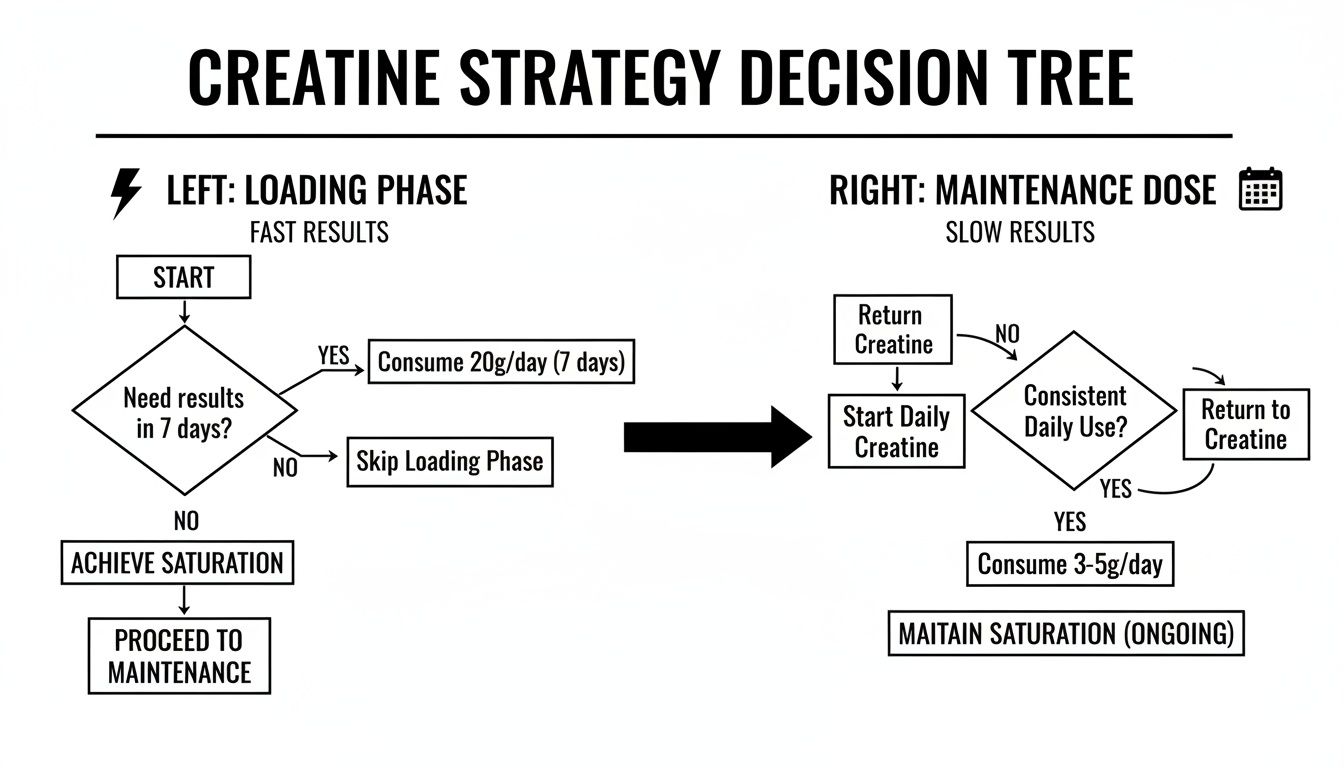
The flowchart makes it crystal clear: while both paths lead to the same destination, the loading phase is the undisputed champion for speed.
Following these rules will set you up for success, but there's one more piece to the puzzle that can make a huge difference: the quality of your creatine. Not all powders are created equal. A gritty, poorly dissolving creatine is far more likely to sit in your stomach and cause issues because it just doesn't get fully absorbed.
This is where choosing the right tool for the job becomes critical. Crazy Muscle's Three-Atine Creatine is engineered specifically for a smoother experience. We use a micronized creatine monohydrate, which means the particles are milled down to be much, much smaller. This helps it dissolve almost instantly in water, dramatically cutting down the chances of it causing any digestive grief.
By picking a high-quality, easily absorbed product, you’re not just buying a supplement; you're investing in a side-effect-free loading phase. It’s the smart choice for turning knowledge into powerful results, minus the discomfort.
Ready to load without the drama? Grab the creatine designed for maximum absorption and minimal side effects. Get your Crazy Muscle Three-Atine Creatine here.
Alright, we’ve gone through the science, shot down some myths, and sketched out the roadmap. But let's be honest, you’ve probably still got a few questions bouncing around in your head. This is where we tackle those last-minute "what ifs" with some straight, no-nonsense answers.
Let's put any final doubts to bed so you can get started with total confidence.
Nope. Not even a little bit. This is hands-down one of the biggest and most stubborn myths in fitness, and it’s time to bury it for good. The water weight you gain during loading is intramuscular, which is a fancy way of saying it gets pulled inside your muscle cells, not layered under your skin like a puffy marshmallow.
This process is actually a massive perk called cell volumization. It makes your muscles look fuller, harder, and more pumped—the exact opposite of soft or bloated. Think of it like inflating a basketball; it gets bigger and firmer, not squishy. That initial fullness is a surefire sign the creatine is doing its job and paving the way for real strength gains.
For the overwhelming majority of people, any side effects that pop up are gone in a flash. They are almost always tied directly to that initial 5-7 day high-dose loading phase while your body is getting used to the new normal.
Any stomach grumbles, like bloating or an upset stomach, usually settle down within a day or two. This is especially true if you’re smart about splitting your doses and chugging plenty of water. Once you drop down to the standard 3-5 gram daily maintenance dose, these issues pretty much always disappear completely.
If you find that side effects are hanging around for more than a couple of days, that's your body waving a big red flag. Listen to it. Just ditch the loading phase, switch straight to the maintenance dose, and you'll get the same awesome long-term benefits without the discomfort.
Let's start with the good stuff: your morning coffee is safe. That old gym-bro wisdom about caffeine canceling out creatine has been thoroughly debunked by modern science. You can absolutely enjoy your daily brew without killing your gains.
That said, both caffeine and creatine can encourage your body to use more water, so hydration becomes non-negotiable. Just think of it as another great reason to keep that water bottle glued to your hand.
Now, for alcohol... it’s probably best to sideline it during your loading week. Alcohol is a dehydrator and can be a real pain for your stomach, which could crank any potential GI side effects up to eleven. To get the best results from loading, make water your best friend and save the booze for later.
Here’s another piece of prehistoric gym advice that science has left in the dust. For healthy folks, there is absolutely no physiological reason to "cycle off" creatine. Your body doesn't build up a tolerance to it, and its benefits don't fade away with consistent use.
Countless long-term studies have shown that a daily 3-5 gram maintenance dose is perfectly safe and effective for the long haul. You can stay on it for as long as you’re hitting the gym and want to keep reaping the rewards.
The only real reasons to stop are simple:
For a deeper dive into what creatine does beyond the loading phase, check out a practical guide to creatine's overall benefits and side effects. It’s a great resource for the full picture. Ultimately, whether you load, maintain, or cycle is all about making the supplement work for your life and your training—not following some ancient, outdated rulebook.
At Crazy Muscle, our mission is to make smart, powerful supplementation easy. If you're hunting for a top-shelf creatine that dissolves like a dream to minimize side effects and send your results soaring, our formula was made for you. We're so confident you'll love it, we want you to try it out. Check out our full lineup of products built for real results over on our Crazy Muscle Amazon Store.

Sign up and save 10% off your next order