
Creatine Monohydrate vs Creatine Hcl: The Ultimate Showdown
Posted by Maximus
on

Alright, let's get real. You’re standing in the supplement aisle (or scrolling online), staring at a wall of creatine tubs, and it all boils down to two heavy hitters: Monohydrate, the tried-and-true classic that built champions, and HCL, the slick new kid on the block promising a smoother ride.
So, what’s the real difference? Monohydrate is the undisputed, most-researched, gold-standard form on the planet. HCL’s claim to fame is that it dissolves like a dream. The big question is: are you sticking with proven power and insane value, or are you willing to shell out more cash for potentially better mixability and fewer stomach rumbles? Let's figure out which one will get you those gains you're chasing.
Welcome to the main event, folks. In one corner, we have Creatine Monohydrate, the reigning, undisputed champion of the supplement world. This is the stuff legends are made of. In the other corner, we have Creatine HCL, the sleek, fast-absorbing challenger looking to knock the king off his throne.
If you’ve ever felt paralyzed by choice, wondering which white powder will actually help you move more weight and look better in the mirror, you're not alone. We're cutting through the bro-science and the over-the-top marketing claims to give you the straight-up, no-BS facts.
This isn't just about what's old versus what's new. It's about what works. We're going to break down everything that matters—power, price, and performance—so you can make a smart call and invest in your gains. And if you're curious about the nitty-gritty science behind it all, you can learn more about how creatine works in our detailed guide.
By the time we're done here, you'll know exactly which creatine deserves a spot in your gym bag.
Let's cut right to the chase. Here’s a no-fluff comparison of how these two stack up where it really counts.
| Feature | Creatine Monohydrate (The King) | Creatine HCL (The Challenger) |
|---|---|---|
| Research | Backed by over 1,000 studies. It's a rock-solid sure thing. | Very few human studies to back up the big claims. |
| Proven Results | The undisputed gold standard for muscle & strength. Period. | Shows potential, but the proof just isn't there yet. |
| Dosage | The standard 3-5 grams per day. Simple and effective. | A much smaller 1-2 grams per day. |
| Cost | Extremely affordable. More gains for your buck. | Way more expensive per serving. You're paying a premium. |
| Solubility | Decent, but can leave a little grit at the bottom. | Mixes like a dream. Dissolves almost instantly. |
Here’s the bottom line: Creatine monohydrate has earned its crown through decades of solid science and real-world, in-the-trenches results. Creatine HCL’s biggest advantage is that it mixes well in water, but there’s simply not enough hard evidence to say it’s any better at building muscle.
This guide is all about helping you invest your money where it will deliver real results for your body and your goals. Ready to pick your winner? Let's dig in.
Let's start with the OG, the legend that basically built the entire creatine empire: creatine monohydrate. You can think of it as the Arnold Schwarzenegger of supplements—it's timeless, brutally effective, and has an almost ridiculous amount of scientific proof behind it. This isn't just marketing fluff; it's the gold standard every other form of creatine gets measured against, and for a damn good reason.
When you take creatine monohydrate, you're pretty much topping off your muscles' fuel tanks for battle. The magic happens when it super-saturates your muscle cells with a high-energy compound called phosphocreatine. This is the secret sauce your body taps into to rapidly regenerate ATP (adenosine triphosphate), which is the primary fuel for all those explosive, high-intensity movements in the gym.
More phosphocreatine means you can crank out those last two reps that really build muscle. It means you can push heavier weight on the bench and sprint just a little bit faster. It's a simple, powerful mechanism that has made it a non-negotiable staple for millions of athletes and bodybuilders across the globe.
What really puts creatine monohydrate on its own level in the creatine monohydrate vs creatine hcl debate is the absolute mountain of evidence supporting it. We're talking about a supplement backed by well over 1,000 studies that confirm its power, safety, and effectiveness. Seriously, no other form even comes close to that level of scientific validation.
The market numbers back this up, too. Creatine monohydrate absolutely dominates, holding a massive 71.3% share of the entire creatine supplement sector. This isn't an accident. It's driven by countless clinical studies proving its ability to boost strength by 5-10% during resistance training sessions, cementing its legacy as the true king of performance nutrition.
Creatine monohydrate's reign isn't built on slick marketing or overhyped claims. Its reputation was forged in the lab and proven in the gym, decade after decade. It works, it's safe, and it's incredibly cost-effective.
One of the most stubborn myths out there is that monohydrate isn't absorbed well. The reality? It has an exceptional bioavailability of over 95% when you take it. That means your body is incredibly efficient at getting it from your gut and sending it straight to your muscles where it gets to work.
Don't let the chatter about "grittiness" or solubility scare you off. A few extra shakes of your bottle is a tiny inconvenience for a supplement with such an ironclad track record. For a deeper dive into what you can expect, check out our guide on the benefits and side effects of creatine monohydrate.
The bottom line here is simple:
This is the foundation of creatine's legendary status, and it’s exactly why its reign as the undisputed king of strength supplements is far from over.
Alright, now let's talk about the new kid on the block, the one with all the hype: Creatine Hydrochloride, or HCL. If monohydrate is the reliable old pickup truck that hauls anything, HCL is the sleek, souped-up sports car. It rolled onto the scene with one major, flashy promise: it dissolves better. A lot better.
The science behind it is actually pretty clever. By attaching a hydrochloride group to a creatine molecule, scientists created a version that mixes into water almost instantly. You can say goodbye to that sandy sludge at the bottom of your shaker bottle—HCL disappears. The theory is that this super-solubility translates into faster, more complete absorption by your body.
This is the whole reason its fans talk about "micro-dosing." Instead of the hefty 5-gram scoop you'd use for monohydrate, HCL advocates often get by on just 1-2 grams per day. The idea is that you're getting more of the good stuff into your muscles with less waste, which is a pretty attractive pitch.
Here’s where the creatine monohydrate vs creatine hcl debate really heats up for a lot of people. For a small but very real group of lifters, monohydrate can cause some stomach issues—bloating, a bit of discomfort. Creatine HCL is marketed as the silver bullet for this exact problem.
The thinking is that because it's absorbed so quickly, it doesn't just sit in your gut drawing water, which is what typically causes that puffy, bloated feeling. While the hard scientific proof is still catching up to the marketing claims, the anecdotal feedback is strong. Lifters with finicky stomachs often swear by HCL as the gentler, more comfortable option. If this is a worry for you, check out our deep dive into whether creatine really makes you bloat.
The core promise of Creatine HCL is simple: get all the muscle-building benefits of creatine without the potential for digestive drama. It's positioned as the premium choice for a seamless experience.
So, does the fancy sports car actually win the race? This is where it gets a little complicated. While the theory behind HCL’s superior absorption sounds fantastic, the library of research proving it actually builds more muscle or strength is tiny compared to the mountain of studies on monohydrate.
Early studies do show it works—it absolutely raises creatine levels in your muscles. What they don't show, at least not yet, is that it works any better than good old-fashioned monohydrate for getting bigger or stronger.
So, the bottom line on HCL? It mixes like a dream and could be a total game-changer if you have a sensitive stomach. But when it comes to raw, proven, muscle-building power, the jury is still very much out. It leaves you wondering: is HCL a true upgrade, or just a more expensive way to get to the same place? No matter which you choose, you need a brand you can trust—which is why thousands of athletes turn to Crazy Muscle for their supplement needs and shop our Amazon listings every day.
Ding, ding, ding! Let's get to the main event. We're putting Creatine Monohydrate and Creatine HCL in the ring for a side-by-side, no-holds-barred comparison. It's time to cut through the marketing hype and gym-bro rumors to see what actually matters for your muscles and your wallet.
This is where the rubber meets the road. We'll score them on pure performance, how they mix, what you need to take, how much they cost, and whether they'll upset your stomach. By the end of this, you’ll know exactly which contender deserves a spot in your shaker cup.
The biggest selling point for Creatine HCL is how easily it dissolves. And to be fair, it's pretty impressive. HCL mixes into liquid almost instantly, leaving zero gritty sludge at the bottom of your shaker. This has led to the marketing claim that it's absorbed faster and more efficiently.
Creatine Monohydrate, on the other hand, can sometimes leave a bit of a sandy texture if you don't give it a good shake. But here’s where marketing spin and scientific reality go their separate ways. The idea that better solubility automatically equals superior absorption is a massive leap of faith.
The truth is, research shows creatine monohydrate has a bioavailability of over 95%. Your body is already a pro at absorbing it. So while HCL clearly wins the mixability contest, the claim that this gives it a real-world performance edge is shaky at best. Both get into your system and do their job.
Now this is where the creatine monohydrate vs creatine hcl matchup gets interesting. Thanks to its supposed superior absorption, HCL is marketed with a "micro-dosing" protocol. You'll typically see recommendations of just 1-2 grams per day. The appeal is obvious—a smaller scoop for the same result sounds fantastic.
Monohydrate follows a more traditional, battle-tested path. The standard dose, backed by mountains of research, is 3-5 grams per day. Some people kick things off with a "loading phase" (about 20 grams a day for a week) to saturate their muscles faster, but it’s totally optional. A steady 5-gram daily dose gets you to the exact same place in about three to four weeks.
While HCL’s smaller dose is undeniably convenient, monohydrate’s dosing is the most studied and proven protocol in the history of sports nutrition. There's no guesswork involved—it’s a simple, effective, and reliable system for building muscle.
This is the round that really matters. Which one actually makes you stronger and helps you build more muscle?
Creatine monohydrate’s corner is packed with champions. We're talking about a library of over 1,000 studies confirming its ability to boost muscle strength, power output, and recovery. It’s been shown again and again to increase strength in weight training by 5-10%. This isn't just another supplement; it's a foundational tool for performance with an ironclad reputation.
Creatine HCL, the challenger, steps into the ring with very little scientific backup. While a few studies suggest it can improve strength, the body of evidence is a tiny fraction of what monohydrate has. When you stack up the hard data, the research overwhelmingly favors the original king of creatines. Both forms actually have a bioavailability over 99%, which effectively debunks HCL's claims of superior absorption. You can get a better sense of the market and science behind these forms by checking out the U.S. creatine market report.
Alright, let's talk about what this is going to cost you. When you break it down serving by serving, the winner here isn't even a contest.
For anyone lifting on a budget—or frankly, anyone who just wants the most bang for their buck—monohydrate is the undisputed financial champ. The value is just unbeatable.
This is HCL's strongest round. A small percentage of people report minor digestive issues like bloating or stomach cramps with monohydrate, especially if they take large doses without enough water.
Creatine HCL is marketed as the perfect fix for this. The theory is that because it's absorbed so quickly, it doesn't sit in your gut and cause trouble. Many users with sensitive stomachs do report a much smoother experience with HCL, which makes it a solid alternative for those who genuinely struggle with monohydrate. However, it's crucial to remember that for the vast majority of people, creatine monohydrate causes no issues at all.
So, after five tough rounds, how do our contenders stack up? We've put together this final scorecard to help you decide which creatine is the champion for your fitness goals.
| Feature | Creatine Monohydrate (The King) | Creatine HCL (The Challenger) |
|---|---|---|
| Effectiveness | Backed by 1,000+ studies to build strength and muscle. The gold standard. | Limited research; no strong evidence it's more effective than monohydrate. |
| Absorption | Excellent bioavailability (>95%), even if it's less soluble. | Marketed as superior, but science shows both are absorbed extremely well. |
| Dosage | Standard 3-5 grams daily. Simple, proven, and effective. | Requires a much smaller "micro-dose" of 1-2 grams daily. |
| Cost Per Serving | Extremely affordable and offers incredible bang for your buck. | Significantly more expensive. You pay a premium for mixability. |
| Side Effects | Well-tolerated by most; a small minority may experience minor bloating. | A great choice for those with sensitive stomachs who want to avoid discomfort. |
Ultimately, the choice comes down to what you value most. Are you looking for the most proven, effective, and affordable option on the planet? Or are you willing to pay a premium for better mixability and potentially fewer stomach issues?
For a product that delivers on the promise of purity and power, check out the options from Crazy Muscle's Amazon store.
Alright, let's cut to the chase. The whole "creatine monohydrate vs. creatine HCl" debate isn't about finding a single "best" creatine—it's about finding the best creatine for you. What works for your training partner might not be the ideal fit for your body, your goals, or your wallet.
So, instead of giving you a generic, one-size-fits-all answer, let's break it down based on who you are as a lifter. We'll look at a few common scenarios to give you a clear, no-BS recommendation.
If you're a visual person, this simple flowchart should point you in the right direction in about five seconds.
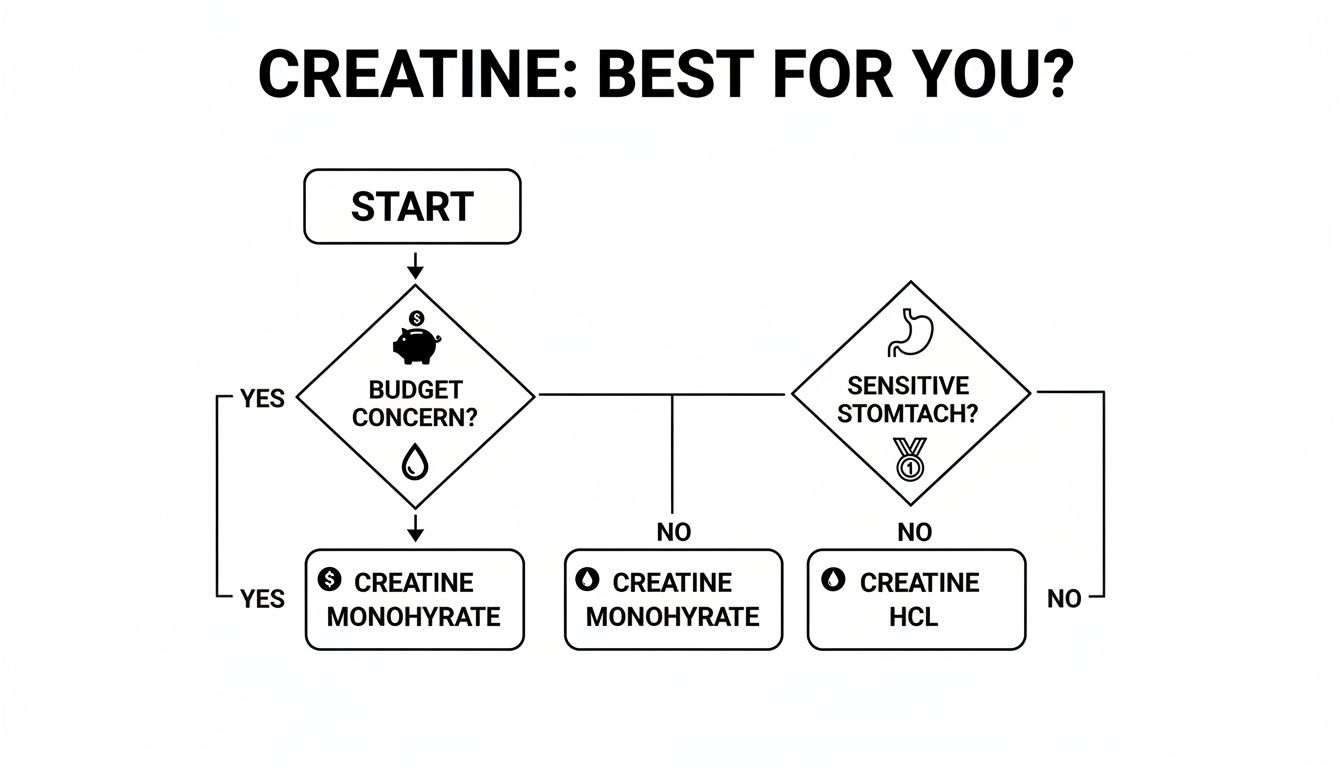
As you can see, for most people, the tried-and-true champ is monohydrate. It's the default choice for a reason.
Just starting out? Your mission is simple: get consistent, build strength, and see enough progress to stay hooked. You don't need some complex, hyped-up formula. You need a reliable workhorse that's been proven to get the job done, time and time again.
Your Winner: Creatine Monohydrate
Seriously, don't overthink this one. Creatine monohydrate is the most heavily researched sports supplement on the entire planet. We're talking decades of scientific studies backing its safety and effectiveness. It's cheap, it's dependable, and it will deliver that noticeable boost in strength and performance that keeps you coming back to the gym. Stick with the gold standard.
You've been grinding for years. Your training is dialed in, you track your macros to the gram, and you know the difference between a good workout and a great one. You're past the beginner gains and are now fighting for every single ounce of muscle.
Your Winner: Creatine Monohydrate
Look, when your goal is maximum, predictable results, you go with what has the most hardcore evidence behind it. Elite bodybuilders and strength athletes have trusted creatine monohydrate for decades for one simple reason: it flat-out works. It reliably saturates your muscles, supporting the top-end strength and hypertrophy you're chasing without any questions or doubts about its power.
You're all in on the benefits of creatine, but your digestive system has other plans. Bloating, cramping, and general discomfort are your enemies, and you've probably been hesitant to even try creatine because of them.
Your Winner: Creatine HCL
This is the exact scenario where Creatine HCL steps into the spotlight. Its biggest selling point is that incredible solubility—it dissolves almost instantly in water. For many people, this translates to a much gentler experience on the stomach. If you've had a bad run-in with monohydrate's side effects, HCL is your ticket to getting all the gains without the gut-wrenching drama.
Paying a little extra for HCL is a no-brainer if it means you can take it consistently without feeling like garbage. The best supplement is always the one you'll actually use.
You're smart with your money. Every dollar you spend on supplements has to pull its weight and deliver real, tangible results. You're not paying for fancy marketing or a slick-looking label—you're paying for performance.
Your Winner: Creatine Monohydrate
This isn't even a fair fight. On a gram-for-gram basis, creatine monohydrate is one of the most cost-effective performance boosters you can buy. For just a few bucks a month, you get a supplement with an undisputed track record for building strength and muscle. It is, without a doubt, the biggest bang for your buck in the entire fitness industry.
What if you're feeling torn? You want the iron-clad proof of monohydrate, but the easy absorption of HCL sounds pretty good. Maybe you've even heard of other forms and want to cover all your bases without having to buy three different tubs.
That’s precisely why we created Three-Atine, our all-in-one creatine formula.
Three-Atine smashes Creatine Monohydrate, Creatine HCL, and Creatine Pyruvate together into a single, powerhouse capsule. This isn't just a random blend; it's engineered to give you the time-tested strength gains, the enhanced absorption for comfort, and the endurance support for those grueling last reps. It takes the guesswork out of the equation and gives your muscles everything they need to grow.
Ready to stop choosing and start gaining? Grab your bottle of Crazy Muscle's Three-Atine on Amazon and feel the difference a complete creatine formula can make.
You've waded through the science and seen the head-to-head battle. The "creatine monohydrate vs creatine hcl" debate has a pretty clear winner for most people, but the real win comes from picking a brand that’s as committed to your goals as you are. That’s our whole game.
Here at Crazy Muscle, we don’t just sling supplements. We’re in the business of building stronger humans. We’ve earned the trust of over 150,000 customers by sticking to the stuff that actually works: pure ingredients, potent formulas, and results you can see in the mirror and feel under the bar.
We get it. You're putting this in your body, and that’s a big deal. Our Creatine Monohydrate is the undisputed champion for a reason. We micronize it, which means it mixes up smooth and absorbs fast, giving you that raw, explosive power monohydrate is legendary for. No fillers, no junk—just the high-octane fuel your muscles are screaming for.
But maybe you're the type who wants it all without the hassle. We made Three-Atine for you. It’s our stacked formula that blends Creatine Monohydrate, Creatine HCl, and Creatine Pyruvate into one powerhouse capsule. You get the proven strength of monohydrate, the easy-on-the-stomach absorption of HCl, and the endurance kick from pyruvate. It’s the ultimate creatine trifecta.
We built our entire brand on a simple idea: you shouldn't have to choose between quality and results. Whether you go with our classic Monohydrate or our advanced Three-Atine blend, you're getting a product backed by thousands of five-star Amazon reviews and a satisfaction guarantee as solid as your next PR.
There’s a reason creatine is flying off the shelves. The global market is projected to explode to USD 10.78 billion by 2034, and monohydrate is still sitting on the throne. Why? Because the research doesn't lie. In the U.S. market, monohydrate holds a massive 55.7% revenue share, all thanks to study after study showing 5-10% strength gains. That’s the kind of performance boost that gets everyone from serious bodybuilders to weekend warriors and older lifters excited—and that’s exactly who we created Crazy Muscle for. You can dive deeper into these stats and see how monohydrate's dominance is shaping the industry.
When you choose Crazy Muscle, you’re not just a customer; you're part of the crew. We know that when you hit "buy," you want your stuff, like, yesterday. That’s why we offer same-day shipping. We hustle to get our products from our warehouse to your front door so you never have to skip a day.
And we stand behind our creatine with a rock-solid satisfaction guarantee. If you don't absolutely love the results you're getting, we'll make it right. Simple as that.
Your road to becoming a beast starts with the right fuel. It's time to stop wondering and start building with a brand that’s got your back.
Ready to make some serious gains? Snag our top-tier Crazy Muscle Creatine on our Amazon store and see what the hype is all about. Let's get to work.
Alright, let's dive into the questions that always hit my inbox about the monohydrate vs. HCl showdown. I'll give you the straight scoop, no chaser.
Ah, the classic loading phase debate. For creatine monohydrate, think of loading (taking about 20 grams a day for 5-7 days) as the express lane. It gets your muscles saturated with creatine faster, so you might feel that extra pop in your lifts a bit sooner. But is it required? Not a chance.
You can absolutely skip it and just stick to the standard 3-5 gram daily dose. You'll hit that same peak saturation level, it'll just take about three or four weeks. It's really about patience versus a quick start.
When it comes to creatine HCl, the pitch is almost always "no loading needed." The whole idea is that its superior solubility means it gets to work more efficiently, so you can bypass that initial high-dose week altogether.
Of course! In fact, you probably should if it helps you remember to take it. Both monohydrate and HCl are team players; they don’t cause a fuss when mixed with other ingredients. Tossing a scoop into your pre-workout for a little extra oomph or your post-workout protein shake to kickstart recovery is a brilliant move.
Creatine is like the reliable utility player on a championship team. It doesn't get in the way of the star players (like protein or pre-workout), it just quietly does its job to make the whole team better.
The most important thing with creatine isn't how you take it, but that you take it every single day. Consistency is king, so whatever routine makes that happen is the right one for you.
This is HCl's biggest selling point, and for a small number of people, there's something to it. A tiny percentage of users report some water retention or bloating with monohydrate, which often happens when they don't drink enough water to help it absorb properly. Since HCl dissolves so easily, it's less likely to just sit in your gut and draw water there, which is what causes that sloshy, bloated feeling.
So, if you have a genuinely sensitive stomach, HCl might just be your holy grail. For the other 99% of us, a high-quality, micronized creatine monohydrate mixed with plenty of water is completely side-effect-free. Don't let a myth scare you away from the most tested, proven, and effective muscle-builder out there.
Here at Crazy Muscle, we’ve cut through the noise for you. Our premium creatine formulas are engineered for pure performance, whether you’re a die-hard monohydrate fan or want an all-in-one powerhouse. Find the perfect fuel for your goals over on our Crazy Muscle Amazon store and get ready to grow.

Sign up and save 10% off your next order