
Creatine Side Effects Myth Busting Guide
Posted by Maximus
on

Here's the honest truth about creatine side effects: for most people, they're a total non-issue when you take it the right way. After decades of research, creatine stands as one of the safest, most effective supplements on the market. The big, scary rumors? Mostly just gym-floor gossip.
The most common complaints are a little bit of bloating or an upset stomach, and even those are ridiculously easy to sidestep. Ready to ditch the myths and unlock some serious gains? Let's dive in.
Let's cut right through the chatter. You've heard the stories, I'm sure. Whispers in the locker room about wrecked kidneys or online headlines screaming about hair loss. Is any of it true?
In a word: no. The gap between what people are afraid of and what the actual science says is a mile wide.
Before we get into the nitty-gritty, it helps to remember what creatine actually is. It's not some bizarre, lab-made chemical. It’s a natural compound your body already uses to fuel muscles during heavy lifting and explosive movements. If you want the full scoop, check out our guide on how creatine works.
To set your mind at ease right away, let's just lay the biggest myths out next to the hard facts. This isn't about my opinion or your gym buddy's—it's about what the data shows, plain and simple.
| Common Myth | Scientific Reality |
|---|---|
| "Creatine destroys your kidneys." | For healthy people, study after study shows no harm to kidney function, even with long-term use. This myth usually stems from a basic misunderstanding of a blood marker called creatinine. |
| "It will definitely make you go bald." | There is zero direct scientific evidence linking creatine to hair loss. This entire rumor mill started from one tiny study that has never been successfully repeated. |
| "Creatine causes severe dehydration and cramping." | The research actually points in the exact opposite direction. Creatine pulls water into your muscle cells, which improves your overall hydration and can even reduce your risk of cramps. |
See? The science is pretty clear on this.
The evidence backing creatine's safety is overwhelming. One massive review looked at 685 clinical trials and found no real difference in side effects between people taking creatine and those taking a placebo.
Even more telling, an analysis of nearly 28.5 million adverse event reports found that a ridiculously small 0.00072% even mentioned creatine. And get this—many of those products didn't even contain creatine in the first place! You can learn more about these groundbreaking safety findings yourself.
So, let's ditch the fear-mongering. It’s time to arm yourself with the facts and get back to what matters: building the strength you've been working for.
Alright, let's get into the nitty-gritty. Creatine is probably one of the most misunderstood supplements on the planet, with more gym-floor horror stories than a Stephen King novel. It's time to bust out the flashlights and see what's really going on.
Spoiler alert: it's mostly just more potential for gains. We're going to tackle the three biggest, scariest creatine side effects you've heard about and pull them apart with actual science.
Think of this as your myth-busting field guide. We'll look at each rumor, figure out where the heck it came from, and then lay down the evidence that clears creatine’s name. By the end, you'll be the one your friends text for the real scoop.
This is the big one—the zombie myth that just refuses to die. The story goes that creatine puts your kidneys under so much stress they'll eventually tap out. So, where did this crazy idea come from? It all boils down to a simple misunderstanding of a blood marker called creatinine.
Here’s how it works: your body breaks down creatine (the supplement) and phosphocreatine (the energy source in your muscles), and the leftover waste product is creatinine. Doctors use creatinine levels to check how well your kidneys are filtering your blood; high levels can sometimes point to a problem. Naturally, when someone taking creatine gets a blood test, their creatinine levels might look a little high.
But context is everything.
An elevated creatinine level from taking creatine is like your car’s engine running a bit hotter during a race. It’s not a sign of engine failure; it’s the expected result of pushing for higher performance. Your body is just processing more creatine—which is exactly the point.
Countless long-term studies, some running for as long as five years, have followed healthy people taking creatine and found absolutely no evidence of kidney damage. For anyone with healthy, functioning kidneys, creatine is safe. The scientific community has put this one to bed for good.
Here's another classic bit of gym lore: creatine will suck all the water from your system, leaving you hopelessly dehydrated and cramping up mid-set. This one sounds believable because, yes, creatine does pull water into your muscle cells. But that's exactly why this myth is completely backward.
By drawing water into your muscles, creatine actually boosts your cellular hydration. This process, called cell volumization, is one of the key ways creatine helps you get stronger and grow. A better-hydrated muscle cell is a happier, more resilient muscle cell.
So, what does the research show?
The verdict is in. Creatine doesn't cause cramping or dehydration; it helps you stay hydrated where it matters most. Of course, you still need to do your part and drink enough water throughout the day, but that’s just common sense for champions.
Last on our list is the claim that creatine will wreck your liver. This fear usually gets tossed in with the kidney worries, born from a general suspicion that anything that boosts performance must have a dark side. The assumption is that the liver, your body's main filter, gets overworked trying to process all that extra creatine.
But here's the thing: your body already makes its own creatine in the liver, pancreas, and kidneys. Taking a supplement isn't introducing some strange, foreign chemical; it’s just topping off your natural gas tank. Extensive research has shown over and over again that creatine has no negative effects on liver function in healthy people when taken at the right doses.
Hundreds of studies have tracked liver enzymes in people taking creatine and have found no signs of damage or stress. The science on this is overwhelming. Just like the kidney myth, this legend crumbles under even a little scrutiny. Creatine is not just effective, which you can learn more about in our guide on how creatine helps build muscle, it’s also one of the safest supplements you can take.
Alright, we’ve tackled the big, scary myths. Your kidneys are safe, your liver isn't going to quit on you, and you're actually more likely to stay hydrated than cramp up. But what about the smaller, more annoying stuff? Let's have an honest chat about the minor league of creatine side effects—the things some people actually experience, like a bit of bloating or an upset stomach.
The good news? These issues are almost always temporary and incredibly easy to manage. They aren't warning signs of some impending doom; they're just your body’s way of saying it's adjusting or that you might need to tweak your strategy.
Think of this as your practical playbook for a smooth and comfortable creatine journey. With a few simple tricks up your sleeve, the only thing you'll be noticing are your gains in the mirror and on the barbell.
One of the first things you might notice is a slight jump on the scale. Before you freak out, let me be crystal clear: this is not fat. It's water, and it's actually a fantastic sign that the creatine is doing exactly what you want it to.
Creatine works by pulling water into your muscle cells. Picture your muscles as tiny sponges. Creatine helps them soak up and hold onto more water in a process called cell volumization. This essentially "super-hydrates" them from the inside out.
This intracellular water is a good thing! It’s what gives your muscles that fuller, more defined look, and it’s a key player in the anabolic (muscle-building) process. This is performance-enhancing water, not the puffy bloating you get after crushing a family-size bag of salty chips.
This initial water weight gain usually amounts to just a few pounds and levels off within the first couple of weeks. My advice? Embrace it. It means you’re primed and ready for better performance and serious growth.
Okay, let's talk about the most common complaints: gastrointestinal (GI) issues like bloating or a finicky stomach. For those who experience bloating in general, exploring different solutions can be a huge help, and you can find some great info on natural remedies for bloating. When it comes to creatine, though, the cause is usually straightforward and easily fixable.
The main culprit? Taking way too much at once.
It's like trying to chug a gallon of water in ten seconds—your system is going to protest. When you dump a massive amount of creatine powder into your stomach, it can pull water into your intestines too quickly, causing discomfort before it ever has a chance to get to your muscles.
The research is really clear on this dose-response relationship. For example, studies have found that while a standard 5-gram dose causes no more issues than a placebo, taking a single 10-gram dose can ramp up the risk of diarrhea by a whopping 56%. This pretty much confirms that most minor creatine side effects are entirely preventable with a bit of common sense.
Ready to make your creatine experience totally seamless? It all boils down to a few simple strategies. These tips will help you sidestep any potential annoyances and get all the benefits without the bother.
Here’s your checklist for success:
By following these simple steps, you're not just dodging side effects; you're using creatine smarter. You're giving your body exactly what it needs, how it needs it, for maximum results and zero drama. Now you can focus on what really matters—crushing your workouts with a premium supplement like the one you'll find on our Crazy Muscle Amazon store.
Ah, the legendary creatine loading phase. It's the kind of thing you hear about in the gym locker room—a full-on, week-long blitz of chugging creatine to cram it into your muscles as fast as humanly possible.
But is this aggressive strategy actually necessary? Or is it just a fast-track ticket to an upset stomach?
Think of it like this: you want to get to the top of a mountain. One way is to take a rocket ship. The other is a steady, scenic hike. Both get you to the same peak, but the journey is completely different.
The rocket ship is the loading phase. You'll reach the summit—fully saturated muscles—in a flash, usually within 5-7 days. The ride can be a little bumpy, though. Forcing 20 grams of creatine into your body every day can be a lot for your gut to handle, which raises the odds of running into those minor side effects like bloating or stomach cramps.
The steady hike is your standard maintenance dose. It's a much smoother, more comfortable journey. By taking just 3-5 grams a day, you’ll reach the exact same peak of muscle saturation. It just takes a bit longer, typically about 3-4 weeks. The big win here? The path is clear, the journey is pleasant, and you're far less likely to hit any turbulence.
If you're staring down a deadline—maybe a competition is just around the corner, or you're just plain impatient for those gains—then loading can make a lot of sense. It’s all about speed.
Here’s the game plan:
This method absolutely works, but you've got to drink a ton of water to help your body absorb it all and keep your digestive system happy.
For most of us, this is the way to go. It’s simple, it’s just as effective in the long run, and it's incredibly gentle on your system. No complex schedules, no mega-doses.
The instructions couldn't be easier:
This approach neatly sidesteps the higher risk of side effects that can come with loading. It’s the "set it and forget it" strategy for unlocking all of creatine's benefits. If you're wondering where you fall in that 3-5 gram range, we've got you covered in our guide on how much creatine you should really take.
This infographic is a great way to visualize how to manage your creatine journey for the best results.
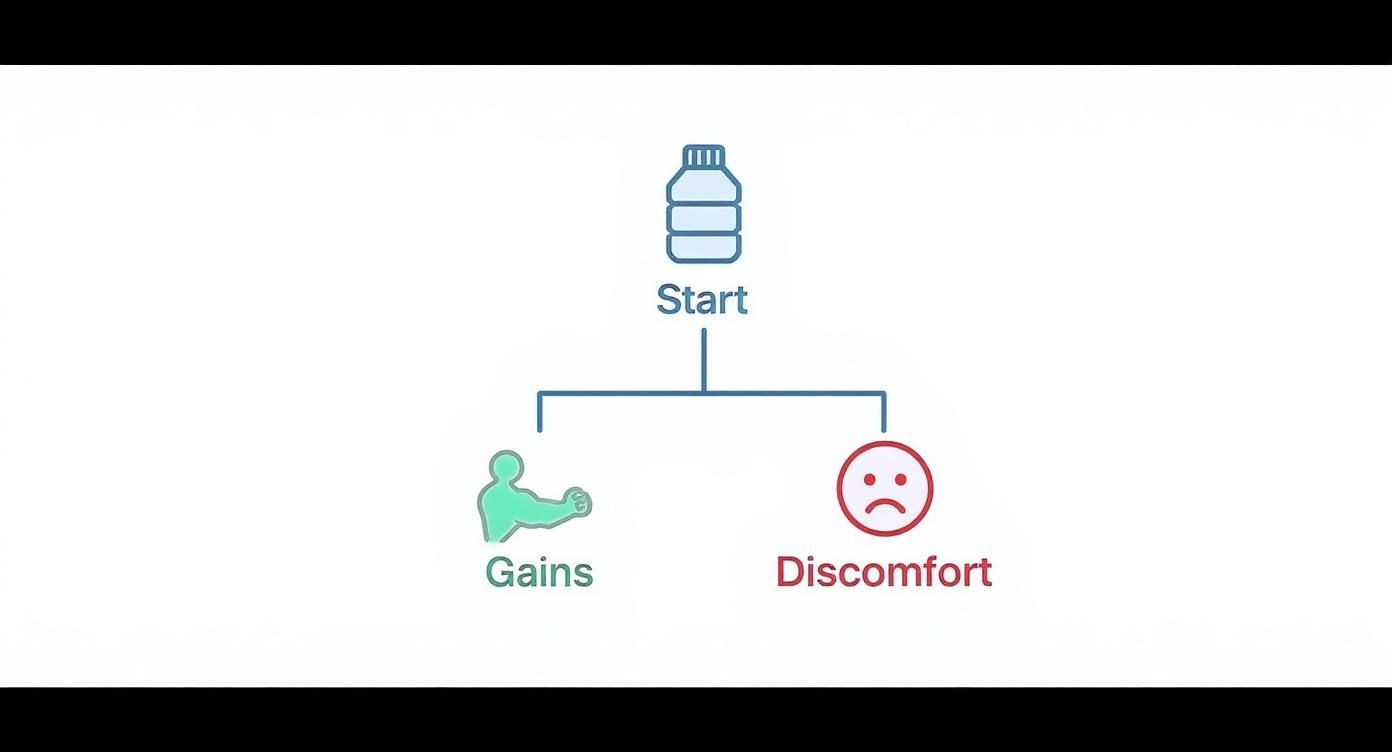
As you can see, smart choices like staying hydrated and getting the dose right lead straight to the good stuff ("Gains"), while cutting corners can lead to discomfort.
Still on the fence? No problem. The best choice really boils down to your goals, your timeline, and how sensitive your stomach is. Let's put them head-to-head to make it simple.
| Factor | Loading Phase (20g/day for 5-7 days) | Standard Dose (3-5g/day) |
|---|---|---|
| Speed to Results | Very Fast (5-7 days to full saturation) | Slower (About 3-4 weeks to full saturation) |
| Risk of Side Effects | Higher (Especially bloating and GI upset) | Very Low (Gentle on the system) |
| Convenience | Lower (Requires splitting 4 doses per day) | Very High (Just one simple dose daily) |
| Long-Term Outcome | Identical to the standard dose | Identical to the loading phase |
Ultimately, both roads lead to the same destination: fully saturated muscles that are primed for better performance and growth. One is just a shortcut that might have a few more potholes, while the other is the reliable scenic route.
There's no wrong answer here. Pick the protocol that fits your life and listen to your body. Whether you take the rocket ship or the hiking trail, consistency is the real secret to getting the results you're after.
Let's be real: not all creatine is created equal. Think of it like this—if you're building a high-performance engine, are you going to use cheap, knock-off parts from some sketchy back-alley garage? Or are you going to demand precision-engineered components you can trust when you're hitting 200 mph? Your body deserves that same level of respect.
When it comes to supplements, the purity of what you're putting into your system is everything. A lot of the horror stories you hear about "creatine side effects" aren't actually about creatine at all. They’re about the nasty, unwanted junk that hitches a ride in low-quality, poorly manufactured powders.
In the sometimes-shady world of supplements, cutting corners is an easy way to make a quick buck. Cheaper, sloppier manufacturing processes can leave all sorts of contaminants behind in the final product. And trust me, these are things you don't want anywhere near your body.
Some of these impurities can include:
These contaminants, not the creatine itself, are often the real culprits behind those unexpected stomach issues and other bad reactions. This is exactly why choosing a brand that’s obsessed with quality isn’t just a good idea—it’s your best defense against side effects.
Picking a high-purity product isn't just about buying creatine; it's about buying peace of mind. You’re cutting out the variables and making sure the only thing you’re getting is a clean, effective fuel source for your muscles.
This is where we draw our line in the sand. At Crazy Muscle, we believe you should never have to wonder what’s actually in your scoop. That’s why our Three-Atine Creatine Monohydrate is formulated to be the cleanest, purest fuel for your fitness journey. We don’t see product quality as a goal; we see it as a promise. To get a better sense of why meticulous sourcing matters for all supplements, check out these insights on supplement formulation and quality.
We make sure our creatine is rigorously third-party tested for both purity and potency. This means an independent lab confirms that what’s on our label is exactly what’s in the bottle—nothing more, nothing less. No contaminants, no fillers, no nasty surprises.
When you use a premium product like ours, you take all the guesswork and risk out of the equation. You can push your body to its absolute limits with confidence, knowing you’re using a supplement that’s as serious about your health as you are about your training. We did the hard work to guarantee purity so you can focus on hitting that next PR.
Ready for creatine you can finally trust? It’s time to stop worrying about what might be hiding in your shaker bottle. Check out Crazy Muscle’s Three-Atine on Amazon and feel the powerful difference that purity makes.
We’ve waded through the science, busted some stubborn myths, and drawn a clear map for getting the most out of creatine without the headaches. Still, you probably have a few last questions bouncing around your head. That’s a good thing—it shows you’re serious about your health and performance.
Think of this as the final lightning round, where we tackle the most common, persistent, and sometimes just plain weird questions we hear about creatine. Let's get you the straight-up, no-fluff answers you need to move forward with 100% confidence.
Alright, let's get the big one out of the way immediately. This is, hands down, the stickiest myth out there, and it's time we scrape it off our shoes for good. The whole "creatine makes you go bald" scare comes from a single, small study from all the way back in 2009.
That study saw that creatine supplementation bumped up levels of a hormone called dihydrotestosterone (DHT), which is indeed linked to male pattern baldness. But here’s the kicker, and it’s a big one: the study never actually measured hair loss. Not a single follicle. It only looked at a hormone marker.
Since then, countless researchers have tried—and failed—to find that same link. Larger, better-designed studies looking specifically for a connection between creatine and hair loss have come back completely empty-handed. The verdict from the scientific community is loud and clear: creatine does not cause hair loss.
Here’s a better way to think about it: If you're genetically predisposed to hair loss, that ship has already sailed, courtesy of your DNA. Creatine isn't going to suddenly hijack your genes and speed up the process. It's just an innocent bystander that got blamed for a crime it had nothing to do with.
So, go ahead and exhale. Your hairline is safe.
The whole idea of "cycling" creatine—taking it for a few weeks, then taking a break—is a leftover habit from the old-school gym playbook. It was borrowed from other supplements, like certain hormones, where cycling is absolutely critical to avoid side effects. But for creatine? It’s completely unnecessary.
Your body doesn't build up a "tolerance" to creatine in the way it does with other compounds. There's zero scientific proof that taking it long-term messes with your body's own production or that you need to give your receptors a "rest." In fact, all the research points in the exact opposite direction, consistently showing it's safe and effective for continuous, long-term use.
Taking it every day is the simplest, most effective way to keep your muscle stores topped off. Cycling just creates a pointless dip in your levels, meaning you're leaving performance gains on the table during your "off" weeks. Keep it simple: take your daily dose and let the gains roll in.
This is a huge question for young athletes and their parents, and it deserves a serious answer. The American Academy of Pediatrics generally recommends that teens focus on a great diet and smart training before reaching for supplements. Honestly, that’s solid advice for anyone.
That said, the research we have on adolescent athletes using creatine shows it's both safe and effective when used responsibly. There is absolutely no evidence that it messes with growth or development.
The key word here is responsible. This means:
For any young athlete thinking about creatine, having a chat with a doctor first is always the smartest play. It gives everyone peace of mind and confirms it's the right choice for their specific situation.
Let's kill this misconception right now. There's a world of difference between looking "full" and looking "puffy." Creatine works by pulling water inside your muscle cells (intracellular water), which is exactly where you want it.
This process is what gives your muscles that fuller, harder, more defined look. It's a sign that your muscle cells are well-hydrated and primed for performance.
The "puffy" or "bloated" look people dread comes from holding water underneath the skin (subcutaneous water). Creatine just doesn't do that. The only time bloating might even be a remote possibility is if someone makes one of two simple mistakes:
This is all easily avoidable. Stick to a standard 3-5 gram daily dose, drink plenty of water, and opt for a high-purity creatine. You'll get all of the muscle-filling benefits with none of the dreaded bloat. You'll just look stronger.
You've made it through the myths, the science, and the FAQs. You're now armed with the knowledge to make smart, confident decisions about your supplementation. The only thing left is to choose a creatine you can trust to deliver clean, powerful results without the drama. At Crazy Muscle, we’re obsessed with purity because we know it’s the key to unlocking your best performance, safely.
Ready to feel the difference a premium, third-party tested creatine can make? Check out our Crazy Muscle Three-Atine on Amazon and start building with confidence.

Sign up and save 10% off your next order