
How to Get Stronger Faster: Your Ultimate Guide to Unleashing Beast Mode
Posted by Maximus
on

So, you want to know how to get stronger, and you want it yesterday? Forget the endless scroll of confusing workouts and snake-oil promises. The real formula is brutally simple, but it demands one thing: relentless consistency. You have to force your muscles to do more than they're comfortable with, give your body the high-octane fuel it craves, and lean on a few proven supplements that actually move the needle.
This isn't about finding a secret exercise or a magic pill. This is about smart, hard work and unlocking the beast you know is inside you.
Let’s cut the fluff. You're here to build raw, earth-shattering strength, not to read a physiology textbook. This guide is your no-B.S., no-bro-science road map to getting seriously strong, starting with your very next workout.
The heart of this whole operation isn't just mindlessly piling more weight on the bar. That’s a one-way ticket to Snap City, and trust us, it's not a fun destination. The real secret sauce is intelligent progressive overload. All that means is you’re methodically and systematically upping the demand on your body, giving it no other option but to adapt by getting bigger and stronger.
To build this blueprint right, you need to nail a few key areas that work in perfect harmony. Slack on one, and your progress will grind to a screeching halt. But master them all? You’ll smash through plateaus you thought were permanent walls.
The goal isn’t just to work harder; it’s to work smarter. Every single rep, every set, and every meal should be a calculated step toward your strength goals. That’s what intelligent effort is all about.
Before you dive headfirst into the iron jungle, let’s get one thing straight about the timeline. In your first year of serious, consistent lifting, the gains can be absolutely massive. Seeing your strength jump by 30% is completely within reach for most beginners. We're talking pure rocket fuel.
But, as you get more experienced, the gains train naturally slows down. After a few years, your progress might level out to somewhere around 50-70% above where you started, simply because you're getting closer to your genetic ceiling. It's a marathon, not a sprint—but that first year? You're a superhero in training.
Let's quickly boil this down. Here's your go-to reference for what matters most.
This table is your quick-glance summary of the essential pillars for rapid strength gains, from your workout to your supplement stack. Keep these principles front and center, and you won't go wrong.
| Pillar | Core Principle | Key Action |
|---|---|---|
| Training | Intelligent Progressive Overload | Systematically add weight, reps, or sets. Focus on perfect, crisp form. |
| Nutrition | Fuel for Performance & Recovery | Hit your daily protein target (1.6-2.2g per kg of body weight). No excuses. |
| Supplementation | Force Multipliers | Take 5g of a quality creatine blend daily to boost raw power output. |
| Recovery | Rebuild & Repair | Aim for 7-9 hours of quality sleep per night; it's non-negotiable. |
Master these four pillars, and you've got a surefire recipe for success. Now, are you ready to ignite that rocket fuel?
Progressive overload is the undisputed king of getting stronger. It's the simple, beautiful principle that to build more muscle, you have to consistently ask your body to do more work than it's used to. Simple, right? But here's where most people get it tragically wrong: they hear "progressive overload" and immediately think "just add more weight."
That’s a rookie mistake and a one-way ticket to Snap City.
Piling on plates you can't handle is the fastest way to stall your progress, collect a bunch of nagging injuries, and completely burn out your motivation. The real art of getting ridiculously strong is learning how to challenge your muscles in smarter, more strategic ways. It's all about playing the long game, making sure you're always adapting, always growing, and never taking two steps back because you let your ego write checks your body couldn't cash.
This whole process boils down to a simple cycle: you lift, you fuel your body to rebuild what you broke down, and you use smart supplements to optimize the entire process.
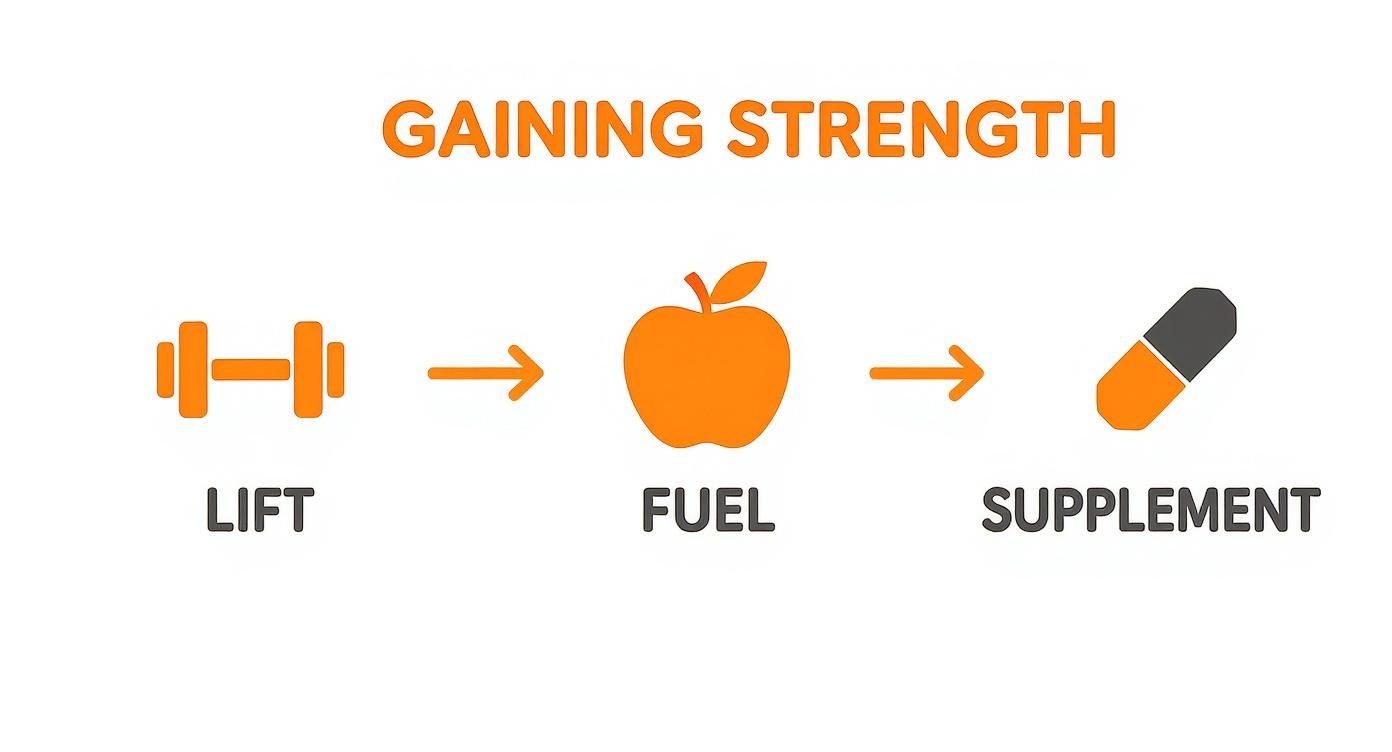
Think of these as three legs of a stool. If you kick one out from under you, the whole thing comes crashing down, and your strength gains grind to a screeching halt.
So, if slapping on another 10-pound plate isn't always the answer, what is? Plenty. Your body is a finely tuned adaptation machine, and it responds to all kinds of stress—not just a heavier barbell. Getting creative with these other variables is the secret sauce for consistent, injury-free gains.
Here are the other tools you need to have in your toolbox:
Don’t just lift the weight; control it. The person who can pause-bench 225 lbs with perfect form is miles stronger than the one bouncing 245 lbs off their chest. True strength is about control, not ego.
Talk is cheap. Let’s put this into practice. Here’s a sample 4-week progression on a classic Push/Pull/Legs (PPL) split that shows you exactly how to weave these principles together. Notice how we’re not just mindlessly adding weight every week.
Focus Exercise Example: Barbell Bench Press (Push Day)
See what happened there? You only added weight once in a whole month. But did you get stronger? You bet your ass you did. In Weeks 2 and 3, you built the stability and control needed to handle that new weight in Week 4 safely and effectively. This is how you build a solid foundation.
If you’re just getting started on this journey, our guide on 8 bodybuilding tips for beginners is a great place to learn more of these foundational principles.
This methodical approach forces your body to adapt in multiple ways, making you a more resilient and well-rounded lifter. It’s the difference between building a house of cards and a fortress of granite. One looks impressive for a second; the other lasts a lifetime.
Let’s get one thing crystal clear: you can't out-train a garbage diet. It's just not possible. Every gut-wrenching squat, every heavy pull, every bench press that makes your vision go blurry—that’s just the signal. The real magic, the part where you actually get stronger, happens when you feed your body the right materials to rebuild.
Think of it this way: your workout is the demolition crew knocking down a building. Food is the construction crew that comes in right after to build a bigger, badder skyscraper in its place. Send in a crew with cheap materials, you get a shack. Give them high-grade steel and concrete, you get a fortress.
This isn’t about eating sad, tasteless chicken and broccoli out of Tupperware for the rest of your life. Not at all. It’s about eating with a purpose, to make every single brutal workout count. It’s about fueling for raw power.
Protein is the single most important nutrient for muscle repair and growth. Period. It's non-negotiable. When you lift heavy, you're literally creating microscopic tears in your muscle fibers. Protein provides the amino acids—the building blocks—needed to patch up that damage and then some.
So, how much do you really need? Forget the standard government recommendations; those are for people who think a brisk walk is a tough workout. For anyone serious about getting stronger, the science points to a much higher number.
Aim for 1.6 to 2.2 grams of protein per kilogram of body weight. That works out to roughly 0.7 to 1.0 grams per pound. If you weigh 200 lbs, you should be shooting for 140-200 grams of protein every single day.
Nailing this target consistently is the difference between spinning your wheels and making real, tangible progress. When your nutrition is finally dialed in, you'll feel the difference not just in your strength, but in how quickly you recover, too.
Somewhere along the line, carbohydrates got a bad rap. Let's set the record straight: carbs are not the enemy. They are the absolute best source of energy for high-intensity training.
When you eat carbs, your body stores them in your muscles and liver as glycogen. This is the premium fuel your muscles burn during those heavy, explosive sets. Running low on glycogen is like trying to drive a race car on fumes—you're going to stall out fast.
Without enough carbs, your performance will tank, you’ll feel sluggish, and your body might even start breaking down muscle tissue for energy—the exact opposite of what you want. Eating strategically gives your body the juice it needs to perform.
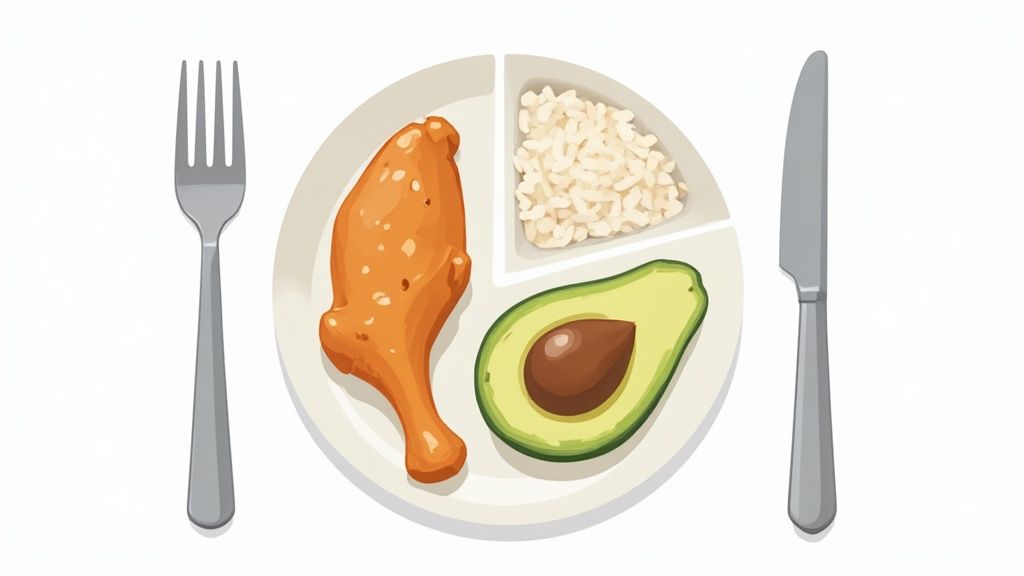
Let’s make this practical. Forget bland meals. Here’s what a delicious, macro-packed plate that supports performance and recovery actually looks like:
This isn't rocket science. It's a simple formula: protein to rebuild, carbs to refuel, and healthy fats to support your hormones. When you're consistently nailing your nutrition, you'll be amazed at how quickly your strength numbers start to climb. If you want to take things a step further, check out our guide on supplements for lean muscle mass to see how other nutrients can support your goals.
Alright, let's talk supplements. The fitness world is an absolute minefield of bogus powders and pills that promise the world but deliver next to nothing. It’s a jungle out there.
But then there’s creatine.
It stands tall above all the nonsense as one of the few supplements that actually lives up to the hype, backed by an absolute mountain of scientific proof. If you're serious about getting stronger, creatine isn't just a "nice to have"—it's a non-negotiable.
Think of your muscles like a smartphone battery. Every explosive movement—a heavy squat, a powerful bench press—drains that battery fast. Creatine is the high-speed charger that tops it up in seconds.
Deep inside your muscles, you have a high-energy molecule called adenosine triphosphate (ATP). This is the raw fuel for any short, intense burst of effort. When you're lifting heavy, you burn through your ATP stores in just a few seconds, leaving you running on fumes.
This is where creatine swoops in like a superhero. It boosts your body's reserves of phosphocreatine, which then rapidly donates a molecule to regenerate ATP. In simple terms, it recharges your muscle’s energy batteries almost instantly, letting you push harder and for longer.
Ever wonder how you can suddenly grind out an extra two or three reps at the end of a brutal set? That’s the creatine advantage. And those are the reps that actually trigger real strength and muscle growth. To really get it, you need to understand what does creatine do on a cellular level.
Creatine isn’t a magic pill. It’s a force multiplier. It takes the hard work you’re already putting in and just amplifies the results, letting you tap into a new level of strength you didn’t know you had.
One of the best things about creatine? It’s incredibly simple to use. There’s no complex protocol or secret timing window you have to stress over. You can forget all the confusing bro-science you’ve heard online.
This simple daily habit is an absolute game-changer. It's not just about raw power, either. One study found that athletes who focused on strength training for just eight weeks saw a mind-blowing 33.2% increase in their one-rep max and a 26% boost in their rate of force development. Creatine helps you get there faster.
Look, not all creatine is created equal. While standard creatine monohydrate is effective, the market is flooded with gritty, low-quality powders that don’t dissolve well and can leave your stomach feeling off. This is where a superior, well-designed formula makes all the difference.
That’s exactly why we developed Crazy Muscle’s Three-Atine. This isn't just another generic tub of creatine. We combined three different forms—monohydrate, alphaketoglutarate, and pyruvate—to create a blend designed for maximum absorption and zero nonsense. It’s clean, it’s effective, and it delivers the results you’re working so hard for.
If you want to get into the nitty-gritty, our guide on how does creatine work breaks down the science even further.
Stop leaving gains on the table. Adding a high-quality creatine like Three-Atine is the missing piece of your strength puzzle. It's the simplest, most effective step you can take to accelerate your progress and start hitting new PRs.
You can have the most dialed-in training plan and a diet that would make a monk proud, but if you treat recovery like an afterthought, you're building your fortress on sand. Strength isn’t forged in the gym; that's just where you tear everything down.
The real magic—the part where you actually get stronger—happens when you’re resting.

This is the single most neglected secret to making insane progress. It’s time to stop thinking of recovery as 'time off' and start treating it as a critical, non-negotiable part of your program.
Forget fancy gadgets and exotic supplements for a minute. The most potent performance enhancer on the planet is completely free, and chances are, you're not getting enough of it. I'm talking about sleep.
During deep sleep, your body floods your system with human growth hormone (HGH), which is absolutely essential for repairing damaged muscle tissue and building new, stronger fibers. Skimp on sleep, and you're just kneecapping your body's ability to bounce back.
Your muscles don't grow while you're lifting; they grow while you're sleeping. Prioritizing 7-9 hours of quality sleep is the biggest investment you can make in your strength.
Getting good sleep is about more than just logging hours. It's about creating a solid routine.
Beyond just sleep, how you spend the time between your workouts can either speed up or stall your progress. The goal isn't to become a couch potato; it's to engage in smart, active recovery that gets your blood flowing without adding more stress.
This is all about accelerating repair. Gentle movement helps flush out metabolic waste from your muscles and delivers fresh, nutrient-rich blood to the areas that need it most. To really speed up muscle repair and recovery, you could even consider things like using a sauna for recovery.
Here are a few tactics to add to your arsenal:
Sooner or later, it happens to everyone. You’re crushing it in the gym, adding weight to the bar every week, and then…bam. It stops. The numbers just won't budge, no matter how much you grunt.
Welcome to the plateau. It’s frustrating, but getting stuck is part of the iron game. Staying stuck, however, is a choice. Think of this as your field guide for smashing through those inevitable training walls.
Let’s be brutally honest for a second. Your progress hasn't stalled because of bad genetics or because you're missing some obscure Bulgarian training secret. Nine times out of ten, it’s one of the same old culprits that have been derailing lifters for decades.
Before you tear up your entire program and start from scratch, you need to figure out what’s actually holding you back. Most plateaus boil down to a few classic blunders.
Your Ego is Writing Checks Your Body Can't Cash: Are you bouncing the bar off your chest on the bench? Turning your deadlift into a glorified back extension? Using sloppy, momentum-fueled reps to move weight you can't truly control is the fastest way to stop making progress and, even worse, get injured.
You've Got "Program ADD": If you’re changing your entire workout every two weeks because of the latest fitness influencer post, you’re spinning your wheels. Your muscles need consistent stress to adapt and grow. Give a solid program at least 8-12 weeks before you even think about switching.
You're Ignoring the weakest link: Is your bench stuck in a rut? The issue might be weak triceps. Squat not moving? Maybe your glutes or core are asleep at the wheel. Trying to build a big lift on a foundation of weak supporting muscles is like trying to fire a cannon from a canoe—it just doesn't work.
A plateau isn't a dead end. It's a signal. It's your body telling you loud and clear that your current approach has run its course and something needs to change.
Sometimes, the best way to blast forward is to take a calculated step back. Enter the deload week.
This isn't an excuse to be lazy; it's a planned, intelligent period of reduced training intensity. It gives your fried central nervous system a break, lets your achy joints heal, and reignites that fire in your belly.
You don't stop training entirely. Instead, you might drop the weight on the bar by 40-50% or simply cut your number of sets in half. It feels wrong, I know. But this period of active recovery is often the very thing that unlocks your next PR. You’ll walk back into the gym the following week feeling like a new person, ready to attack the weights with a vengeance.
Alright, let's tackle some of the common questions that pop up when you're on a mission to get seriously strong. Think of this as your personal myth-busting session to clear the air so you can focus on what really matters: moving big weight.
You'll feel stronger almost immediately. Seriously, within a couple of weeks, your nervous system starts to wise up and gets way better at recruiting the muscle you already have. It's a cool feeling.
But for those gains you can see in the mirror and prove on the barbell? Give it a solid 8-12 weeks of sticking to the program. That first year of lifting is often called the "newbie gains" phase for a reason—a 30% jump in strength is totally possible if you're consistent. After that, progress is a game of inches, not miles.
The short answer? Nah.
A loading phase, where you slam 20g a day for about a week, will saturate your muscles with creatine faster. No doubt about it. You might feel that performance bump a little sooner.
But just taking a standard 5g dose every day will get you to the exact same place in about a month. The destination is the same; you're just picking between the express train and the scenic route.
The real secret isn't how you start; it's that you don't stop. Loading or not, taking creatine daily is what delivers the results. Consistency is the name of the game.
One hundred percent, yes. Getting strong is as much a skill as it is a physical trait. It's about training your brain and nervous system to fire your muscles with maximum force and efficiency. That’s precisely what lifting heavy, low-rep sets trains you to do.
If you keep your calories right around maintenance level while hammering your protein goals, you can build pure, dense strength without adding a ton of size. You just have to train and eat for the specific goal you're chasing.
Ready to stop leaving gains on the table and see what you're really capable of? Crazy Muscle has the fuel you need to smash through plateaus and build real, undeniable strength. It's time to find your secret weapon.

Sign up and save 10% off your next order