
How to Speed Up Muscle Recovery and Crush Your Next Workout
Posted by Maximus
on

Let’s be real. To get stronger, you have to break yourself down a little bit first. The real magic, though, isn’t just about lifting heavy—it’s about how quickly and efficiently you can put yourself back together. That’s where a smart recovery plan comes in, turning that post-workout ache into actual muscle growth.
You know the feeling. That day-after-leg-day waddle where even sitting down becomes an Olympic event. That’s Delayed Onset Muscle Soreness (DOMS), and it's basically your muscles sending you a very clear, very loud message: you did some work.
When you push your limits in the gym, you’re creating tiny, microscopic tears in your muscle fibers. This isn't a bad thing; in fact, it's the entire point. This damage is the signal your body needs to kickstart the repair process. It says, "Okay, we need to rebuild this, but let's make it bigger and tougher for next time." Your body's response involves inflammation and a cellular clean-up crew, which is what causes that signature soreness you feel 24 to 48 hours later.
Think of it like renovating an old kitchen. You can't install shiny new cabinets and countertops until you've ripped out the old, outdated stuff. The tearing down part is messy, but it’s essential for the upgrade. DOMS is just the feeling of that demolition and construction crew working overtime in your muscles.
But here’s the thing: just sitting on the couch and waiting for the pain to go away is a huge missed opportunity. The goal isn't to avoid getting sore—soreness means you’re challenging yourself. The goal is to manage it, shorten its duration, and get back to your next session feeling strong and ready to go again.
There's a reason the world is waking up to the importance of recovery.
The sports medicine market is blowing up, projected to more than double from USD 6.40 billion in 2025 to a massive USD 13.03 billion by 2034. A huge chunk of that is driven by recovery. With things like knee injuries making up 41% of all sports-related issues, it's obvious that getting back to 100% is a top priority for everyone. You can dig into these market trends in sports medicine to see just how big this is getting.
This guide is your game plan for taking control of your recovery. We're going to stop being a victim of soreness and start actively driving our own growth.
You just demolished that workout. Your muscles are screaming, you’re drenched, and you feel invincible. But what you do right now matters just as much as that final, gut-wrenching rep. This is the "Golden Hour"—that crucial 60-90 minute window after training when your muscles are screaming for nutrients and ready to soak them up like a dry sponge.
Think of it this way: your muscles are a construction site that just got hit by a wrecking ball. They need raw materials, and fast. You’re the delivery driver. If you fail to show up, the rebuilding process stalls. But if you nail it, you kick recovery into overdrive.
This is about more than just chugging a protein shake and hitting the shower. It's a strategic mission to deliver the perfect one-two punch of fuel to repair those muscle micro-tears and restock the energy you just torched.
The real secret sauce for kicking off recovery is a smart combo of protein and carbohydrates. Protein delivers the amino acids—the actual bricks and mortar—for muscle repair. Meanwhile, carbs are the emergency crew, rushing in to replenish your depleted glycogen stores. Glycogen is your muscles' go-to fuel, and running on empty guarantees you'll feel sluggish and sore for days.
The sweet spot is a carb-to-protein ratio of about 2:1 or 3:1. So, if you're taking in 25 grams of protein, pair it with 50-75 grams of simple, fast-acting carbs.
This simple strategy is a huge reason the global sports nutrition market was valued at an eye-watering USD 66.27 billion in 2024. The massive demand for post-workout fuel is no accident—it's because this stuff flat-out works. You can see how massive these exploding sports nutrition trends are and why everyone is so obsessed with this golden hour.
The timeline below shows exactly how your hard work in the gym translates into growth, and it highlights where your post-workout choices make all the difference.
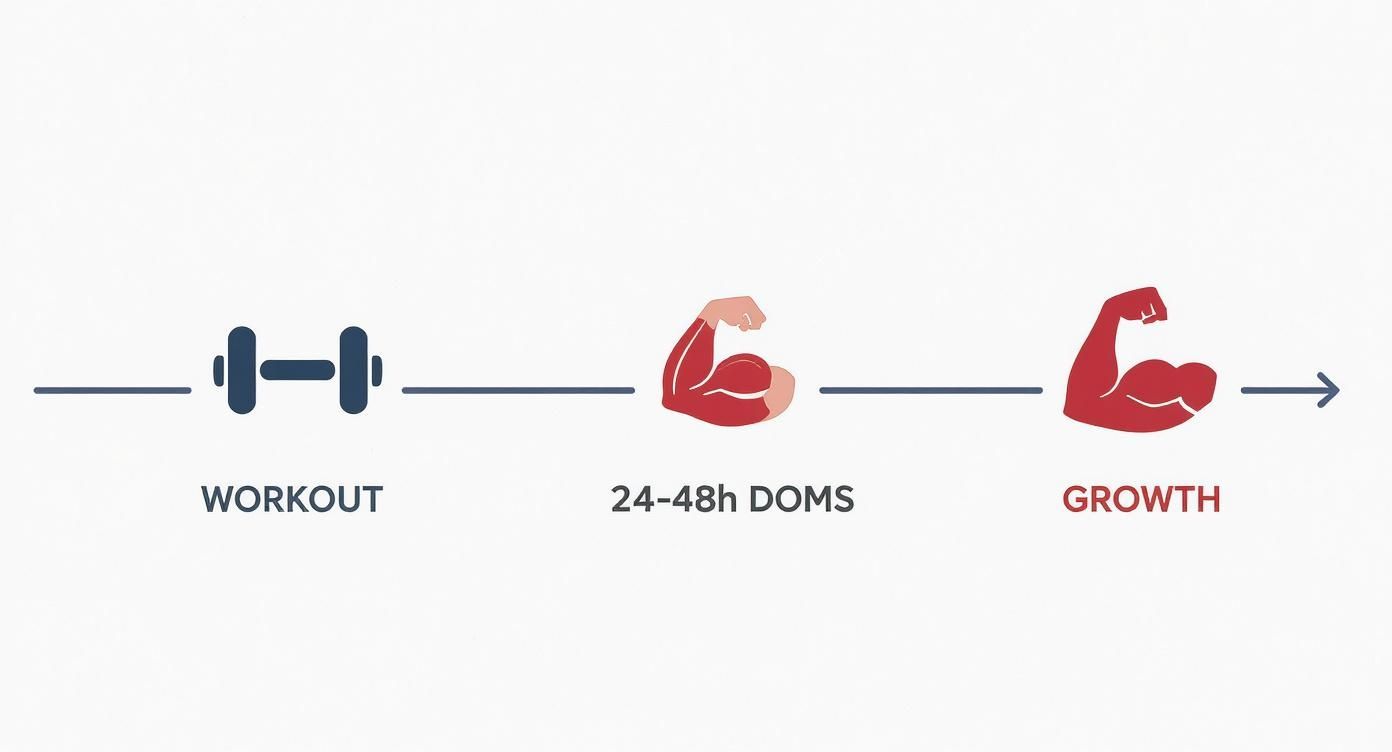
Remember, that "good pain" (DOMS) is a sign you’re on the right track. It's the prequel to the muscle growth you're chasing.
All those amazing nutrients need a ride to the party. That’s where water and electrolytes come in. You lose crucial minerals like sodium and potassium when you sweat, and chugging plain water often isn't enough to replace them.
Electrolytes are the unsung heroes of recovery. They help shuttle nutrients into your muscle cells and carry waste products out, dramatically improving how to speed up muscle recovery.
Without proper hydration, your muscles stay cramped and tight, and that nutrient delivery system grinds to a halt. Something as simple as adding a pinch of sea salt to your water or using an electrolyte powder can be a total game-changer. For those of you stacking supplements, we’ve already broken down everything you need to know about mixing creatine with your protein shake.
Alright, so you absolutely wrecked your workout, slammed a protein shake, and now you’re melted into the couch, waiting for the muscle gods to grant you the ability to walk normally again. Sound familiar? It’s what most people do, but it’s not what the smart lifters do.
The real secret to bouncing back faster isn't to become a permanent fixture on your sofa. It's to get up and move... gently.
This is the magic of active recovery, and it’s a total game-changer for slashing your downtime. When your quads are screaming, the last thing you want to do is move. But light activity is like a cleanup crew for your muscles. It gets the blood flowing, which helps flush out all that metabolic junk (hello, lactic acid!) and delivers fresh oxygen and nutrients to the tissues that are begging for repairs.
Seriously, if you don't own a foam roller, you're missing out on one of the best and cheapest massage therapists you can find. This simple piece of foam is a miracle worker for ironing out those gnarly knots and tight spots in your fascia, which is the connective "shrink wrap" around your muscles.
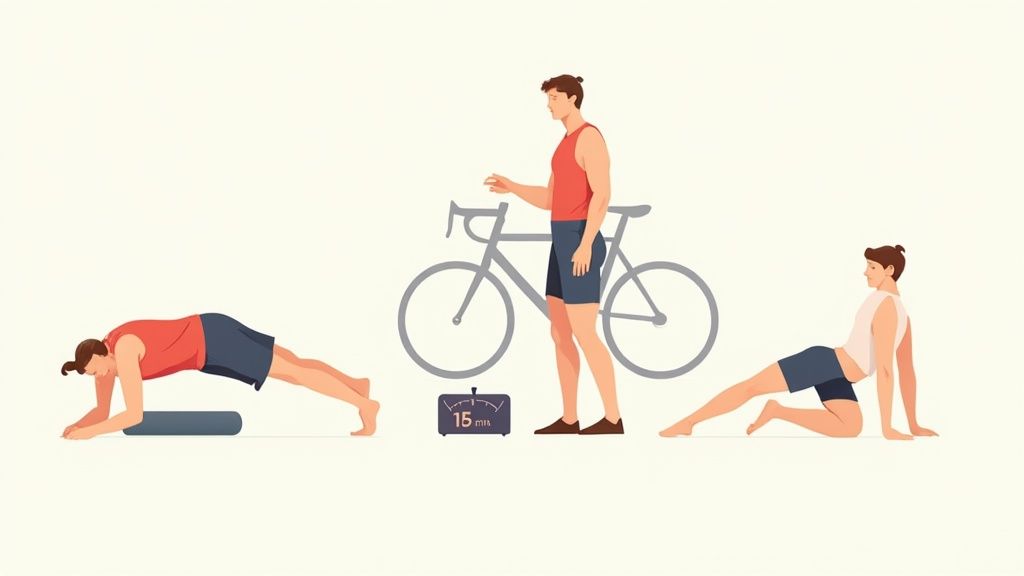
Spending just 10-15 minutes after a session rolling out the big players—quads, hamstrings, glutes, and back—can completely change how you feel the next day. It’s essentially a self-administered deep-tissue massage that helps break up adhesions and get your flexibility back. Yeah, it might hurt so good, but that’s how you know you're hitting the right spots.
Quick tip: Don't just roll back and forth like you're rolling out pizza dough. When you find a sore spot, park on it for 20-30 seconds. Breathe through the discomfort, and feel that muscle start to let go. That targeted pressure is the key to unlocking real relief.
Let's be clear: active recovery is not another workout. The goal here is low-intensity, low-impact movement that elevates your heart rate just enough to get the blood pumping without causing any more stress to your muscles. Think a brisk walk, a casual spin on a bike, or a few easy laps in a pool.
You can get some great ideas from these Top 6 Post-Workout Recovery Tips to round out your strategy. Even a simple 15-minute mobility flow can work wonders.
Here's a go-to routine you can do literally anywhere:
The main thing is to be consistent. Some days, a good active recovery session is more productive than another brutal workout, especially when you feel like you've been hit by a truck. And if you're constantly feeling beat down, you might need more than just a light walk. Our guide on when and how to take off weeks from training is a must-read for anyone serious about long-term progress.
Let's get one thing straight. You can have the perfect training split, a diet dialed in to the last calorie, and a supplement stack that would make a pro bodybuilder blush. But if your sleep sucks, you're building a house of cards. It's a massive, self-inflicted wound to your progress.
You're leaving huge, undeniable gains on the table.
Think of sleep as the most potent, all-natural performance enhancer money can't buy. It's during those deep sleep cycles that your body finally flips the switch on its internal repair shop. This is prime time for your pituitary gland, which floods your system with Human Growth Hormone (HGH)—the MVP of repairing and rebuilding the muscle you just spent an hour tearing down in the gym.
When you skimp on sleep, your HGH production tanks. It's like sending the construction crew home right after demolition. You did all the hard work breaking things down, but the rebuilding process gets completely short-circuited. Way too many people chasing gains completely drop the ball on this.
Getting better sleep isn't just about logging more hours in bed; it's about making those hours count. A few simple tweaks can transform your restless nights into powerful recovery sessions.
To really get the most out of sleep for muscle growth, you need to start by understanding and enhancing sleep quality.
Being sleep-deprived does more than just make you feel like a zombie. It unleashes the ultimate villain for muscle growth: cortisol. This stress hormone is catabolic, which is just a fancy way of saying it actively breaks down muscle tissue for energy. It's the polar opposite of what you want.
When you don't sleep enough, your cortisol levels skyrocket while your HGH levels plummet. You’re basically creating the perfect hormonal storm to sabotage your own progress—literally eating away at the very muscle you’re trying to build.
There isn't a supplement on the planet that can fix a consistently bad hormonal environment.
By making 7-9 hours of quality sleep a priority, you’re not just resting. You are actively creating the ideal anabolic state for your body to repair, rebuild, and come back stronger. This isn’t an optional extra; it's a non-negotiable cornerstone of any serious training program. And to make sure your body has all the fuel it needs for that critical recovery window, get your supplement plan locked down with some of the essentials from Crazy Muscle.
Let's cut through the noise. The supplement aisle is a chaotic mess, isn't it? Every bottle screams promises of god-tier recovery and superhuman strength. When you're serious about getting back in the gym faster, you don't have time for snake oil—you need stuff that actually works.
Make no mistake: nutrition, sleep, and smart training are the bedrock of your progress. But the right supplements? They’re the turbo button. They give your body's natural repair processes a serious kick in the pants.
If there's one supplement that's been through the scientific wringer and come out on top every single time, it's Creatine Monohydrate. Think of it as your muscles' express energy source. It helps rapidly regenerate ATP, the high-octane fuel your muscles guzzle during heavy, explosive lifts.
When your muscles are fully loaded with creatine, you can squeeze out that extra rep or two that you'd normally fail on. That extra work means more muscle breakdown, which is the trigger for more growth. But the recovery magic goes deeper.
Creatine literally pulls water into your muscle cells, a process called cellular hydration. This doesn't just give you a fuller, more pumped look; it creates an ultra-hydrated, anabolic environment that's primed for protein synthesis and repair.
A well-hydrated muscle cell is a happy, growing muscle cell. By optimizing this internal environment, creatine directly speeds up the recovery and rebuilding phase, getting you back under the bar faster and stronger.
It's no surprise the supplement industry is booming. The global market for muscle recovery powders alone is projected to hit US$ 8.3 billion by 2024. This isn't just hype; it's a massive response to the demand for proven recovery aids.
While creatine is definitely the star of the show, a few other key players deserve a spot in your recovery toolkit. Branched-Chain Amino Acids (BCAAs)—that's leucine, isoleucine, and valine—are the building blocks of muscle repair. Think of them as the first responders that swoop in to minimize muscle protein breakdown during and after a brutal workout.
Sipping on BCAAs can help take the edge off muscle soreness and signal your body to flip the muscle-building switch. This is why building a smart supplement stack is so crucial for anyone pushing their limits. For a deeper dive, check out our guide on the best supplements for muscle recovery to build your ultimate arsenal.
For a quick-glance guide, I've put together a cheat sheet of the heavy hitters.
Here's a no-fluff breakdown of the supplements that have earned their place in a serious lifter's cabinet.
| Supplement | Primary Recovery Benefit | Best Time to Take |
|---|---|---|
| Creatine Monohydrate | Enhances ATP production for strength and promotes cellular hydration for faster repair. | Daily, anytime. Post-workout is a popular and effective choice. |
| BCAAs | Reduces muscle protein breakdown during exercise and can decrease post-workout soreness. | Intra-workout (during) or immediately post-workout. |
| Glutamine | Supports immune function (which is stressed by hard training) and can help replenish muscle glycogen. | Post-workout or before bed to aid overnight recovery. |
| Whey Protein | Provides a rapid source of essential amino acids to kickstart the muscle protein synthesis process. | Within 30-60 minutes post-workout. |
Remember, these are supplements, not replacements for a solid nutrition plan. They're designed to fill the gaps and accelerate a process you've already started with good food and hard work.
If you're looking for an all-in-one creatine powerhouse, our own Three-Atine blend was engineered for maximum impact. By combining three distinct forms of creatine, Three-Atine is designed to boost absorption and effectiveness, helping you get the most out of every single scoop. It’s all about working smarter to give your body the elite fuel it needs to crush recovery and get back to building muscle. Get your hands on it today at our Crazy Muscle Amazon Store.
You've got questions, and when it comes to muscle recovery, the gym is buzzing with answers. The problem? A lot of it is "bro science" or just plain bad advice. Let's cut through the noise and tackle the real questions you're asking with some straight talk.
We all know that satisfying ache after a killer leg day. It's a badge of honor, a sign you put in the work. For the most part, that's true. Delayed Onset Muscle Soreness (DOMS) is a perfectly normal part of the muscle-building process. If you can still get through your day, even with a bit of a grimace, you're probably just fine.
But there's a line. If the pain is sharp, feels like it’s in a joint, or you can't properly extend or flex a limb after 48-72 hours, you might be looking at an injury, not just garden-variety soreness.
Here's the golden rule I live by: Listen to your body. If you're so sore that it messes with your form on the next workout, just take an active recovery day or train something else. Trying to be a hero and pushing through severe pain is a one-way ticket to Injuryville, not Gains City.
Ah, the infamous ice bath. Every pro athlete seems to be plunging into a frozen abyss, so it must be the secret weapon for recovery, right? Well… it's not that simple.
There's no doubt that ice baths can slam the brakes on inflammation and numb that immediate post-workout ache. That icy shock constricts your blood vessels, which can help flush out some of the metabolic junk that builds up after a tough session.
But here’s the trade-off: some research suggests that constantly blunting that natural inflammatory response might actually get in the way of long-term muscle growth signals. A little inflammation is actually a key trigger for your muscles to adapt and get stronger.
First off, a deload week isn't a permission slip to morph into a couch potato. It’s a strategic retreat—a chance for your body to fully repair and come back stronger. You’re dialing back the volume and intensity in the gym, which means your recovery strategy needs a little tweak, too.
Don't suddenly tank your nutrition. Your body is in full-on repair mode, so slashing your protein intake now is a bad move. Keep feeding the machine the good stuff it needs to rebuild.
The real change is where you put your focus. A deload is the perfect time to go all-in on the other recovery tools we've been talking about:
Think of it like a pit stop in a Formula 1 race. You’re not quitting; you’re refueling, changing the tires, and fine-tuning the engine so you can floor it on the next lap. A well-executed deload is one of the most powerful recovery weapons in your entire arsenal.
Here at Crazy Muscle, we live by the motto that what happens outside the gym is just as crucial as what happens inside. It's time to fuel your comeback and give your muscles the elite support they've earned.
Ready to stop guessing and start growing? Check out our full lineup of recovery supplements on Amazon and accelerate your gains.

Sign up and save 10% off your next order