
Micronized Creatine vs Regular Creatine The Ultimate Showdown
Posted by Maximus
on

Alright, let's get into the ring for the ultimate creatine showdown. In one corner, we have the old-school, tried-and-true champion: regular creatine monohydrate. And in the other, the slick, modern challenger: micronized creatine.
So, what’s the real tea? Is "micronized" just some fancy marketing term cooked up to get you to spend more money, or is there some legit sorcery to it? Let's be real, you're here because you want bigger lifts, not a chemistry lesson. So, let’s find out which one will help you absolutely crush it.
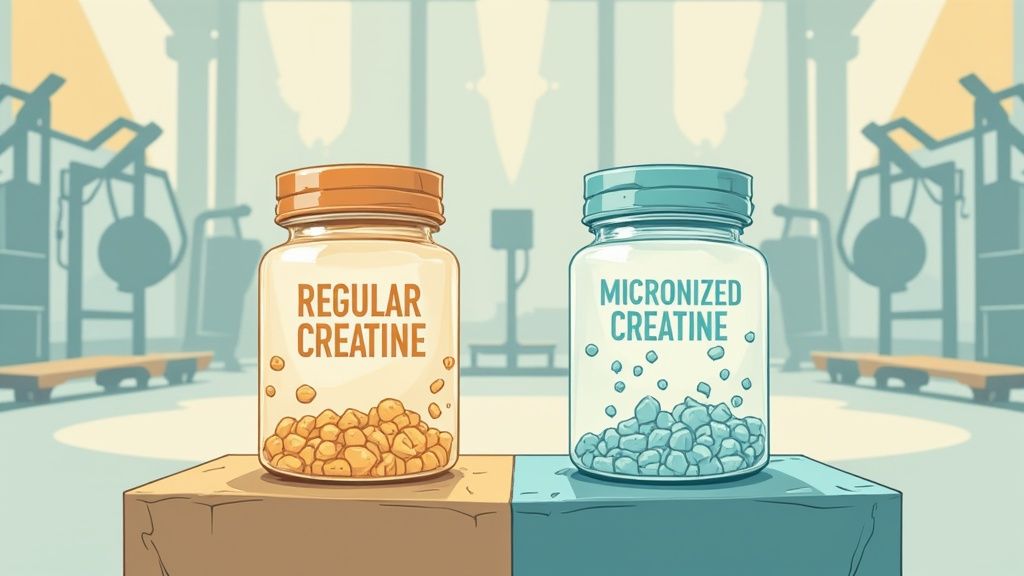
Let's cut through the BS. Micronized creatine is regular creatine monohydrate. The only thing that's changed is it’s been put through a process that grinds the particles down to be much, much smaller. Think of it like comparing chunky beach sand to super-fine, powdery dust. Same stuff, just a different texture.
The process, called "micronization," pulverizes standard creatine crystals until they are up to 20 times smaller. This doesn't alter the creatine molecule one bit, but it massively increases the powder's surface area. And that, my friend, is where the magic happens.
Ever tried to stir a big sugar cube into your iced coffee? It takes forever, and you're left with a crunchy lump at the bottom. Gross. Now, imagine using powdered sugar instead—it vanishes almost instantly. That's the exact principle behind micronized creatine. It’s all about a better user experience so you can stop gagging on sandy supplements.
This one simple change can have a pretty noticeable impact on your daily supplement routine. We’re not just talking about mixability; it can also affect how it sits in your stomach.
The showdown between micronized creatine vs. regular creatine isn't about one being fundamentally "stronger." It's about user experience—how it mixes in your shaker cup and how it feels in your gut.
Before we get into the nitty-gritty of performance and side effects, let's lay out the key differences side-by-side.
Here’s a quick summary of the key differences between micronized and regular creatine monohydrate to help you understand the core distinctions instantly.
| Feature | Regular Creatine | Micronized Creatine |
|---|---|---|
| Particle Size | Standard, larger crystals | Up to 20x smaller particles |
| Solubility | Can be gritty; may settle at the bottom | Dissolves quickly and smoothly |
| Stomach Comfort | May cause bloating in sensitive users | Generally easier on the stomach |
| Cost | The most budget-friendly option | Often slightly more expensive |
See? It’s pretty straightforward. Both get the job done by saturating your muscles with the fuel needed for that extra burst of strength and power. The difference is all in the delivery.
If you want the undisputed gold standard that mixes great without the extra cost, our Crazy Muscle Creatine Monohydrate powder is your go-to. It’s a premium formula that gives you all the proven benefits without any fuss. Now, let’s dig deeper.
Ever chugged your pre-workout, only to be ambushed by a mouthful of sandy grit at the bottom of your shaker? That’s the ghost of regular creatine past, haunting your drink. This is where we get into the nitty-gritty of why micronized creatine is the smooth operator of the supplement world, and it’s a total game-changer.
The magic word here is micronization. This process pulverizes standard creatine monohydrate into particles up to 20 times smaller, which massively increases the powder's total surface area. Think of it like this: a single, solid ice cube melts slowly in your drink. But crush that same cube into a fine snow, and it dissolves almost instantly. That's the difference we're talking about.
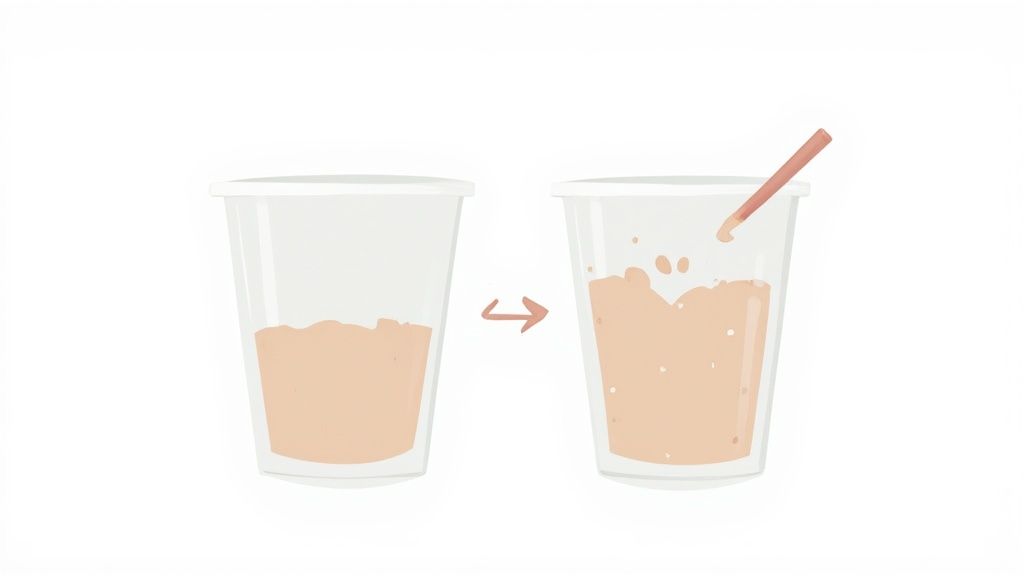
This incredible solubility means a smoother, grit-free drink every single time. No more swishing that last sandy sip around your mouth like you’re panning for gold. But this is about more than just a better drinking experience; it's about maximizing every gram you take to fuel your gains.
This is the million-dollar question: does a powder that dissolves better actually get into your muscles more effectively? Common sense says it should. If your creatine dissolves completely in the shaker, it stands to reason it will be absorbed more readily in your gut instead of just sitting there causing trouble.
This all comes down to understanding bioavailability—the rate and extent to which a substance actually gets absorbed and used by your body. For creatine, better bioavailability means more of it reaches your bloodstream and, ultimately, your muscle cells. If you want a refresher on the basics, our guide on how creatine works breaks it all down.
The fancy scientific term for how a substance moves through the body is pharmacokinetics. This field looks at stuff like peak plasma concentration (how much creatine hits your blood at its highest point) and its half-life (how long it hangs around).
Enhanced solubility isn't just for a smoother shake. It's the first step toward potentially better absorption, ensuring more of what you pay for actually gets a chance to work in your muscles.
And the research is starting to back this up in a big way. A 2022 pharmacokinetic study put a specialized micronized creatine head-to-head with regular creatine monohydrate (CM) and the results were eye-opening. The micronized version led to a 71% increase in total creatine exposure, a clear sign of superior bioavailability. Its peak plasma concentration was 18.10% higher, and its half-life was extended by 21.37%. In simple terms, more creatine got into the blood, and it stuck around longer for your muscles to use.
Okay, let's translate this science into gym-talk. A higher peak concentration and a longer half-life mean your muscles have more creatine available, for a longer window of time, after you take your dose. This could seriously speed up muscle saturation, especially during a loading phase.
When it comes down to it, the battle of micronized vs. regular creatine on the absorption front is pretty compelling. While both are built on the rock-solid foundation of creatine monohydrate, that micronization process offers a clear upgrade in user experience and a strong scientific case for better bioavailability. If you’re serious about optimizing every part of your supplement stack, choosing a high-quality micronized powder is a no-brainer.
Alright, let's get to the real meat and potatoes. The million-dollar question: will switching to micronized creatine actually help you smash your personal records? Does a tinier particle size really translate to bigger lifts or faster sprints? It's time to cut through the marketing noise and look at the hard truth.
The engine driving your gains is creatine monohydrate. Full stop. Both the regular and micronized versions get the job done by saturating your muscles with phosphocreatine. This little molecule is your body's "go-to" for rapidly regenerating ATP (adenosine triphosphate), which is the raw fuel for explosive, high-intensity movements. Think of it as putting premium, high-octane fuel in your tank—the end result is more horsepower.
https://www.youtube.com/embed/Apgm6lKBfUA
So, the debate isn't about if it works. We know it does. The real question is whether the souped-up delivery system of micronized creatine actually leads to superior outcomes. Does better absorption in your gut automatically mean better results in the gym?
When it comes to raw strength and power, the evidence is crystal clear. The core ingredient—creatine monohydrate—is what delivers the goods, no matter how small the particle is. Your muscles honestly don't care how finely ground the powder was before you chugged it; they just care about getting loaded up with creatine.
This means that once your muscles are fully saturated, both forms will give you the same incredible benefits:
From a physiological standpoint, studies comparing different forms of creatine consistently find no significant difference in muscle gains or strength bumps. The fundamental mechanism works brilliantly in either form.
So, does smaller actually mean stronger? The short answer is a resounding no. Micronized creatine isn't some magic bullet that unlocks a new level of performance that regular monohydrate can't touch. The performance benefits are virtually identical because the active molecule is, well, identical.
The real advantage of micronized creatine comes down to user experience—it mixes way better and is gentler on your stomach. It’s a premium delivery system for the same high-performance engine.
Think of it this way: you can get to your destination in a standard sedan or a luxury one. Both cars will get you there safely and efficiently, but the luxury model offers a much smoother, more comfortable ride. That's the difference here. Micronized creatine provides a more pleasant journey (no gritty texture, less potential for bloating), but the destination—complete muscle saturation and enhanced performance—is exactly the same.
Of course, the type of creatine you use is just one piece of the puzzle. For serious athletes, it's all part of a bigger picture when it comes to understanding high-performance nutrition.
Ultimately, your choice should boil down to your personal preference and how your body reacts. If regular creatine works for you without any drama, you’re golden. But if you can't stand a chalky drink and want to dodge any potential stomach trouble, then upgrading to micronized is a no-brainer.
For a top-tier option that dissolves flawlessly, check out our Crazy Muscle Creatine Monohydrate powder and feel the difference for yourself.
Let's talk about the one creatine side effect everyone whispers about in the locker room—the dreaded bloat. You know the feeling: your stomach feels like an overinflated basketball, cramps kick in, and you're generally miserable. It's a real issue for some lifters, and it's almost always tied to one specific culprit: regular creatine monohydrate.
The problem with standard creatine comes down to its gritty, sand-like particles. They just don't play well with water. When you chug them down, they can hit your stomach before fully dissolving, where they proceed to pull water into your intestines and just… sit there. This undissolved creatine can kickstart a gut party you definitely weren't invited to, leading to a host of GI issues that can kill your workout vibe.

This is where micronized creatine swoops in to save your stomach. It’s not magic, just simple science. Because it dissolves so much better, it gets absorbed quickly and efficiently instead of hanging around in your digestive tract causing trouble.
For anyone with a sensitive stomach, the difference between micronized creatine and regular is night and day. Since it dissolves almost completely, there’s way less free-floating creatine to suck water into your gut and cause that awful bloating and cramping.
Think of it like this: trying to swallow a spoonful of sand versus a spoonful of sugar that instantly melts. One is just asking for irritation, while the other goes down without a fight.
The number one reason people switch to micronized creatine isn’t necessarily for better performance—it’s for comfort. It delivers all the same muscle-building power without the digestive drama.
This is a huge deal during a "loading phase," when you're taking much higher doses. Trying to stomach 20 grams of gritty, regular creatine every day can be a recipe for disaster. With a micronized powder, that same high dose is far more manageable and much less likely to cause an uprising in your gut. If you want to get into the nitty-gritty of it, you can learn more about why creatine bloating happens and how to sidestep it.
If you're one of the people who gave up on creatine because your stomach just couldn't handle it, it’s time to give the micronized version a real shot. It’s the gentle giant of the supplement world, offering a way to get all the gains without the pains.
Here’s a quick gut-check guide to get you started on the right foot:
At the end of the day, your supplement routine should help you, not hurt you. Don't let past tummy troubles keep you from reaching your potential. A quality micronized powder like Crazy Muscle’s Creatine Monohydrate is specifically designed for superior mixability and comfort, making it the perfect choice.
Alright, let's talk about the cold, hard cash. You’ve seen them sitting side-by-side on the shelf—micronized creatine almost always has a slightly beefier price tag. So, is it actually worth shelling out those extra dollars, or is it just a clever way to lighten your wallet? Time for a brutally honest cost-benefit analysis.
When you break it down, one thing is crystal clear: regular creatine monohydrate is the undisputed king of affordability. It’s cheap to produce, widely available, and has been the gold standard for decades for a reason. It flat-out works and won't break the bank.
Market analysis consistently shows that creatine monohydrate remains the most dominant and budget-friendly option in the global supplement game. A massive review of over 120 creatine products found the average price per gram of pure creatine monohydrate was about $0.12, making it roughly 116% cheaper than alternative forms. Despite all the new, fancy options, there's limited scientific proof that they outperform the original, as you can explore in this detailed market breakdown.
So, if performance is the same, what does that extra cost for micronized creatine get you? You're not paying for stronger muscles; you're paying for a premium user experience.
For some, these benefits are non-negotiable. If you've ever quit creatine because you couldn't stand the gritty texture or the stomach cramps, then paying a little extra for a micronized version isn't just worth it—it's the only way you’ll stick with it.
You’re not paying more for better results; you’re paying more for a better experience. The question isn't "which is stronger?" but "which one fits my lifestyle and body best?"
This simple decision tree can help you choose based on what truly matters to you—your budget or your digestive comfort.
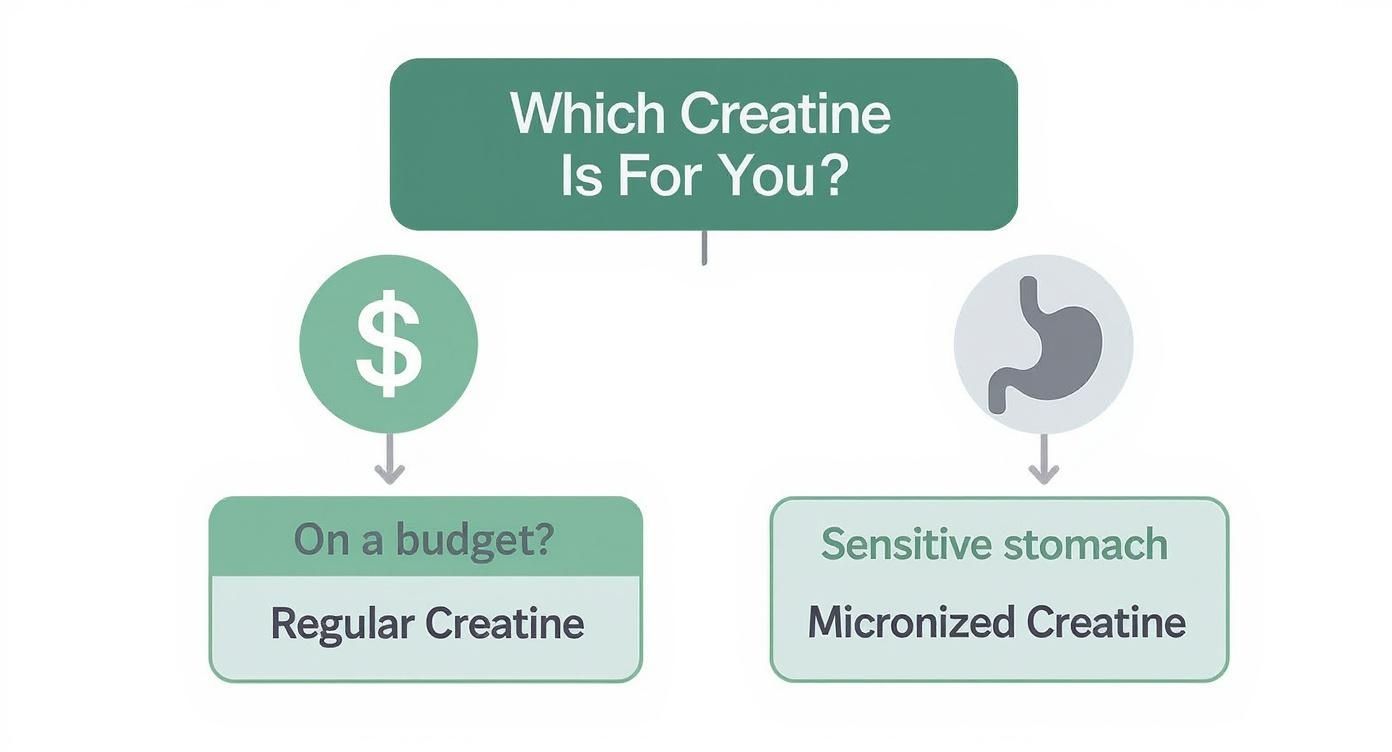
The infographic perfectly illustrates the choice: if your wallet is the top priority, regular creatine is your champion. However, if stomach comfort is a non-negotiable, the path clearly leads to micronized creatine.
So, is micronized creatine worth the extra cash? Here's the bottom line:
Ultimately, the best value is the product you'll take consistently. Don't let a few dollars stand between you and your gains if it means the difference between sticking to your routine or quitting. For a premium micronized powder that delivers all the benefits without the drama, Crazy Muscle’s Creatine Monohydrate is the smart investment.
Alright, after all the science, smack talk, and gritty details, it's time to crown a winner. But here's the plot twist: there's no single champion. The best creatine is the one that fits your goals, your gut, and your budget like a glove.
Let’s skip the fluff and get right to it. This isn't about one form being universally "better" than the other. The micronized vs. regular creatine debate is all about matching the right tool to the right job. You wouldn't use a sledgehammer to hang a picture, right? Same logic applies here.
Are you just getting started with lifting? Maybe you're a veteran who just wants proven, no-frills results. Is your budget the deciding factor?
If you're nodding along, regular creatine monohydrate is your undisputed champ. It's the most studied, most trusted, and most affordable performance supplement on the market. It flat-out works. As long as you can handle a little sediment in your shaker and your stomach doesn't complain, there's no real need to spend more.
Do you want a supplement that dissolves instantly, leaving zero grit behind? Is your stomach a bit sensitive? Are you focused on maximizing absorption to get every possible ounce of benefit?
If that sounds like you, micronized creatine is your MVP, hands down. Think of it as the luxury upgrade that turns your daily routine from a chore into a pleasure. That slightly higher price is a small trade-off for a smooth-mixing drink and a happy gut, making it way easier to stay consistent and see those killer results.
The real choice isn't about which one builds more muscle—they both get the job done. It’s about the experience you want: the budget-friendly classic or the smooth, stomach-friendly upgrade.
Here at Crazy Muscle, we don't believe in a one-size-fits-all approach. We know every athlete is different, which is why we've got you covered no matter which path you choose.
For the Premium Powder Fan: If the easy-mixing, gentle-on-the-stomach perks of micronized won you over, our Crazy Muscle Creatine Monohydrate powder is your new best friend. It’s a top-shelf micronized formula that delivers all the proven power in a super-soluble form.
For Ultimate Convenience and Power: What if you just hate powders altogether? Our Three-Atine creatine capsules are an awesome, innovative solution. You get a powerful blend of three different creatine forms packed into a simple, no-mess pill—perfect for anyone on the move. Still on the fence? Our guide on figuring out what is the best creatine supplement for you can help nail down the decision.
At the end of the day, the final call is yours. Pick the creatine that aligns with your body and your ambitions, and get ready to smash your next PR.
Got a few more questions rattling around in that big brain of yours? Let's clear them up. Here are the most common things we hear from lifters trying to decide between micronized and regular creatine.
Ah, the age-old loading question. While you can do a loading phase (slamming about 20 grams a day for 5-7 days) to saturate your muscles faster, it’s definitely not a requirement. Think of it as taking the express train versus the scenic route—both get you to the same station.
The slightly better absorption of micronized creatine might mean you can shorten that loading window a bit, but honestly, most people just skip it altogether.
You'll hit that same sweet spot of full muscle saturation by just taking the standard 3-5 grams daily. It'll just take about 3-4 weeks. Plus, if you've ever had a sensitive stomach, skipping the high-dose loading phase is your best bet. A simple daily scoop of micronized creatine will get the job done without any drama.
Absolutely! This is where micronized creatine really shines. Its super-fine powder dissolves so well you'll wonder if you even put it in there. It's the perfect sidekick for your post-workout protein shake, pre-workout drink, or even a glass of juice.
Forget that gritty, sandy sludge regular creatine leaves at the bottom of your shaker. Micronized creatine mixes in completely, so it won't ruin the smooth texture of your favorite drink.
This is a game-changer. It makes stacking supplements a breeze and ensures you get your daily dose without that chalky, unpleasant mouthful.
When it comes to actual performance in the gym, it’s a tie. The real difference boils down to convenience and what fits your lifestyle, not what happens when you're under the bar.
Ultimately, both will get you to the same place: bigger lifts and better performance. If you live and breathe by your shaker bottle, the powder is your best bet. If you're always on the move, capsules are your secret weapon for consistency.
No matter which form you choose, the goal is the same—fueling your gains. Crazy Muscle has your back with premium options designed for every kind of athlete. Ready to upgrade your stack and feel the difference? Check out our top-tier, ultra-soluble Crazy Muscle Creatine Monohydrate on Amazon now.

Sign up and save 10% off your next order