
You Just Crushed Your Workout. So Why Do You Feel Like You Got Hit By a Truck?
Posted by Maximus
on

So, you just obliterated leg day. You walked out of the gym feeling like a god, a modern-day titan ready to conquer the world. Fast forward 24 hours, and the simple act of getting out of bed feels like an Olympic event you definitely didn't train for. The stairs? Your mortal enemy.
Sound familiar? Welcome to the club, champ. You've just earned a visit from the infamous Delayed Onset Muscle Soreness, or as we affectionately call it, DOMS. It's the sneaky villain that turns yesterday's hero into today's wincing, groaning mess who makes weird noises just trying to sit on the toilet.
This isn't about being out of shape. It's the calling card of progress—proof you pushed your body to adapt and grow. But just because it's a sign of a good workout doesn't mean you have to surrender to days of crippling pain.
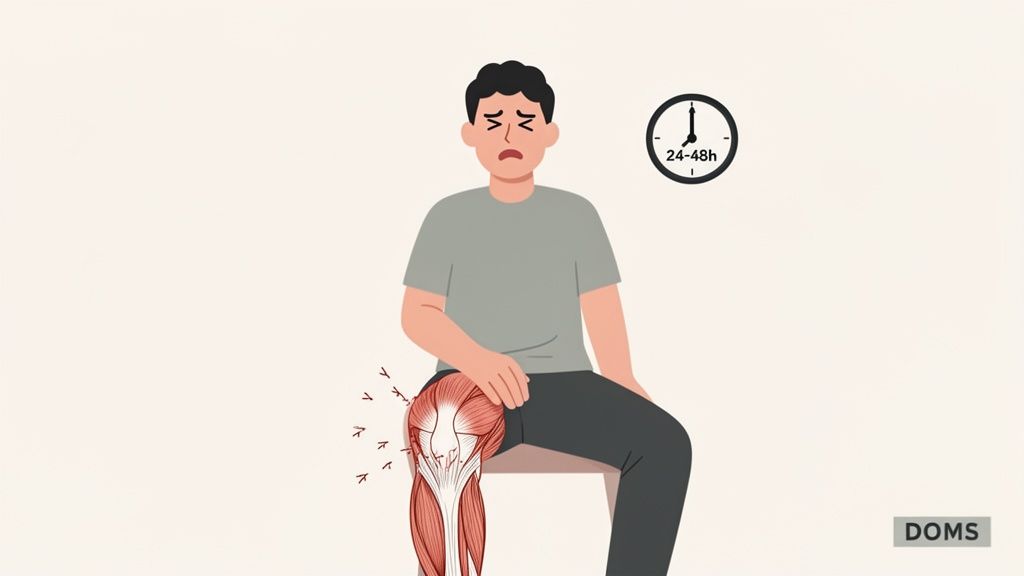
Let's bust a myth right now. For decades, gym-goers blamed lactic acid for this post-workout agony. That's old-school "bro science" that’s been thoroughly debunked. Your grandpa might still believe it, but we know better.
The real culprit? Microscopic tears in your muscle fibers.
When you challenge your muscles with new or intense exercise—like adding an extra plate to your squat or tackling a new deadlift PR—you're literally creating tiny bits of damage. This sounds bad, but it’s the entire point of training! It’s the signal your body needs to kickstart the repair process, which is how you build bigger, stronger muscles.
This damage triggers a natural inflammatory response. Your body sends in its cellular "construction crew" to clean up and rebuild, leading to the swelling, stiffness, and tenderness we all know a little too well.
The Big Idea: Soreness is your body's way of saying, "Okay, I see what you did there. I'm going to rebuild this area stronger so you can't do that to me again." It’s an awesome process, but it doesn't have to feel awful.
The pain doesn't show up immediately, which is why it's called delayed onset. It creeps up on you, typically peaking around 36-48 hours after your workout. In fact, studies simulating new exercise routines found this was the peak pain window for a whopping 45% of people. So no, you're not imagining it; that second day after leg day is legitimately the worst. You can read the science behind it here.
Here’s the game-changer: you don't have to just "suck it up." Letting soreness sideline you for three days isn't a badge of honor; it's a sign you're leaving gains on the table.
With a smarter, proactive approach, you can turn this painful rite of passage into a manageable—and even minor—part of your fitness journey. We're talking about a multi-pronged attack:
This is exactly where powerhouse supplements, like the creatine blends from Crazy Muscle, come into the picture. By arming your body with the fuel it needs before the damage gets out of hand, you can dramatically cut down on post-workout soreness and get back to what you love—crushing your next session.
It’s time to stop wincing and start winning the war on soreness.
To get you started, here's a quick-glance table of the low-hanging fruit. These are the immediate actions you can take to get ahead of the pain game.
| Strategy | Why It Works | Crazy Muscle Pairing |
|---|---|---|
| Dynamic Warm-Up | Increases blood flow and core temp, prepping muscles for stress. Think of it as waking them up gently. | Take Creatine Monohydrate 30-60 minutes pre-workout to saturate your muscles with energy. |
| Static Cool-Down | Helps muscles transition from work to rest, promoting flexibility and clearing metabolic byproducts. | Have a post-workout shake with Three-Atine and a scoop of protein to kickstart recovery immediately. |
| Hydration | Dehydrated muscles are tight, cramp-prone, and recover poorly. Water is essential for nutrient transport. | Sip on water mixed with our BCAA/Glutamine blend during and after your workout to fight muscle breakdown. |
| Active Recovery | Gentle movement (walking, light cycling) on rest days boosts circulation, delivering fresh blood and nutrients to sore muscles. | Fuel your active recovery days with a smaller dose of Creatine Monohydrate to keep levels topped off. |
Think of this table as your emergency plan. Nail these basics, and you're already halfway to taming the beast that is DOMS. Now, let's dive deeper into the full battle plan.

The final rep crashes to the floor. The workout's done. But the real fight—the one to reduce post workout soreness—is just getting started. What you do in the next 60 minutes is what separates the pros from the people who wake up feeling like they were used as a human speed bump.
Don't be that person who just collapses in a heap and calls it a day. Your muscles are screaming for help. It’s time to build a bulletproof ritual that answers the call.
I see it all the time: someone drops their last dumbbell and makes a beeline for the locker room. Rookie mistake. Your body needs to transition out of kill-mode. Think of a cool-down as gently landing a plane, not just cutting the engines mid-flight and hoping for the best.
A proper cool-down lets your heart rate and breathing return to normal gradually, which helps prevent that dizzy feeling you get when blood pools in your limbs. Just 5-10 minutes of light activity is all it takes to make a huge difference.
This simple step starts flushing out all the metabolic junk your muscles just created, giving you a head start on recovery before you even leave the gym floor.
Don't skip the cool-down. It's your first and easiest line of defense in the war against soreness. It's the signal that tells your body the emergency is over and the repair work can begin.
Once you’ve brought your heart rate down, it’s time for some stretching. We’re not aiming to join Cirque du Soleil here. The goal is simply to release the tension you just spent an hour building up.
While your muscles are still warm and pliable, static stretching is your absolute best friend. This just means holding a stretch for 20-30 seconds without any bouncing. Make sure you hit the muscle groups you just annihilated.
This isn't about some massive flexibility gain in one session. It's about telling your muscles it’s time to relax and lengthen, which can seriously dial down that next-day stiffness.
Alright, now for the real game-changer. Your muscles are like depleted sponges, desperate to soak up nutrients and start repairing themselves. The obvious move is a fast-digesting protein and carb source.
But if you really want to supercharge that recovery shake, there's one ingredient that towers above the rest: creatine.
This is where you weaponize your recovery. Taking a high-quality creatine supplement right after your workout is a masterstroke. Why? Because that intense session just torched your muscle's primary energy source, ATP. Creatine's entire job is to slam those stores back to full.
By throwing a serving of Crazy Muscle's Three-Atine into your post-workout shake, you’re not just refueling; you’re reloading. You're giving your muscles the raw energy they need to kickstart repairs on the spot, cutting down the muscle damage that leads to that infamous next-day agony. For an even deeper dive, check out our guide on the best time to take creatine for optimal results.
Think of it this way: your shake is the construction crew, and creatine is the high-octane fuel for all their power tools. Without it, the work gets done slowly and painfully. With it, you're on the fast track to rebuilding bigger and stronger—and spending less time wincing, more time winning.
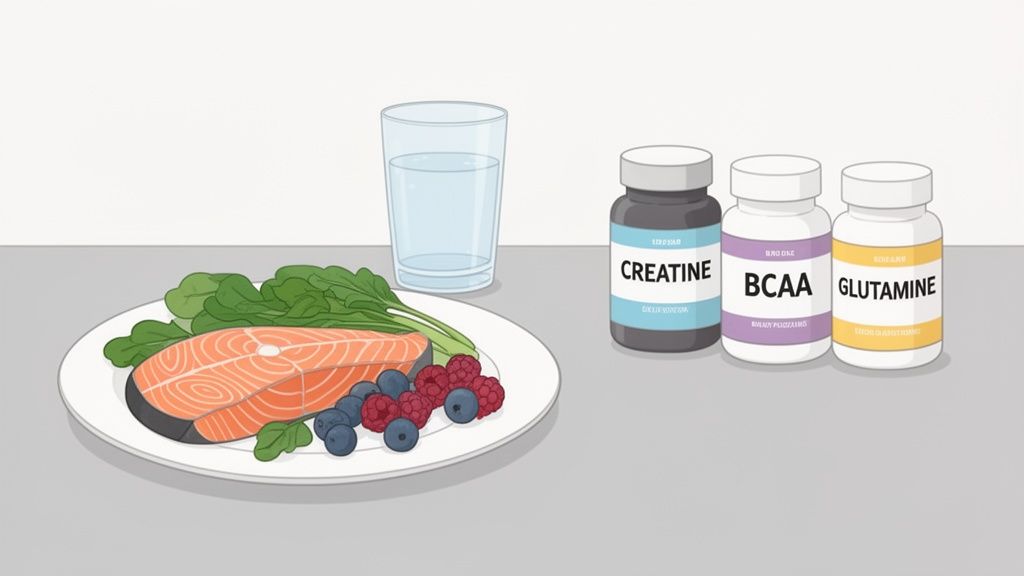
The battle to reduce post workout soreness isn’t won in the hour after your last rep—that’s just the opening bell. The real war is fought over the next 24 to 72 hours, and your kitchen is your command center.
What you put on your plate (and in your shaker cup) during this critical window is what separates a quick bounce-back from days of waddling around like a penguin.
Sure, you’ve probably got the "eat more protein" memo down, and that's a great start. But building a truly unstoppable recovery engine requires more than just bricks. You also need the mortar, the tools, and a skilled crew to get the job done right.
Let's get one thing straight, because this old-school gym myth needs to die. The searing pain you feel days after a brutal leg day is not caused by lactic acid. That’s science fiction born from some weird frog-leg experiments back in the early 1900s.
Modern science shows that lactate is actually a crucial fuel source for your muscles during intense workouts, not some evil villain leaving you sore. The real culprit behind DOMS is the one-two punch of microscopic muscle damage and the inflammatory response that follows.
So, if inflammation is the enemy, your diet needs to be the hero. This means loading up on foods that fight the good fight on your behalf.
Your plate should look like a battlefield where nutrients are overwhelming inflammatory agents. Every meal is a chance to send in reinforcements.
And don't forget the most basic tool in your arsenal: water. Dehydration is a massive enemy of recovery. Your muscles are about 75% water, and when you're running low, everything grinds to a halt. Nutrient transport slows, waste products hang around, and your muscles feel tighter and more painful. Gulping down water all day is one of the easiest wins you can get.
While whole foods are your foundation, targeted supplementation is the cheat code. It's about giving your body a concentrated dose of exactly what it needs, right when it needs it. This is where a smart recovery stack becomes your secret weapon.
First and foremost is your daily creatine. I’m not just talking about chugging it around your workout. To truly keep soreness on the ropes, you need to keep your muscle creatine stores fully saturated, 24/7.
Consistent daily use of a high-quality creatine like Crazy Muscle's Three-Atine ensures your muscles are always primed for repair. Think of it as keeping the fuel tank full at all times, not just topping it off before a road trip. Some studies have even found that consistent creatine users can experience up to 40% lower soreness ratings during peak DOMS. That's a huge difference.
But why stop there? For the ultimate recovery protocol, you bring in the specialized troops.
For those who really want to geek out on the science, you can learn more about the specific roles of amino acids for muscle recovery in our in-depth guide.
Combining daily creatine with strategically timed BCAAs and Glutamine creates a powerful synergy. You're not just rebuilding muscle; you're actively fighting inflammation and supporting your whole system from the inside out. This is how you stop being a victim of your workouts and start recovering like a pro.
So, you’ve got your post-workout nutrition dialed in, but you still feel like a truck hit you after a tough session. You're right to think there's more you can do. The gap between good recovery and elite recovery is filled with the little details—the stuff pros live by to get back in the fight faster.
Let's be honest. Collapsing on the couch for a three-day Netflix binge might feel like recovery, but it’s probably the worst thing for your sore muscles. They're screaming for blood flow, not a prison sentence on the sofa.
This is where the magic of active recovery comes into play. It’s a simple but brilliant idea: light, gentle movement is way better than doing nothing on your rest days. Picture your sore muscles as a traffic jam of inflammation and metabolic junk. Sitting still just lets that traffic get worse.
Active recovery is like opening a new express lane on the highway. It boosts circulation, pumping fresh oxygen and nutrients to those aching muscles while helping to flush out all the gunk that’s making you so stiff.
The golden rule is to keep the intensity way down. You should be able to hold a conversation without gasping for air. This isn't another workout; it's a strategic play to speed up the whole healing game.
You can eat perfectly and take all the best supplements in the world, but if your sleep is garbage, you're fighting a losing battle. Period. Sleep is, without a doubt, the most powerful—and totally free—recovery tool you have.
While you're off in dreamland, your body is working overtime. It's repairing muscle tissue, getting your hormones back in check, and locking in what you learned in the gym. This is prime time for your body to release Human Growth Hormone (HGH), the undisputed MVP of muscle repair and growth.
Skimping on sleep is like hiring a world-class construction crew to rebuild your muscles but only letting them work a two-hour shift. It just doesn't work.
Aim for a solid 7-9 hours of quality sleep every single night. To make that a reality, you need to get serious about your sleep hygiene:
Ever look at your gym buddy who crushes a brutal leg day and then strolls in the next day like nothing happened, while you're hobbling around like you're 90? You can thank genetics for that. Your DNA plays a huge role in how badly DOMS hits you. In fact, some studies suggest that genetics can account for up to 50% of the difference in soreness people feel.
This is exactly where smart supplementation stops being a luxury and becomes a total game-changer. For those of us who didn't win the genetic lottery for recovery, this is how we level the playing field.
Creatine, in particular, is an absolute monster for this. By keeping your muscles fully stocked with phosphocreatine, it helps reduce that initial damage and keeps the inflammatory response from going haywire. Study after study shows that consistent creatine use can slash the severity of DOMS by a massive 25-50%.
When you combine these advanced tactics—active recovery, killer sleep, and strategic supplementation—you're no longer leaving your recovery up to chance. For those pushing the boundaries of performance, exploring things like peptides for healing and recovery can add another sophisticated layer to your strategy.
Ready to build your ultimate recovery stack? Dive into our full guide on the best supplements for muscle recovery to see how you can combine the right tools for even better results. This is how you start recovering like a pro, no matter what your DNA says.
All the science and strategies in the world don't mean a thing without a solid plan. Theory is great, but a simple, actionable game plan is what actually gets you results. This is where we put all the pieces together—no more guesswork, just a clear roadmap to not just survive your workouts, but to absolutely thrive.
Forget waking up and wondering, "What should I do for recovery today?" We're going to build a system that works on autopilot. That way, you can focus on what really matters: getting stronger, faster, and better, day in and day out.
This isn't about adding a dozen complicated new habits to your life. It’s about weaving a few powerful, high-impact actions into your existing routine. A little structure goes a long, long way in the fight to reduce post-workout soreness.
Let's get practical. A good plan covers all your bases: your training, your active recovery, your rest, and—most importantly—your supplement timing. Nailing your supplement schedule is crucial because it ensures your body has the right tools for the job exactly when it needs them.
Here's a look at what a killer anti-soreness week could look like. Think of this as your template; feel free to tweak it based on your own training split and schedule.
This timeline breaks down the core pillars of pro-level recovery: smart movement, solid sleep, and targeted supplementation.
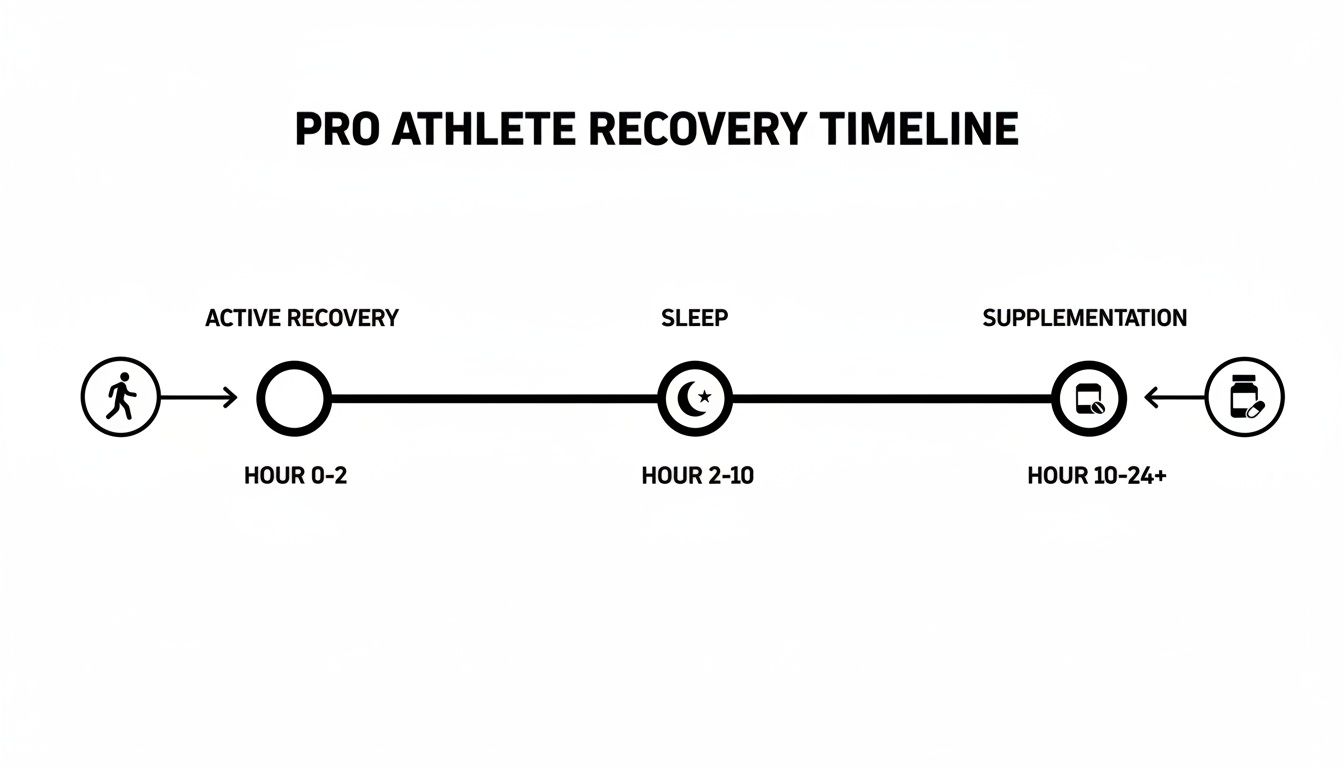
The key is realizing these aren't isolated events. They're part of a continuous cycle that supports your body 24/7.
Pro Tip: Consistency is king. The real magic happens when these actions become automatic. Set reminders on your phone for your supplements and active recovery sessions until they become second nature. You won't regret it.
This schedule isn't just about minimizing pain; it's about maximizing progress. When you recover faster, you can train harder and more frequently, which is the express lane to hitting your goals.
Okay, let's put this into a simple, day-by-day format you can follow. This table shows you exactly how to integrate your workouts with smart recovery and Crazy Muscle supplement timing.
| Day | Activity | Recovery & Supplement Action |
|---|---|---|
| Monday | Leg Day (High Intensity) | Pre-Workout: Take Three-Atine 30 mins before. Post-Workout: Protein shake immediately after with BCAA Tablets to kickstart repair. |
| Tuesday | Active Recovery | Activity: 30-min brisk walk or light cycling. Supplements: Take your daily maintenance dose of Glutamine to support immune health. |
| Wednesday | Upper Body (Push Day) | Pre-Workout: Take Three-Atine 30 mins before. Post-Workout: Protein shake with another serving of BCAA Tablets. |
| Thursday | Active Recovery | Activity: 20-min foam rolling session followed by light stretching. Supplements: Daily dose of Glutamine. |
| Friday | Upper Body (Pull Day) | Pre-Workout: Take Three-Atine 30 mins before. Post-Workout: Protein shake and BCAA Tablets to protect muscle tissue. |
| Saturday | Full Body Conditioning | Pre-Workout: Take Three-Atine 30 mins before. Post-Workout: The usual shake and BCAA combo. Focus on hydration all day. |
| Sunday | Full Rest Day | Activity: Enjoy your day off! Supplements: Take a maintenance dose of Glutamine. |
Following a structured approach like this transforms recovery from an afterthought into a core part of your training strategy. You’re no longer just reacting to soreness; you're actively preventing it from derailing your progress.
You're putting in the hard work in the gym. It's time to get the rewards without that painful price tag. By following a smart weekly plan and fueling your body with the right tools, you can finally get ahead of the soreness curve.
Ready to build your ultimate anti-soreness stack and put this plan into action? You can find everything you need, from our powerhouse Three-Atine to our muscle-saving BCAAs and Glutamine, right on our Crazy Muscle Amazon store. It’s time to stop letting soreness dictate your training schedule and start recovering like the beast you are.
Let's clear the air. When it comes to how to reduce post workout soreness, there's a mountain of conflicting advice out there. So, let's tackle the biggest questions head-on with some no-fluff, straight-up answers. This way, you can feel confident you’re not just spinning your wheels.
Ah, the golden question! The honest answer? It depends.
If you’re just feeling a bit stiff and mildly sore, some light activity is a fantastic idea. Hitting a completely different muscle group or just going for a walk can actually speed up recovery by boosting blood flow. Think of it as gently nudging your body along.
But if you’re in serious pain—the kind where your range of motion is shot and putting on a t-shirt feels like a new Olympic sport—your body is screaming for a break. Pushing through that level of DOMS is a fast track to injury. A consistent supplement strategy really shines here; it helps dial down that crippling soreness, giving you more "green light" training days.
You'll feel creatine’s performance perks—like cranking out extra reps—within a week or two once your muscles are fully saturated. But the real magic for soreness happens with consistency.
The goal is to keep your muscle's creatine stores topped off. This way, they're always ready to fight inflammation and kickstart repairs right after a tough session.
Think of it like this: You don't wait until your car is sputtering on fumes to find a gas station. Consistent creatine use keeps your recovery tank full, so you’re always prepared for whatever you throw at it.
Grab our Three-Atine creatine blend to make staying consistent a no-brainer.
The age-old debate! Truthfully, there’s a time and place for both.
An ice bath is great for calming that initial wave of inflammation right after a brutal workout. On the other hand, heat—like a warm bath or a heating pad—works wonders 24-48 hours later. It's perfect for increasing blood flow and loosening up those ridiculously tight muscles.
They’re useful tools, for sure. But for systemic, around-the-clock recovery that works from the inside out, nothing beats a solid nutrition and supplement plan.
A whole-food diet is the absolute bedrock of health, no question. But getting therapeutic doses of key recovery nutrients from food alone? That’s next to impossible.
For example, you’d have to chow down on several pounds of red meat every single day to get the amount of creatine found in one convenient scoop of a supplement.
And sometimes, soreness isn't just in your muscles. If you're dealing with a stiff neck or aching shoulders, even the perfect diet won't fix a bad pillow. Finding the best pillow for neck and shoulder pain is a perfect example of how other factors play a massive role in how you feel and recover.
Crazy Muscle supplements are designed to deliver these key compounds in a concentrated, effective form. It’s the most reliable way to give your body exactly what it needs to repair, rebuild, and come back stronger than ever.
Ready to stop guessing and start recovering like a pro? The Crazy Muscle team has put together the ultimate lineup of science-backed supplements to help you crush soreness and get back to doing what you love. Check out our full collection on our Amazon store and build your personal anti-soreness stack today.

Sign up and save 10% off your next order