
Strength Training Over 60: Safe Workouts to Build Muscle
Posted by Maximus
on

Let's get one thing straight: strength training over 60 is the single most powerful thing you can do to grab life by the horns, build a body that won't let you down, and live completely on your own terms.
This isn't about looking like some jacked-up bodybuilder. This is about raw, functional strength. The kind of strength that lets you haul your own luggage on a dream trip to Italy, hoist your grandkids into the air without a single grunt, and handle any curveball life dares to throw your way. Spoiler alert: your strongest, most badass years could be right around the corner.
It's time to smash a tired old myth into a million little pieces: the idea that getting older automatically means getting weaker is absolute garbage. That's a choice, my friend, not a life sentence. Picking up weights is you planting a flag and declaring, "Nope, not me. I'm choosing to get stronger, more mobile, and more capable every single year."
And this isn't just some rah-rah motivational fluff, either—it's backed by rock-solid science. Forget those little pink dumbbells and gentle stretching. We're talking about real, effective resistance training that sends a powerful signal to your body: it's time to rebuild, reinforce, and get tough.
The magic of lifting weights goes so much deeper than just building muscle. Think of it as a complete system overhaul for your entire body, a factory reset for feeling awesome.
When you start a proper strength training program after 60, you kick off a chain reaction of incredible benefits:
The greatest discovery is realizing that your body has an amazing capacity to adapt and grow stronger, regardless of your age. You just need to give it the right stimulus.
Still a bit skeptical? Let's talk about the incredible studies that took frail nursing home residents—with an average age of 87—and had them lifting heavy weights. The results were staggering. They saw massive gains in strength.
In fact, sweeping reviews of multiple studies confirm this, showing mind-blowing improvements of up to 8.5% in maximal force per session. That’s hard proof that your birth certificate doesn't dictate your potential. You can discover the full research findings on strength gains in older adults and see what's possible.
The core principles of getting stronger are the same whether you're 25 or 75. You might even find that our guide on muscle building after 40 offers some fantastic foundational insights. This isn't about hitting the brakes; it's about hitting the gas for all the adventures yet to come.
Alright, let's ditch the theory and build a real-world plan to get you stronger. Starting a new fitness routine can feel like trying to assemble a piece of IKEA furniture with half the instructions missing. It doesn’t have to be that complicated. We’re going to lay out a simple, step-by-step blueprint.
First things first: have a quick chat with your doctor. I know, I know, it sounds like a chore, but this is your pre-flight check. A quick visit ensures you’re cleared for takeoff and helps you navigate any personal health quirks, like managing blood pressure or working around a grumpy arthritic knee.
Once you have the green light, it’s time to decide where this is all going to happen. You’ve got options, and trust me, the "best" one is simply the one you'll actually stick with.
Your environment can make or break your motivation. You want a space that feels energizing, not intimidating.
Whether you choose to work out at home or join a gym, the core principles of building strength are exactly the same. It's a simple, powerful cycle that leads to some pretty incredible results.
As you can see, the simple act of lifting weights directly fuels a stronger body, which in turn powers a more active and vibrant life. It all works together.
To build a solid foundation, we'll start with full-body workouts. This approach hits all the major muscle groups and gives you plenty of recovery time, which is crucial in the beginning. Here's what your first month could look like:
| Day | Focus | Example Exercises | Rest/Recovery |
|---|---|---|---|
| Monday | Full Body Workout | Goblet Squats, Dumbbell Bench Press, Seated Rows | Active recovery: light walk |
| Tuesday | Rest | Light stretching or a walk | Full rest day |
| Wednesday | Full Body Workout | Romanian Deadlifts, Overhead Press, Lat Pulldowns | Active recovery: gardening, stretching |
| Thursday | Rest | Full rest or a leisurely activity | Full rest day |
| Friday | Full Body Workout | Lunges, Push-ups (on knees or wall), Bird-Dog | Active recovery: go for a swim |
| Saturday | Rest | Active recovery or complete rest | Full rest day |
| Sunday | Rest | Enjoy a well-deserved day off | Full rest day |
This schedule is a fantastic starting point. The goal isn't to crush yourself, but to show up consistently and let your body adapt. Listen to your body and don't be afraid to take an extra rest day if you need it.
To make real, lasting gains, you just need to grasp three key concepts. Forget all the confusing fitness jargon; this is all you need to know about effective strength training over 60.
1. Frequency: How Often You Train
When it comes to building strength, nothing beats consistency. The sweet spot for most people is two to three full-body workouts per week. This schedule gives your muscles the jolt they need to grow while leaving plenty of time for recovery. Remember, the magic happens between workouts, not during them.
2. Intensity: How Challenging It Is
Intensity is the secret sauce. You have to challenge your muscles to give them a reason to change. A great rule of thumb is to pick a weight where the last two reps of a set feel tough, but you can still complete them with good form. If you’re breezing through 12 reps like it’s nothing, it’s time to nudge the weight up a bit.
You're aiming for that "productive struggle." The goal isn't total exhaustion. It’s about feeling like your muscles genuinely worked, sending that all-important signal to your body: "Time to build back stronger!"
3. Progression: How You Keep Getting Stronger
Your body is incredibly smart. It gets used to whatever you throw at it. To keep making progress, you have to keep giving it a reason to adapt. This concept is called progressive overload, and it's the cornerstone of all successful strength programs.
It doesn’t always mean lifting heavier. Progression can look like:
This slow-and-steady increase ensures you're always moving forward without jumping ahead too fast and risking injury. This is your map—designed to build your confidence and make this whole process feel empowering from day one.
Think of your body as a high-performance engine. Your workouts are you flooring it—powerful, exciting, and getting you where you want to go. But what happens if you try to run that engine on cheap, watered-down fuel? It sputters, stalls, and eventually breaks down. That’s exactly what happens to your muscles without the right nutrition after a tough strength session.
You simply can't build a strong, resilient body with flimsy materials. The effort you put in under the weights is only half the battle. The other half—the part that actually builds the muscle and makes you stronger for next time—happens in the kitchen and with a little help from smart supplementation. This is where your hard work turns into real results.
As we age, our bodies get a little less efficient at using protein to build muscle. It's a phenomenon known as "anabolic resistance," which is just a fancy way of saying we need to turn up the volume to hear the music. To get the same muscle-building response you had in your 30s, you need to give your body more high-quality protein now.
For anyone serious about strength training over 60, protein isn't a suggestion—it's a non-negotiable. It provides the amino acids, the literal building blocks, your body desperately needs to repair the micro-tears in your muscles and weave them back together stronger than before. Skimping on protein is like sending a construction crew to a job site with no bricks.
So, what’s the magic number? Aiming for at least 25-30 grams of protein per meal is a fantastic target. This drip-feeds your body the materials it needs to stay in a muscle-building state all day long.
Here are a few dead-simple ways to hit that goal:
Making protein the star of every meal is one of the single most effective changes you can make to supercharge your strength gains.
If protein is the bricks, think of creatine as the spark plug that ignites the whole engine. It's one of the most researched, safest, and most effective supplements on the planet, especially for our age group.
Here’s how it works: Creatine supercharges your body's primary energy currency, a molecule called ATP. When you're pushing through a tough set of squats, your muscles burn through ATP at a blistering pace. Creatine jumps in and rapidly refills your ATP stores, letting you squeeze out that extra one or two reps you couldn't get before. And those extra reps? That's where the magic happens. That’s the signal that tells your body it's time to grow stronger.
But the benefits don't stop there. Creatine also helps pull water into your muscle cells, which supports protein synthesis and can kickstart the recovery process. That means less soreness and more enthusiasm for your next workout. To really get a handle on your post-workout plan, explore effective strategies to recover faster from workouts that work hand-in-hand with your nutrition.
Creatine isn't some weird chemical cooked up in a lab; it's a natural substance your body already makes. Supplementing just tops off the tank, ensuring your muscles have the high-octane fuel they need to perform at their absolute best.
For women, understanding how this powerhouse supplement works with your unique physiology is crucial. We’ve put together a guide that dives into the specifics—check out our article on creatine for women over 40 for more tailored info.
We get it. You don't want to mess around with gritty powders, complicated loading phases, or strict timing schedules. You just want something simple, pure, and effective that slots right into your daily routine. That's precisely why we created Threeatine.
Threeatine is our premium creatine formula, designed for people who value results without the hassle. We’ve combined three of the most effective forms of creatine into one simple, easy-to-swallow capsule. No mixing, no chalky taste, and no guesswork.
This powerful trifecta ensures your muscles are fully saturated, giving you the boost you need to smash through plateaus and recover like a champion. Just take the capsules with a glass of water, and you’re done. It's the perfect, no-fuss way to unlock the full potential of your strength training. Ready to feel the difference? Supercharge your results with Threeatine by checking it out on Amazon
Okay, theory is great, but it's time to put some iron in your hands and see how this all feels. I've put together a beginner-friendly, full-body routine that hits all the major muscle groups.
This isn’t just a random collection of exercises. These are the big, foundational movements that give you the most bang for your buck, translating directly into real-world strength. Think of it as building the chassis for a stronger, more resilient you.
We’re going for quality over quantity here. Every single repetition should be deliberate and controlled. The goal is to finish feeling strong and energized, not completely wiped out. This is your starting line, not the finish.
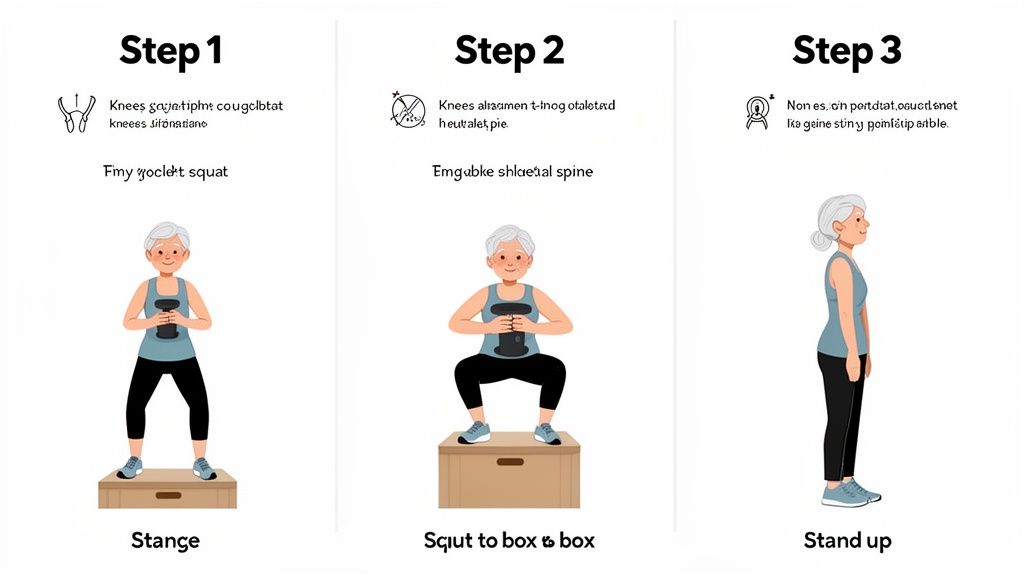
The squat is, without a doubt, the king of lower-body exercises. It’s the exact motion you use every single time you stand up from a chair or get out of the car. Using a sturdy box or chair behind you is a brilliant little hack for beginners—it acts as a safety net and helps you nail perfect form from the get-go.
How it’s done:
Shoot for 3 sets of 10-12 repetitions. Once that feels pretty comfortable, you can either pick up a slightly heavier dumbbell or, if you're feeling confident, remove the box and squat a little deeper.
Think of this as your secret weapon for a stronger back and better posture. It's the perfect antidote to the "forward slump" we can develop over time. This move pulls your shoulders back, opens up your chest, and builds the strength you need to stand tall and proud.
How it’s done:
Perform 3 sets of 12-15 repetitions. The real magic happens in that squeeze, so don't rush it.
The big secret to strength training isn't just lifting the weight. It's about reconnecting with your body—feeling which muscles are firing and controlling every single inch of the movement. This mind-muscle connection is what separates truly effective training from just going through the motions.
This is a true classic for a reason. It builds strength in your chest, shoulders, and triceps—all your primary "pushing" muscles. This is the kind of strength you use to push a heavy grocery cart, get yourself up off the floor, or lift a grandchild high into the air.
How it’s done:
Start light here. Aim for 3 sets of 10-12 repetitions. If you're new to this, don't hesitate to ask a spotter or a gym staff member for a hand getting into position the first few times.
Don't let the name scare you off! The RDL is a simple but incredibly powerful "hinge" movement. It's a lifesaver for strengthening your hamstrings, glutes, and lower back—the entire "posterior chain" that helps you pick things up off the floor without throwing your back out.
How it’s done:
Really focus on the feeling of your hamstrings stretching on the way down and contracting on the way up. Do 3 sets of 12-15 repetitions. This one is all about mastering the hinge, not lifting heavy.
As you get more comfortable, you might want to mix things up. We have a fantastic guide covering a wide range of bodyweight exercises that make a perfect addition to any lifting routine.
Let’s be honest. The real magic of strength training over 60 doesn’t happen in one perfect workout. It's not found in some miracle supplement, either. True, lasting strength is forged in the quiet, consistent habits you build day after day, week after week. This is how you turn a gym routine into a lifelong source of power and vitality.
This isn't just about showing up and lifting weights. It’s about mastering the art of recovery, staying nimble, and frankly, winning the mental game. So, let's pull back the curtain on the secrets that transform a good program into an unbreakable habit.
Jumping straight into a workout without warming up? That’s like trying to drive a car on a frosty morning without letting the engine run for a minute. It’s a recipe for something to go wrong. A proper warm-up does more than just get your blood flowing; it’s a crucial signal to your joints, muscles, and nervous system that it's time to work. This simple step dramatically cuts down your risk of injury.
You don't need anything complicated—a simple 5-10 minute routine is perfect:
And don't skip the cool-down. It’s your body's off-ramp, helping it transition from high alert back to a state of rest and repair. A few minutes of gentle, static stretching for the muscles you just trained can do wonders for your flexibility and help ease that next-day stiffness.
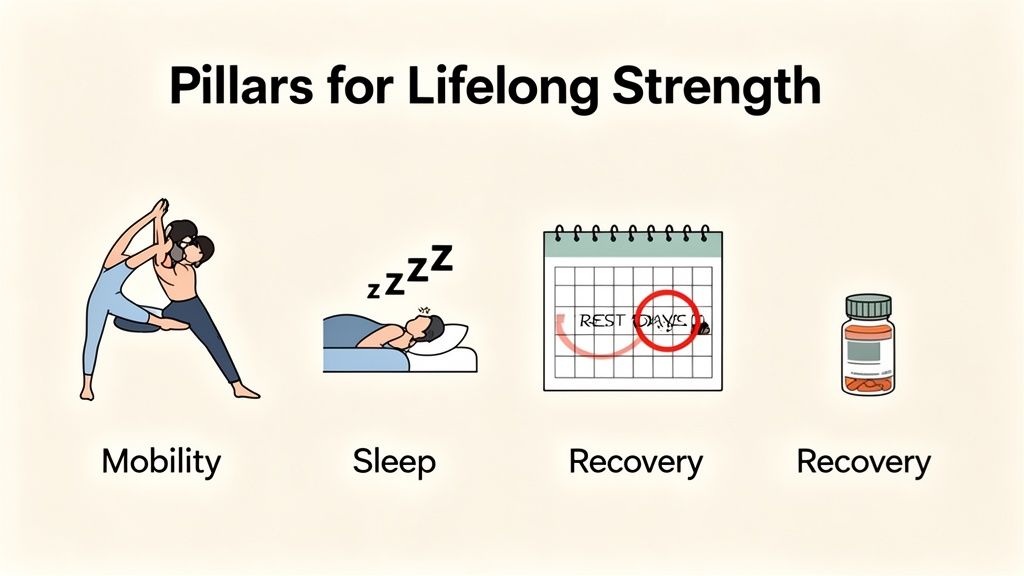
Here’s a fact many people miss: your muscles don't get stronger while you're lifting. They get stronger while you're resting. Ignoring recovery is the fastest way to hit a plateau or, worse, get sidelined. To stay in the game long-term, you have to treat your rest days with the same respect you give your training days.
This is when all the important rebuilding happens. Here are the absolute non-negotiables:
Don’t just track your workouts; track your recovery. How are you sleeping? How are your energy levels? Your body is giving you constant feedback—the real secret is learning to listen to it.
The biggest weight you'll ever have to lift is the six inches between your ears. Motivation is fickle; it comes and goes. A resilient mindset, on the other hand, is what keeps you showing up long after the initial excitement has faded.
Set realistic, bite-sized goals. Instead of fixating on some huge, far-off number, learn to celebrate the small wins along the way. Did you add five pounds to your squat? Did you finally nail your form on a tricky new exercise? Did you show up on a day you really didn't feel like it? Those are the victories that build unstoppable momentum.
The stakes here are incredibly high. Data from a massive U.S. National Health Interview Survey showed that seniors who strength train at least twice a week slash their risk of dying from any cause by a staggering 46%. That isn't just about living longer; it's about stacking the deck for a healthier, stronger, more capable life. Discover more about these incredible findings on longevity.
This journey is about celebrating what your body can do, right now, and building a sustainable practice that will serve you for decades. Ready to build a stronger you? Explore our full range of support products on Amazon.
Jumping into something new is bound to bring up a few questions, and that’s a great sign. It means you're being smart about your health and setting yourself up to win. Let's clear the air on some of the most common worries people have about strength training over 60 so you can get started with rock-solid confidence.
Think of this as a quick myth-busting session. We're here to swap out any nagging doubts with straight-up, reassuring facts.
You bet it is. Not only is it safe, it’s one of the best things you can do for your body, when you do it the right way. The old-fashioned idea that older adults should stick to tiny pink dumbbells is a myth that's done more harm than good. Study after study shows that lifting challenging weights is the fast track to building serious muscle and fortifying your bones.
The magic isn't in ego lifting; it's in progressive overload. You start with a weight you can handle with perfect form, and then you slowly, patiently, make it a little bit heavier over time. Just be sure to get the all-clear from your doctor first. Pro-tip: investing in a few sessions with a qualified trainer is money well spent to make sure your form is locked in from day one.
You'll feel the difference long before you see it in the mirror. Most people report a real jump in energy, better balance, and just a general feeling of strength within the first 2-4 weeks. Suddenly, you're not out of breath after a flight of stairs, or you're hauling that giant bag of dog food out of the car like it's nothing.
As for visible muscle tone and definition? That usually starts to show up after about 6-8 weeks of sticking with it, hitting your workouts at least two or three times a week. Consistency is everything here. And if you really want to kick things into high gear, pair your training with good nutrition and a proven supplement like our Threeatine.
You can get incredibly strong without ever stepping foot in a gym. Honestly, the best workout plan on the planet is the one you’ll actually do. A gym has a ton of fancy equipment, sure, but you can build an amazing routine at home with some adjustable dumbbells, a few resistance bands, and a good, solid chair.
Don't let a gym membership (or lack thereof) be your excuse. The most important equipment you'll ever own is your own body and a can-do attitude.
The sample workout we laid out earlier can easily be done from your living room. The goal isn't to have a perfect, Instagram-worthy home gym—it's just to get moving. Start where you are, with what you have.
Not only is it an option, but it's also one of the best things you can do for your joints! Doctors and physical therapists often recommend it. When you build the muscles around a joint, they act like a natural brace, taking a huge amount of pressure and strain off the joint itself. For many, this leads to a surprising reduction in arthritis pain.
The trick is to listen to your body and work smart. This might mean swapping a barbell for dumbbells to be kinder to your shoulders, or not going quite as deep on a squat. You should never, ever push through sharp, shooting pain. A lot of folks find that a well-designed strength routine becomes their secret weapon for managing their arthritis symptoms and living with less pain.
Here at Crazy Muscle, we know for a fact that strength has no age limit. You have the power to forge a tougher, more resilient body for whatever adventures life throws your way, and our supplements are built to back you up every step of the journey.
Ready to give your muscles the fuel they crave? Explore our full range of top-rated supplements on Amazon and feel the difference high-quality support makes.

Sign up and save 10% off your next order