
What Is the Best Creatine for Real Muscle Growth
Posted by Maximus
on

Alright, let's cut through the gym-bro science and marketing fluff. You want to know what the best creatine is for building actual, head-turning muscle. The answer couldn't be clearer. For jacking up your strength, packing on size, and getting results you can actually flex in the mirror, Creatine Monohydrate is the undisputed, heavyweight champion of the world.
It's the most studied, most trusted, and flat-out most effective form on the market. Period. End of story.
Walking into the supplement aisle can feel like navigating a minefield of flashy labels and ridiculous promises. You’ll see stuff like creatine HCL, ethyl ester, buffered creatine, and a dozen other formulas screaming that they’re the "next big thing."
But here’s the unvarnished truth: none of them have the mountain of hard evidence backing them up like good old creatine monohydrate.
Think of it like this: creatine monohydrate is a classic, perfectly tuned V8 engine. It’s been battle-tested for decades, it’s ridiculously powerful, and its performance is legendary. The other forms? They’re often just unproven prototypes with a flashy paint job, a higher price tag, and not much under the hood to justify it.
So, what makes monohydrate the reigning champ? It's simple. It just works.
This isn't some myth passed around the locker room; it's a cold, hard fact cemented by literally hundreds of scientific studies. It consistently delivers on its promises, helping you lift heavier, squeeze out more reps, and pack on lean muscle faster than you could without it.
Whether you're a seasoned bodybuilder or just starting your fitness journey, sticking with the proven winner is the smartest play you can make. It's not just the most effective—it’s also the most affordable. You get more power for your buck and more muscle for your efforts.
Choosing creatine monohydrate means you're investing in a supplement with an unmatched track record. You get all the power and none of the marketing fluff, ensuring your hard work in the gym pays off with real, measurable gains.
The scientific community is united on this one. Study after study confirms its power to supercharge muscle growth and athletic performance when you're hitting the weights.
In fact, a massive 2022 review drove the point home, finding that creatine supplementation leads to significant increases in muscle strength and size compared to a placebo. It's not uncommon for users to pack on an extra 2-4 pounds of muscle mass in just 4-12 weeks of training with it. Want to see for yourself? Check out the full research on creatine’s effectiveness.
This is why we're so confident in recommending it. It's not hype; it's science.
Ready to stop guessing and start growing? Grab your supply of our ultra-pure creatine and start building serious muscle.
Ever wondered how that simple white powder actually helps you hoist more weight and shatter your old PRs? It’s not some kind of gym voodoo; it’s pure, beautiful science. Let's lift the hood and see what's really going on inside your muscles when you supplement with creatine.
Think of every muscle cell in your body as having its own tiny, rechargeable battery. This battery is called adenosine triphosphate, or ATP for short. It's the high-energy juice that fuels every single explosive contraction—every squat, every press, every pull. The catch? Your body burns through this precious fuel fast, especially during those all-out, heavy-lifting sessions.
This is where creatine enters the scene, acting as the ultimate backup generator for your muscles. Your body takes the creatine you consume and stores it in your muscles as phosphocreatine, which is basically a ready-to-go power pack for your drained ATP batteries.
When you're grinding through a brutal set of squats, your ATP levels plummet, and that's when you feel your strength give out. Your muscles are screaming for a break. But when your muscles are fully stocked with creatine, the game changes.
That stored phosphocreatine steps in and instantly donates a molecule to recharge your spent ATP. It's like having a lightning-fast pit crew for your muscles, getting you back to full power in the blink of an eye.
Suddenly, that set where you used to fail at eight reps? You can now push through for ten, or even twelve. Those last few, muscle-searing reps are where the real growth happens.
This ability to squeeze out more work, set after set, is the secret behind creatine's strength-building magic. You’re able to consistently challenge your muscles with more volume and intensity, forcing them to adapt by getting bigger and stronger. To make the most of this, understanding the optimal training frequency for hypertrophy is key to turning that extra work into real gains.
But wait, there's more! Creatine’s job isn't done once it recharges your energy. It also creates a prime environment for muscle growth through a cool process called cell volumization.
In simple terms, creatine is "osmotically active," a fancy way of saying it draws water directly into your muscle cells. This isn't the soft, puffy water retention you might get under your skin. This is targeted hydration inside the muscle, making your muscles look and feel fuller, harder, and more pumped.
This "super-hydration" isn't just for looks, either. It sends a powerful signal to your body to get growing.
This cellular swelling is one of the key reasons creatine supports long-term muscle growth. You're not just getting a temporary pump; you're creating the perfect biological environment for building serious, lasting muscle.
For an even deeper dive, check out our guide on how creatine works to boost your strength. The bottom line is simple: creatine gives you both the raw energy for more reps and the ideal cellular setup to turn those reps into rock-solid gains.
Walk down any supplement aisle, and you’ll be blinded by a dizzying array of creatine tubs. You've got Creatine HCL, Ethyl Ester, Buffered, and even Liquid formulas, each one practically screaming from the shelf that it’s the next evolution in muscle-building tech.
They throw around flashy promises like "superior absorption," "no bloating," and "faster results." It all sounds pretty convincing, right?
But here's the multi-million dollar question: do any of these fancy, high-priced newcomers actually live up to the hype? Or are they just clever marketing wrapped around a less effective—and more expensive—product?
It's time to put them in a head-to-head battle with the reigning, undisputed champion of the world: Creatine Monohydrate.
Let's cut right to the chase. When you look at the hard, scientific proof, this fight is laughably one-sided.
Creatine Monohydrate is backed by a mountain of over 1,000 studies conducted over decades. It's one of the most thoroughly vetted supplements in history, with its effectiveness and safety proven time and time again.
The flashy newcomers? Not so much. Most of their claims are built on theory or small, company-funded studies that just don't hold a candle to the massive body of evidence supporting good old monohydrate.
Spoiler alert: When you dismantle the marketing, you find that none of these expensive alternatives have been proven to be more effective than classic monohydrate. In fact, some have been proven to be less effective.
Let's break down the common claims you'll see and see how they stack up against the cold, hard facts.
This simple chart shows exactly how creatine supplementation fuels real-world benefits by powering your muscles for more work.
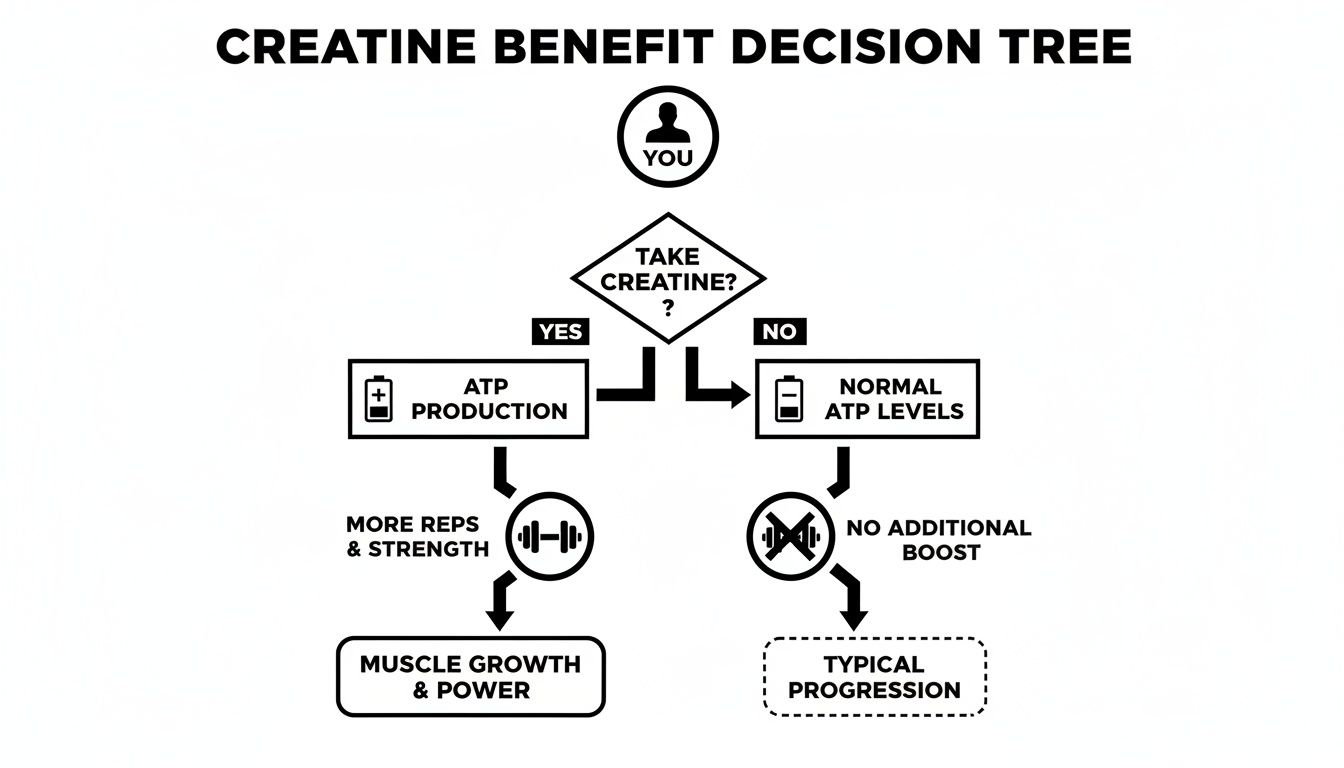
As you can see, starting with supplementation directly powers your ATP (your muscles' energy batteries), which allows you to bang out more reps and ultimately achieve greater muscle growth. Simple and effective.
To make it even clearer, let's put these forms side-by-side. You'll quickly see a pattern emerge.
| Creatine Form | Proven By Research? | Cost-Effectiveness | The Verdict |
|---|---|---|---|
| Monohydrate | YES (Over 1,000 studies) | Excellent | The gold standard. Proven, safe, and affordable. |
| HCL | No | Poor | More expensive with no evidence of being more effective. |
| Ethyl Ester | No | Very Poor | Scientifically proven to be less effective. A waste of money. |
| Buffered | No | Poor | Solves a non-existent problem while costing more. |
| Liquid | No | Very Poor | Often unstable and less effective than powder forms. |
The evidence is overwhelming. The new kids on the block just can't compete with the champ on performance, science, or price.
So, are all variations useless? Not quite. There is one meaningful improvement you should actually look for on a label: micronized.
Micronized creatine monohydrate is simply the same proven ingredient ground into much smaller particles. This doesn't change its effectiveness one bit, but it dramatically improves how well it dissolves in liquid.
It mixes easier, gets rid of that gritty texture, and can be gentler on the stomach for some people. Think of it as the only upgrade that actually improves the user experience without trying to reinvent a wheel that already works perfectly. If you're comparing forms, you can learn more about the differences between Creatine HCL vs Monohydrate in our detailed guide.
At the end of the day, the answer to "what is the best creatine?" remains unchanged. The classic, most-studied, and most affordable option is still the undefeated champ. Don't let clever marketing and fancy names trick you into paying more for less.
While we're on the topic, it's always good to understand the broader supplement world, like exploring some interesting alternatives to whey protein powder. But when it comes to creatine, the choice is clear.
Stick with what's proven. Stick with what works. Creatine monohydrate earned its title for a reason, and it's not giving up the throne anytime soon.
Alright, you’ve got the champion of supplements—creatine monohydrate. Now, let's talk about how to use it like a pro. Forget all the complicated rituals and confusing bro-science you've heard. Using creatine is ridiculously simple, but a little bit of strategy can turn good results into game-changing gains.
This is your step-by-step guide to squeezing every last drop of potential out of your creatine. We’ll break down the two main ways to get started, bust a few persistent myths, and give you a rock-solid plan that takes all the guesswork out of the equation.
When you first start taking creatine, you’ve got two proven options. Neither is "wrong," but one definitely gets you to the finish line faster. Think of it as choosing between taking the express train or the scenic route to Gainsville.
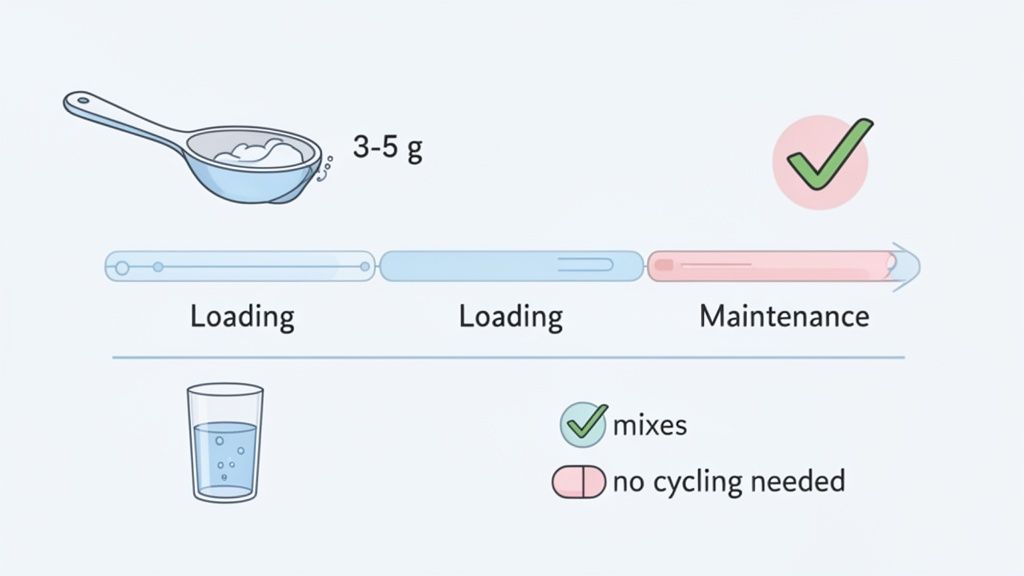
The Loading Phase (Express Train): If you're itching to see and feel results as fast as humanly possible, this is your ticket. For 5-7 days, you’ll take a total of 20 grams of creatine per day, typically split into four 5-gram servings. This strategy floods your muscles and gets them fully saturated in about a week. It’s a bit intense, but it's the quickest way to feel that extra power on your lifts.
The Maintenance Dose (Scenic Route): Prefer a simpler, steadier approach? This one's for you. Just take a single dose of 3-5 grams of creatine once a day, every day. It’ll take about three or four weeks for your muscles to reach full saturation, but you'll get to the exact same place in the end. This method is way easier for most people to stick with and is just as effective over the long haul.
The bottom line is simple: loading gets you there faster, while a steady maintenance dose is simpler. Just pick the path that best fits your lifestyle and patience level.
Once your muscles are saturated—either from loading or after a month of maintenance—the plan is beautifully simple. All you need is 3-5 grams per day to keep your muscle stores topped off. For the vast majority of people, 5 grams is the sweet spot.
So, when’s the best time to take it? While you can technically take it anytime, some science suggests there's a slight edge to taking it post-workout. Your muscles are like sponges after a tough session, primed and ready to soak up nutrients.
Mixing your creatine with some carbs (like in fruit juice) or a protein shake can help shuttle it into your muscles even more efficiently. But seriously, don't overthink this. The most important rule is consistency. Taking it every single day is far more critical than pinpointing the perfect minute to take it.
For a deeper dive into finding your ideal amount, our complete creatine dosage guide has you covered.
One of the most stubborn myths out there is that you need to "cycle" creatine—taking it for a few weeks, then stopping for a while. Let’s put this one to bed for good.
There is zero scientific evidence suggesting you need to cycle creatine.
Decades of research have confirmed that long-term, continuous use is perfectly safe and effective for healthy people. The only thing cycling off does is drop your muscle creatine levels back to baseline, which means you lose all the performance benefits until you start all over again.
So, keep it simple. Find your dose, take it every day, and focus on crushing your workouts. This game plan makes using creatine a breeze, whether you're scooping a powder or enjoying the insane convenience of our Threeatine capsules. Your muscles will thank you for it.
Creatine is easily one of the most powerful and heavily researched supplements out there. So why is it surrounded by so many ridiculous gym-bro myths and locker-room legends?
You’ve probably heard them all. The whispers that it’s a steroid, that it’ll shred your kidneys, or that it’s the secret reason your hairline is retreating. It’s time to drag these myths out into the sunlight and hit them with a dose of cold, hard science. Let's put these rumors to bed, once and for all.
Let’s get the biggest and most absurd myth out of the way first. Creatine is not, has never been, and will never be an anabolic steroid. The comparison isn't just wrong; it's laughable.
Anabolic steroids are synthetic drugs that hijack your hormones to force muscle growth, often bringing a whole train of nasty side effects along for the ride. Creatine, on the other hand, is a completely natural compound your body already makes to help fuel your muscles. You also get it from eating foods like steak and salmon.
Here’s a better way to think about it: taking creatine is like putting premium, high-octane fuel in your car's engine. Taking steroids is like illegally strapping a rocket to the roof. One simply helps the system you already have run better, while the other is a dangerous and unpredictable game-changer.
This is the scary one that just won't die, no matter how much research proves it wrong. The rumor probably got started because creatine creates a byproduct called creatinine, which your kidneys filter out. In medical tests, high creatinine levels can be a sign of kidney problems.
But here's the catch: when you supplement with creatine, your creatinine levels will naturally go up a bit simply because there's more creatine to process. This is a perfectly normal and harmless outcome, not a red flag for kidney failure.
For healthy individuals, the science is crystal clear: long-term creatine use does not harm your kidneys. It’s one of the safest supplements you can take.
In fact, the incredible safety profile of creatine monohydrate is one of its biggest selling points. It's backed by over 25 years of clinical trials that confirm it's safe for long-term use in healthy adults. Major sports bodies like the IOC and NCAA even give it the green light for their athletes. You can discover more about its incredible safety record from extensive research and see for yourself.
Alright, let's tackle this two-for-one myth combo. The whole hair loss panic traces back to a single, small study from 2009. It found that creatine increased levels of DHT, a hormone that can be linked to male pattern baldness. But here's the kicker: the study never actually measured any hair loss, and its findings have never been duplicated in the dozens of studies since. It's a classic case of one tiny piece of data getting blown way out of proportion.
The dehydration and cramping myth is even more bizarre because creatine literally does the opposite. It works by pulling water into your muscle cells. This super-hydrates your muscles, which actually improves your hydration status and can help prevent cramping. As long as you’re drinking a normal amount of water, creatine is your friend, not your enemy.
After taking a sledgehammer to these myths, it’s easy to see why so many athletes put their trust in creatine. It’s not some risky, mysterious substance—it’s a safe, legal, and ridiculously effective tool for anyone serious about getting stronger.
When you’re ready for a proven supplement you can trust, you can find the best creatine options right here on our Crazy Muscle Amazon store.
Alright, you've waded through the science and seen the evidence. You know creatine monohydrate is the real deal—the undisputed king for anyone serious about getting stronger and building muscle. Now for the million-dollar question: which one do you actually buy?
Look, we could give you a slick sales pitch, but that's not our style. In a market overflowing with flashy tubs and bogus claims, Crazy Muscle is all about one thing: results you can actually feel. It's the foundation of everything we do.
We keep things simple because simple works. Our creatine is just that—creatine. We're talking pure, high-quality monohydrate without any of the junk fillers, mystery additives, or unproven fluff that other brands sneak in. We stick to the gold standard that science has backed for decades. No frills, no nonsense.
We get it. You're not just buying a supplement; you're investing in your own hard work. That's why we make it easy to trust us, with a no-questions-asked satisfaction guarantee and lightning-fast, same-day shipping to get you started ASAP.
We’re not in the business of selling magic dust. We’re here to arm a community of lifters with supplements that are as committed to their training as they are.
Let’s be honest, life is chaotic. The last thing you need is another chore, and fumbling with messy powders and shakers can be a pain. That’s exactly why we made Threeatine, our creatine in super-convenient capsules. It’s the full, effective dose of pure creatine monohydrate, minus the hassle.
When you grab a bottle of Crazy Muscle, you're not just another order number. You're joining a tribe of over 150,000 athletes who rely on us to power their workouts. Our 92% five-star satisfaction rate isn’t just a metric; it's a reflection of the PRs being shattered and goals being crushed by our community every single day.
We’ve put in the work to create products that deliver. Now it's your turn to put them to the test.
Ready to see what a no-nonsense, high-quality creatine can do for you? Join the Crazy Muscle crew and get your Threeatine today.
Alright, let's clear the air. You've probably heard a thing or two about creatine on the gym floor or scrolling through your feed. Time to separate the myths from the muscle. Here are the straight-up answers to the questions we get asked all the time.
This is probably the biggest myth out there, so let's squash it right now. The answer is a hard no. Creatine works by pulling water inside your muscle cells, a process called cell volumization.
Think of it this way: it’s not the soft, under-the-skin water retention that makes you look puffy. It's water being put to work in the muscle, making it look fuller, harder, and more dense. This is the good stuff that supports performance, not the fluff you're worried about.
You've heard about loading, right? The whole "take 20 grams a day for a week" thing. Think of it as the express train to getting your muscles fully saturated with creatine. It works, and you’ll feel the strength kick in faster, usually within a week.
But is it 100% necessary? Nope. You can just as easily take the scenic route by sticking to a simple 3-5 gram dose every day. It'll take about three to four weeks to reach the same saturation point, but you'll get to the exact same destination. The choice is yours—it just depends on how patient you are.
Let’s be crystal clear: Absolutely! Creatine is an incredible supplement for women. It helps you get stronger, push harder in your workouts, and build lean, toned muscle. It will not magically make you bulky.
Getting "bulky" comes from a very specific training style combined with eating a massive amount of calories. Creatine simply fuels your muscles to perform better. For women, it’s a game-changer for building a powerful, athletic physique and can even support bone health.
So, you decide to take a break. What's the damage? Honestly, not much. Over the next three to four weeks, your creatine stores will gradually return to their normal, pre-supplement levels.
The muscle you built through all that hard work isn't going anywhere. Those gains are yours to keep! You might feel a slight drop in your top-end strength or that last rep might feel a bit heavier, but your physique won’t disappear. And you can always hop back on whenever you're ready to power up again.
You've got the facts, now it's time to get the results. Over 150,000 lifters trust Crazy Muscle for a reason—we make pure, powerful creatine that just works. No hype, no nonsense. See what you've been missing. Check out our top-rated creatine on Amazon and start building stronger today!

Sign up and save 10% off your next order