
The Ultimate 4-Day Split Workout for Maximum Muscle Growth
Posted by Maximus
on

Let's be real for a second. A 4-day split is your workout blueprint for hitting the gym four times a week. It’s the perfect formula for packing on serious muscle and strength without making the gym your second home.
Forget the fluff—this is about balancing beast-mode training days with the recovery time your body is screaming for.
Ever feel like you’re just spinning your wheels? You’re either in the gym so much you're burning out, or you’re not there enough to see any real change. I've seen it a hundred times. Lifters get stuck bouncing between extremes, and their progress flatlines.
The 4-day split demolishes that problem. It’s the Goldilocks of workout schedules—not too much, not too little, but just right for triggering real growth.
This setup lets you absolutely hammer each muscle group with the volume needed for hypertrophy (that’s the science-y word for muscle growth). Then, it gives you plenty of time to heal up and come back even stronger. It’s a total game-changer, whether you're just starting out or you're a gym veteran trying to bust through a stubborn plateau.
So, what’s the magic behind training four days a week? It all boils down to training frequency and recovery. Most 4-day splits let you hit every muscle group about twice a week, which is widely seen as the ideal frequency for maximizing muscle protein synthesis—the engine of muscle building.
Unlike a grueling 5 or 6-day split that can fry your central nervous system and leave you feeling perpetually wrecked, a 4-day split gives you three entire days off. This isn't just lazy downtime; it's growth time. It's when your body is actually doing the hard work of rebuilding muscle tissue.
Key Takeaway: The 4-day split isn't just about the days you train. It’s about making the most of the days you don't train to let your body repair, rebuild, and grow stronger.
A solid 4-day split is incredibly versatile. Think of it less as a rigid set of rules and more as a flexible framework you can mold to fit your life, your goals, and your energy levels. This makes it way easier to stick with long-term compared to more demanding schedules.
Speaking of which, let's see how the 4-day split stacks up against other popular training routines.
Here's a quick look at why a four-day schedule often provides the best balance for most people focused on growth.
| Split Type | Pros | Cons |
|---|---|---|
| Full Body (3-Day) | Great for beginners, good for overall strength. | Can be hard to get enough volume for specific muscles to grow. |
| 4-Day Split | The sweet spot: Enough volume for hypertrophy and enough recovery. Very flexible. | Requires good planning to ensure all muscles are hit adequately. |
| 5-day split | Allows for high volume and specialization on individual body parts. | High risk of overtraining; requires a very consistent schedule. |
| 6-Day Split | Maximum volume, great for advanced bodybuilders pre-competition. | Extremely demanding on the body and life; very little recovery time. |
As you can see, the 4-day split consistently hits that sweet spot, offering a sustainable yet powerful path to your goals.
The bottom line? This approach just plain works. It combines the most critical principles of building muscle into a schedule you can actually follow week after week. It’s time to stop just working out and start training with purpose.
Alright, theory is great, but results are built in the gym. Let's get down to business with four proven 4-day split templates that actually work. Don't think of these as rigid rules carved in stone; see them as a starting point—a well-drawn map for your specific fitness journey.
Whether you're looking to pack on serious size, get brutally strong, or just look incredible, one of these is for you. We’ve handled the programming so you can focus on the lifting. Pick the one that gets you fired up, stick with it, and prepare for some real changes in the mirror and on the bar.
This is a great way to visualize why this training frequency works so well. You get the intensity you need to grow, plus the recovery time that makes it all happen.
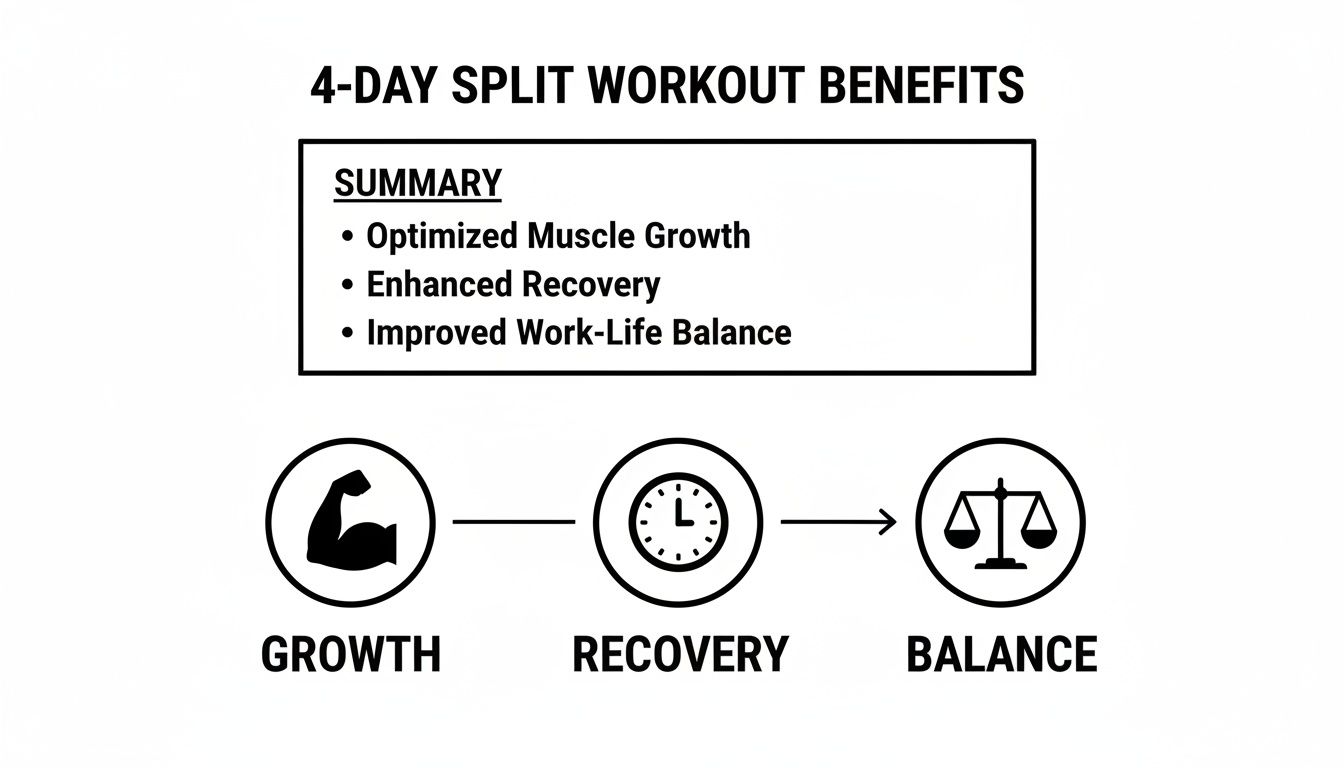
Simply put, a 4-day split is a smart system. It balances the all-out effort of your workouts with the crucial downtime your body needs to repair, rebuild, and come back stronger.
This is the grandfather of smart training splits, the foundation upon which countless impressive physiques have been built. The Upper/Lower split is so effective because it’s simple: you hit every major muscle group twice a week, which research and decades of gym wisdom show is the sweet spot for muscle growth.
It's a perfect starting point for beginners needing to build a solid base and a reliable workhorse for intermediates chasing consistent, all-around gains.
You’ll train your entire upper body, then your entire lower body, rest, and repeat the cycle. It’s efficient, balanced, and almost impossible to get wrong.
This setup is brilliant. You move heavy, low-rep iron at the beginning of the week when you’re fresh, then chase a nasty pump with higher-rep, muscle-building work later on.
A Quick Tip from the Trenches: Don't have a barbell bench press station? No problem. Grab some dumbbells. No leg press machine? A set of Bulgarian split squats will humble you and blow up your quads just as effectively. The movement pattern is what truly matters, not the specific tool.
If your main goal is pure aesthetics—building that classic, sculpted, bodybuilder look—then this is your ticket. The body-part split, affectionately known as the "bro split," lets you dedicate an entire training session to demolishing just one or two muscle groups.
This approach allows for a massive amount of training volume and an incredible mind-muscle connection, which is fantastic for bringing up stubborn body parts and maximizing hypertrophy. The trade-off is that you only train each muscle directly once a week, but the sheer intensity of that single session often makes up for it.
Here’s a popular and highly effective way to structure it:
This allows you to go to war with a muscle group, knowing it has a full 7 days to recover and grow before its next battle.
Are you the type of person who lives for the thrill of adding another plate to the bar? If getting seriously strong is your priority, but you still want to look the part, the Strength-Hybrid split is calling your name.
This routine is the best of both worlds, blending powerlifting principles with bodybuilding volume. You’ll prioritize getting stronger on the big, compound lifts while still hitting enough accessory work to build a thick, dense physique.
This is a demanding program, no doubt about it. You absolutely have to eat and sleep to keep up. To really crush both the heavy and volume days, smart supplementation isn't just a good idea—it's practically a requirement. Something as simple and proven as creatine can give you that extra horsepower for those tough sets. If you're going to train this hard, you might as well support your efforts with quality supplements, like the ones you can check out on Amazon.
This one is for the person who wants to be as much "go" as they are "show." It’s designed not just for looks, but for building explosive power, functional strength, and real-world athleticism.
You'll still build a physique that turns heads, but the focus shifts toward movements that make you a better athlete and a more capable human. It’s less about isolating individual muscles and more about teaching your body to work as a single, powerful machine.
A solid layout looks like this:
This is the perfect template for weekend warriors, athletes in an off-season, or anyone who wants their gym time to directly translate into better performance on the field, court, or in everyday life.
Let's get one thing straight: you can have the most killer 4-day split on the planet, but if your nutrition is garbage, you're just spinning your wheels in the gym. All that sweat and effort? It's just the signal you send to your body to grow. The food you eat and the supplements you take are the raw materials that actually get the construction job done.
Think of it this way: your workouts are the demand for bigger, stronger muscles. Your diet is how you pay the invoice.
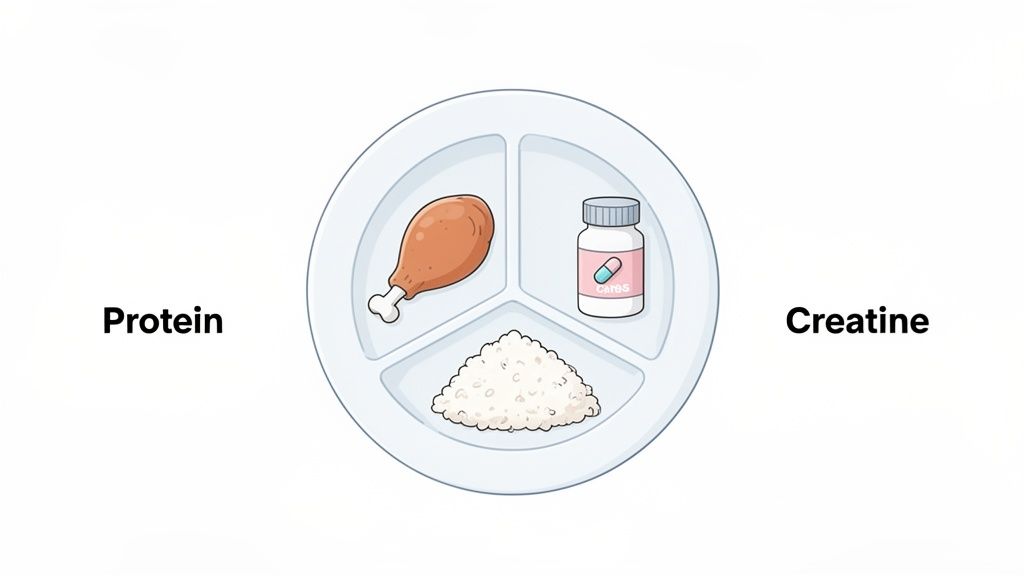
You don’t need a Ph.D. in nutrition to nail this. Honestly, it comes down to being consistent with a few key principles. Your time in the gym creates the potential for gains, but what happens on your plate and in your shaker cup makes it a reality.
Macros—protein, carbs, and fats—are the holy trinity of building a better physique. It sounds complicated, but it's really not.
Protein: This is the one you absolutely cannot skimp on. Protein is what your body uses to repair and rebuild torn muscle fibers. A solid rule of thumb is to aim for about 1 gram of protein per pound of your body weight each day. So, if you weigh 180 pounds, you're shooting for 180 grams. Hit that number, and you're good to go.
Carbohydrates: Carbs have gotten a bad rap for no good reason. For anyone training hard, carbs are your best friend. They're your body's high-octane fuel, stored as glycogen in your muscles. Shortchange yourself on carbs, and watch your performance in the gym tank.
Fats: Don't fear the fat! Healthy fats are critical for producing key hormones—like testosterone—that are massive players in the muscle-building game.
Forget complex spreadsheets. Just nail that protein goal, then fill out the rest of your daily calories with a healthy mix of carbs and fats. Listen to your body and adjust based on your energy levels and how you're looking in the mirror.
People get way too wound up about the "anabolic window," frantically chugging a protein shake within 30 minutes of their last rep. The truth? It’s far less stressful than that. Your total daily protein intake is what truly moves the needle.
That being said, it’s a smart move to spread your protein out across 3-5 meals during the day. This gives your muscles a steady stream of amino acids to work with. And sure, having a protein shake or meal an hour or two before or after you train is a great habit, but missing that "window" won't derail your progress.
Fueling is a 24/7 Job: Muscle growth doesn't just happen in the hour after you leave the gym. It's an around-the-clock process, especially when you're sleeping. Consistent, solid nutrition every single day—including your rest days—is what separates decent results from amazing results on a 4-day split.
Beyond just food, proper muscle recovery after workout is crucial for making consistent progress without burning out.
Alright, you've got your training and diet dialed in. Now, it's time to add a performance enhancer that actually works. If your diet is the foundation, then smart supplementation is the turbocharger. And at the top of that list, sitting on a throne, is creatine monohydrate.
Creatine works by topping off your body's supply of ATP, which is the raw energy your muscles use for explosive movements. More ATP means more power when you're lifting heavy.
So, what does that actually look like during your 4-day split workouts?
This isn't just bro-science; creatine is one of the most heavily studied and proven supplements on the market. For anyone who takes their training seriously, it's a game-changer. It’s what turns a good workout into a great one.
To get the full effect, you need to keep your muscles saturated with it. This is where a simple, no-fuss product becomes your best friend. Using something like Crazy Muscle’s Three-Atine in convenient capsules takes all the guesswork out of it. No more messy powders or chalky drinks—just pop the capsules and get the pure fuel your muscles are screaming for. Take it daily, even on your off days, to make sure your energy tank is always full.
If you want to explore other proven options, our guide to the best supplements for muscle gain and recovery covers what else you can stack with creatine to maximize your results.
Look, just dragging yourself to the gym four days a week isn't going to cut it. If the numbers on the bar aren't going up, the muscles aren't growing. It’s that brutally simple. The Grim Reaper of all gains is the plateau, and our job is to keep him far, far away.
This brings us to the one principle that governs all muscle growth: progressive overload. It’s the not-so-secret sauce that every single successful lifter, from your local gym hero to pro bodybuilders, has used to get where they are.
All it means is you have to give your muscles a reason to get bigger and stronger. You have to consistently ask more of them over time, forcing them to adapt. They don't grow out of kindness; they grow because you force their hand.
So, how do you actually apply this without turning your workout log into a quantum physics equation? It’s way simpler than you think. You’ve got a few key tools in your toolbox to make each workout just a little bit tougher than the last.
Add More Weight: The most classic approach. If you benched 185 lbs for 8 reps last week, the mission this week is to bench 190 lbs for 8 reps. Simple and effective.
Add More Reps: Can't quite make the jump in weight? No problem. Stick with that 185 lbs but fight for 9 or 10 reps instead of the 8 you got last time. That’s still progress!
Add More Sets: This is a fantastic way to increase your total workload, or volume. Did 3 sets of squats last week? Try adding a fourth set this week to really challenge your legs.
The trick is to pick one method at a time for each exercise. Trying to add weight, reps, and sets all at once is a surefire recipe for burnout. We're chasing small, consistent wins that add up to massive gains over time.
Let’s see how this plays out in the real world. Here’s a practical look at how you might progress your main lifts over a month on a classic Upper/Lower 4-day split.
| Week | Bench Press (Upper Day 1) | Squat (Lower Day 1) | Progress Tactic |
|---|---|---|---|
| 1 | 185 lbs x 3 sets of 8 | 225 lbs x 3 sets of 8 | Establish Baseline |
| 2 | 185 lbs x 3 sets of 9 | 225 lbs x 3 sets of 9 | Add Reps |
| 3 | 190 lbs x 3 sets of 8 | 230 lbs x 3 sets of 8 | Add Weight |
| 4 | 190 lbs x 3 sets of 9 | 230 lbs x 3 sets of 9 | Add Reps |
See the pattern? It’s a simple, repeatable process that builds momentum week after week. This is exactly how you build strength that snowballs. For a deeper dive into these strategies, you can learn how to get stronger faster in our complete guide.
This methodical approach is what separates the people who see results from those who just spin their wheels.
Now, you can't just keep your foot slammed on the gas forever. Even a finely tuned race car needs a pit stop, and if you redline your body for too long, you’re going to blow a gasket. In the lifting world, we call this overtraining, and it will slam the brakes on your progress.
Feeling sore all the time? Are weights that used to feel manageable now feeling glued to the floor? Are you cranky, exhausted, and sleeping terribly? Those are the red flags waving.
This is your body screaming for a break. The absolute worst thing you can do is ignore it and try to "push through." The smart move? Take a deload week.
A deload is a planned, strategic week of lighter training, typically taken every 4-8 weeks. This isn't a lazy week off on the couch. Think of it as an active recovery period that lets your joints, tendons, and central nervous system fully repair and recharge.
Here's the game plan:
It's going to feel almost laughably easy. That’s the entire point. After a proper deload, you’ll storm back into the gym feeling refreshed, powerful, and ready to absolutely smash your old personal records. It’s a tactical retreat that sets you up for the next big win.
Let's get one thing straight: the most scientifically "perfect" workout plan you find online is worth absolutely nothing if it doesn't fit your actual life. You know how it goes. A project blows up at work, a kid comes home with the flu, or you just wake up feeling like you wrestled a bear and lost.
A great 4-day split isn't a prison sentence; it’s a starting point. It’s a blueprint that needs to be tweaked and tailored until it becomes your plan—one that can handle the chaos of real life.
Your training age—how long you’ve been lifting seriously—matters. A lot. The plan that gets a seasoned lifter jacked could bury a beginner, and a newbie's routine will be a snoozefest for someone who’s been in the trenches for years. It's time to dial in the volume and intensity for where you are right now.
For the New Lifter: First off, welcome! Your mission, should you choose to accept it, is to master the main movements. Forget about ego lifting or trying to do a million sets. Your body is primed to grow from just about any new stimulus, so we’re going to take full advantage of that.
Your goal is to build a rock-solid foundation of technique and muscle. Think consistency, not intensity. That’s your mantra.
For the Seasoned Lifter: You’ve paid your dues. You know how to push yourself, but you’re also painfully aware that your joints don't have the warranty they used to. Your game is now about smart training and longevity.
Life doesn’t care that Monday is your upper body day. Things happen. The great thing about a 4-day split is just how forgiving it can be.
So, what do you do when your week implodes?
The "Better Than Nothing" Workout: Some days, you're lucky to get 30 minutes. On those days, pick the top three exercises on your list, hit 3 hard sets of each, and call it a win. A short, intense workout crushes a skipped one every single time.
The way you train shouldn't be identical when you're trying to gain weight versus when you're trying to lose it. Your energy and recovery capacity are worlds apart in these two scenarios.
Training in a Calorie Surplus (Bulking): This is prime time. You’re well-fed, your recovery is on point, and you have the fuel to push for new muscle. It's time to step on the gas.
Training in a Calorie Deficit (Cutting): This is a whole different ballgame. Your primary mission is no longer to build muscle; it’s to preserve the muscle you've already built. With calories low, your recovery is in the tank. You have to train smarter, not just harder.
By making these simple, strategic tweaks, you take a generic template and forge it into your personal plan for progress. No matter who you are or what life throws at you, your 4-day split can be molded to fit you perfectly.
Alright, you’ve got the templates and the game plan. But let's be real, a few questions are probably still rattling around in your head, stopping you from going all-in. It's time to put those doubts to rest.
Let's dive into the most common questions I hear so you can walk into the gym with the confidence of a seasoned pro.
Heck yes. In fact, a 4-day split is one of my go-to recommendations for anyone new to the iron game. It hits that sweet spot perfectly. You get enough practice to really nail your form on the big lifts, but you also get plenty of recovery days so you don't burn out.
That recovery time is gold when you're starting out. Your body isn't used to this kind of work, and it needs that downtime to repair and grow. If you're just getting your feet wet, I highly suggest sticking with the Upper/Lower template. It’s the best way to build a rock-solid foundation of both muscle and strength.
This is the classic debate, and honestly, the right answer depends entirely on what you're chasing. One isn't magically "better" than the other, but one is probably better for you and your goals right now.
Upper/Lower Split: With this setup, you’re hitting every muscle group twice a week. That higher frequency is an absolute powerhouse for driving strength gains and overall muscle growth. If you want to get bigger and stronger all over, this is your ticket.
Body Part "Bro" Split: This is all about total annihilation. You get to dedicate an entire session to bombing a specific muscle with a ton of volume. A lot of guys find they get a way better pump and mind-muscle connection this way, which is fantastic if your main goal is pure aesthetics.
Here's My Two Cents: Try Both. Seriously, don't get stuck in analysis paralysis. Run the Upper/Lower split for a solid 6-8 weeks. Track everything. Then, switch to the Body Part split for the next 6-8 weeks. See how you feel, how you look, and which one you actually enjoy showing up for.
Yes. End of story. This is one of the few non-negotiables if you want to see what creatine can actually do for you.
Think of it like this: your muscles are a sponge. To get that performance-enhancing, rep-squeezing benefit, the sponge has to be completely full. Taking creatine only here and there is like trying to drive cross-country on a quarter tank of gas. You just won't get very far.
Consistency is king. A daily 5g dose keeps your muscle creatine stores completely topped off. This means you're always primed to perform, ready to grind out those extra reps that actually trigger growth.
This is the whole reason we formulated Crazy Muscle’s Three-Atine. It removes all the guesswork. Taking it every single day—especially on your rest days—ensures your muscles are always loaded and ready for war. It’s not about having one good workout; it’s about making every single workout better.
You have the knowledge and the plan. Now it's time to execute. To give your body the high-octane fuel it needs to recover and grow stronger after every session, make Crazy Muscle’s Three-Atine a daily habit. Grab your bottle on Amazon and feel the difference yourself.

Sign up and save 10% off your next order