
Master Your Bench Press Wrist Position for a Stronger Lift
Posted by Maximus
on

Let's be honest. You're probably here because your bench press has hit a wall, your wrists are screaming at you after every session, or—let's face it—both. It’s a frustrating spot to be in, and I'll bet the culprit is something you're overlooking: your wrist position.
We're going to cut right through the noise you hear on the gym floor. The "broken" wrist grip isn't just a bad habit; it's actively sabotaging your strength and practically begging for a nasty injury. The second you fix this, everything changes.
Imagine your arms are steel pillars built to transfer every ounce of force into the bar. When you let your wrists bend back, those pillars turn into wobbly noodles. All that power you're generating just leaks out, and the stress gets dumped right into your delicate wrist joints.
This visual says it all. Take a look at the difference between a weak, bent-back wrist and a powerful, stacked one.
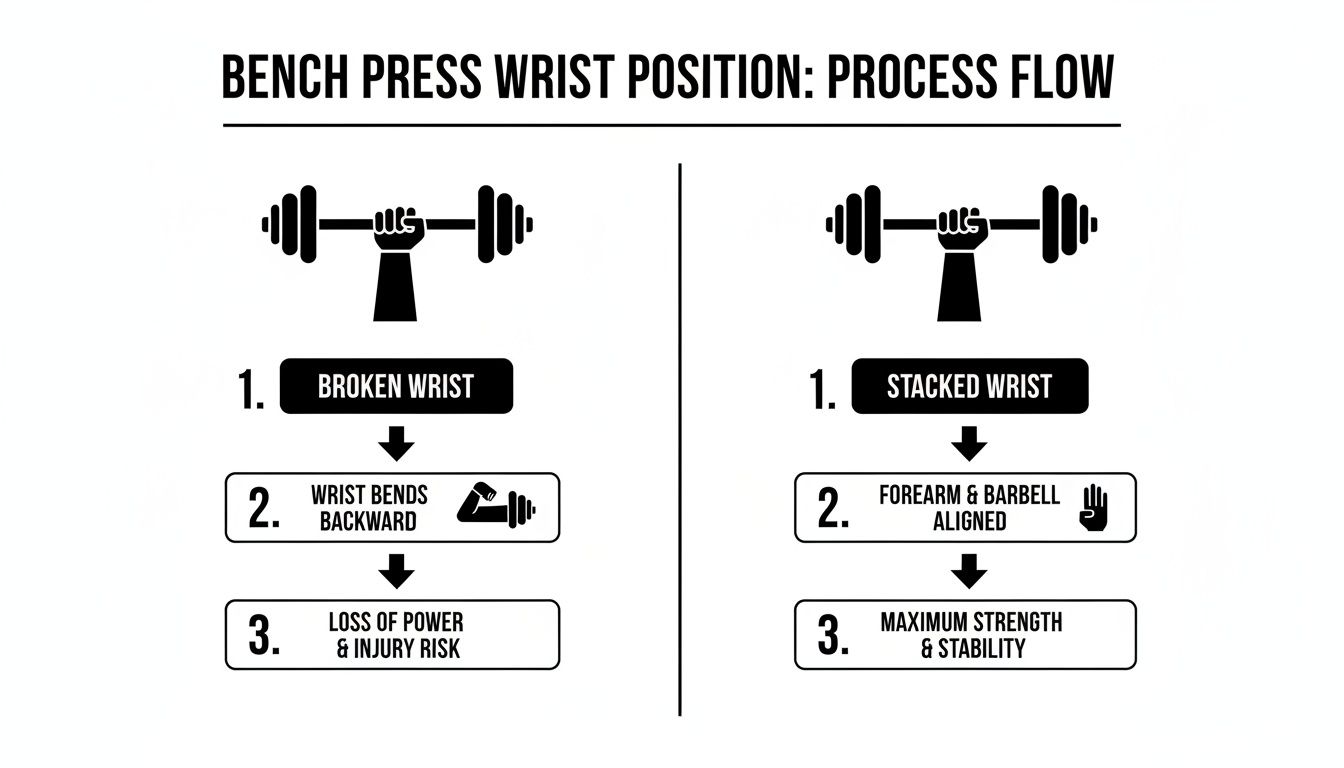
See that? A "stacked" wrist creates a straight, brutal line of force. The "broken" wrist creates a dangerous angle that kills your power and puts your joints in a seriously compromised position.
To really hammer this home, let’s put these two techniques head-to-head. This quick comparison shows you exactly why one way leads to bigger lifts and the other leads to the physical therapist's office.
| Attribute | Broken Wrists (The Wrong Way) | Stacked Wrists (The Right Way) |
|---|---|---|
| Grip & Feel | Bar rests high on the palm, feels unstable. | Bar sits lower, on the "heel" of the palm. |
| Power Transfer | Leaks energy, feels weak and disconnected. | Direct force transfer, feels solid and powerful. |
| Joint Stress | Extreme pressure and shearing force on the wrist. | Minimal stress, forearm takes the load. |
| Injury Risk | High risk of sprains, strains, and chronic pain. | Dramatically lower risk of wrist injuries. |
| Strength Potential | Severely limited. You're fighting your own body. | Unlocks your true strength potential. |
The verdict is clear. Stacking your wrists isn't just a suggestion—it's the only way to bench press for serious, long-term gains.
Fixing your form isn't just about dodging pain; it's about unlocking strength you already have, right now. The science is settled on this. Ever since the powerlifting boom of the 1970s, lifters have dialed in on wrist position as a non-negotiable part of a big bench.
In fact, a 2021 trainer analysis found that letting your wrists extend back by more than 20 degrees completely tanks your leverage. How much? We're talking a drop in power output by as much as 15-25%! A neutral, stacked wrist, on the other hand, stabilizes the entire kinetic chain, giving you maximum force and bar speed.
Correcting this single mistake delivers a nasty one-two punch:
This isn't just some minor tweak you can ignore. A stacked wrist is the foundation. It's the platform you need to safely build a much, much bigger lift.
By mastering this, you're not just lifting heavier—you're lifting smarter. For even more tips on blowing past your plateaus, check out our complete guide on how to increase bench press strength. This one change is a total game-changer for anyone who's serious about getting brutally strong and staying in this for the long haul.
Alright, let's get into the nitty-gritty. This is where you transform your bench press from an awkward, wobbly lift into a display of pure, controlled power. Forget everything you think you know about grabbing the bar; we’re about to build your grip from the ground up, coach-in-your-ear style.
The first mistake most lifters make is placing the bar way too high in their palms. When the bar sits up by your fingers, your wrists are forced to bend back under the load. Instead, you need to find the sweet spot: the meaty, heel part of your palm, directly above your forearm bones.
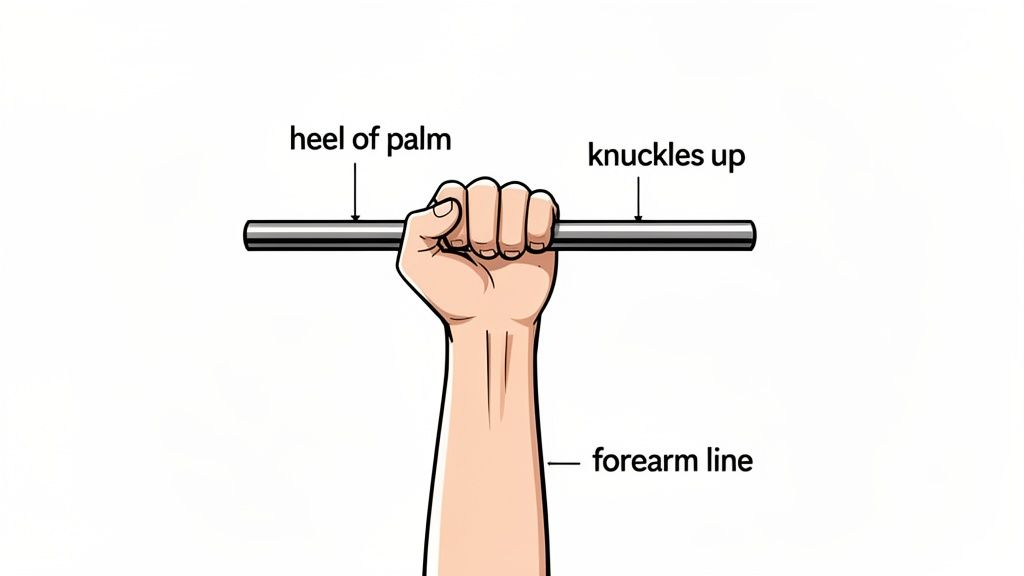
This position creates a solid, direct line of force. Think of it as stacking blocks—you want your hand, wrist, and forearm to form one unbreakable column. Once you’ve found this spot, wrap your fingers and thumb around the bar like you’re trying to crush it into dust. This isn't a passive hold; it’s an active, vice-like grip that screams "I own this weight."
Here’s the single most powerful cue you’ll ever get for your bench press wrist position: knuckles to the ceiling.
When you set your grip, consciously think about punching your knuckles straight up. This simple action forces your wrists into a perfectly neutral, stacked alignment. It takes the pressure off your joints and channels all your pressing power directly into the bar where it belongs.
Combine this with the correct bar placement, and you have a recipe for a seriously strong and safe press. This principle is not just for flat benching; it applies everywhere:
This alignment also works hand-in-hand with core stability. Just as you brace your abs for a heavy lift, a solid grip stabilizes the "top" of the chain. For a deeper dive, check out our guide on the power of abdominal bracing exercises to lock in your entire body.
Your grip width doesn't just change which muscles you target; it directly impacts your wrist angle and stability. Finding the right one depends on your goals and your body.
A fascinating 2017 study on competitive athletes analyzed how different grips and angles affected muscle activation. It found that a wide grip on a flat bench was king for lifting maximum loads and firing up the triceps. However, when they moved to an incline, the wrist mechanics changed, forcing the biceps to work harder to stabilize the shoulder. You can explore the full breakdown of these EMG findings on muscle activation.
The Big Takeaway: Your grip and bench angle aren't just minor details—they dictate which muscles do the work and how much stress your joints endure. A wide grip may be great for powerlifting, but a narrower grip might be safer on your shoulders and wrists, especially if you're chasing chest hypertrophy.
Experiment with different widths to find what feels strongest and most comfortable for your body. Start with a medium grip (just outside your shoulders) and adjust from there. No matter the width, the core principle remains the same: bar on the heel of the palm, knuckles to the ceiling. Master this, and you’re ready to build a bench that’s as strong as it is safe.
Walk into any serious gym on a Monday, and you'll see it: lifters meticulously cranking down their wrist wraps before a big bench press. It’s almost a ritual. But are they a badge of honor for moving heavy weight, or just a crutch for iffy form?
The answer isn't so black and white. Lifters use them for one simple reason—they make the weight feel more stable in your hands. But does that feeling actually help you press more?
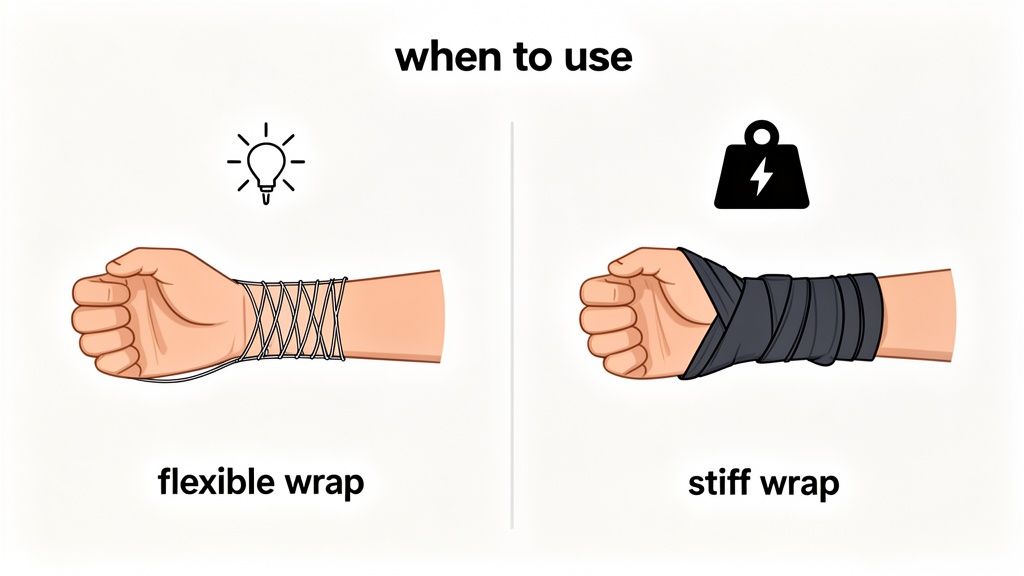
Here's the kicker: probably not. A fascinating 2024 study put this very question to the test with experienced lifters. The research showed that while both flexible and stiff wraps made the lifters feel way more stable, it had zero impact on their one-rep max (1RM), peak power, or how fast the bar moved. If you want to get nerdy, you can dive into the full research on wrist wrap effectiveness here.
So what's the real story? Wrist wraps are a confidence booster. They provide subjective stability, but they won't magically add plates to the bar. Think of them as a tool for support, not a substitute for raw strength.
Not all wraps are built the same, and grabbing the wrong one is like bringing a knife to a gunfight (or a cannon to a knife fight). You have two main camps.
Flexible Wraps (The "All-Rounder"): These are your daily drivers. They're thinner, more pliable, and give you support without turning your wrist into a solid block of concrete. They're perfect for higher-rep sets, general accessory work, or any time you just want a little extra reassurance.
Stiff Wraps (The "Powerlifter's Choice"): Now we're talking serious business. These wraps are thick, rigid, and create a cast-like effect. They're designed to severely limit wrist extension and are made for one thing: hitting a new PR. These are overkill for most training and should be saved for those max-effort, "go-for-broke" singles.
The biggest mistake I see is lifters slapping on wraps for their very first warm-up set. Don't do that. It’s a fast track to developing weak, flimsy wrists that can’t support weight on their own.
Instead, be strategic.
Work your way up through all your warm-up and sub-maximal sets completely raw. This builds the foundational strength and motor control needed for a rock-solid bench press wrist position. You're teaching your body how to do the work.
Then, when you get to your top sets—the real heavy-hitters where fatigue might cause your form to slip—it's time to wrap up. Make sure the wrap covers the actual wrist joint, not just your forearm or hand. Pull it tight enough for compression, but not so tight that your fingers start tingling. And for goodness sake, loosen them between sets to let your hands breathe!
This way, wraps become a powerful tool to confidently handle loads that push your limits, helping you break through plateaus safely. They become a partner in your progress, not a crutch that holds you back. Pair this smart training with the right fuel for recovery and growth, and you’re set. You can explore our full range of performance-supporting products at the Crazy Muscle Amazon store.
Look, perfect bench press technique is great, but it all falls apart if your wrists feel like they’re about to snap the second the weight gets serious. If you’re tired of your wrists being the weak link in your bench press, it's time to stop wishing and start building.
We’re going to forge those wrists into something that can handle heavy-duty iron. Think of these drills as your personal armor-plating for the joints that connect you to the bar.
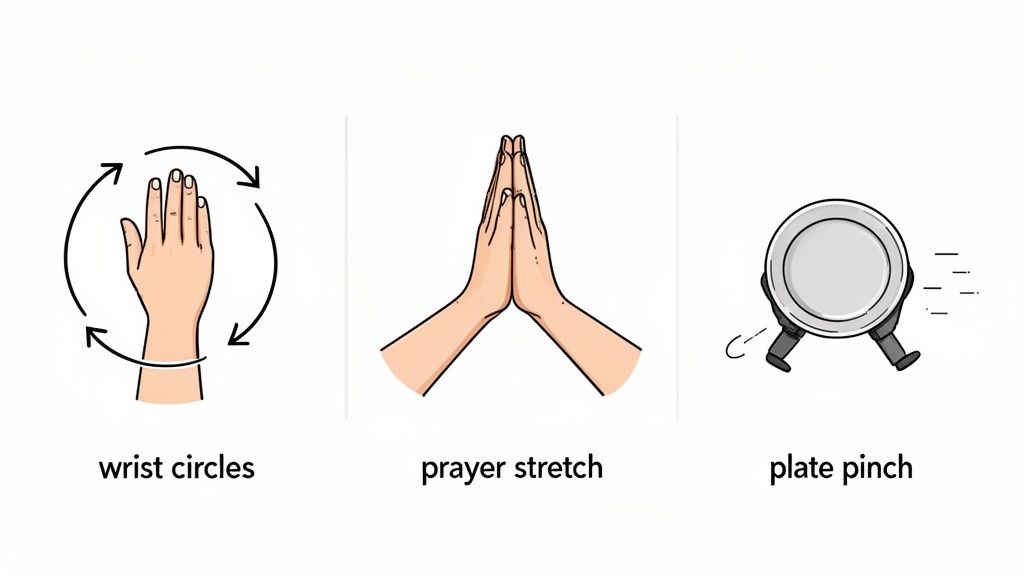
First things first: you can’t force a stiff joint into a strong position. It just doesn’t work. We need to improve your wrist’s range of motion before we load it up.
You don’t need a complicated, hour-long routine. Just a few minutes dedicated to these two simple movements before you train will make a world of difference.
Mobility is only half the battle, though. Now we need to add the raw strength that will keep those wrists from folding under pressure.
These are the meat-and-potatoes exercises that build real, functional strength you'll feel on the bench.
The whole point of this is to build wrists that make a solid, stacked position feel second nature. When your wrists are strong, you're not just safer—you're stronger. The entire press feels more powerful.
And while you're putting in the work, don't forget about recovery. Some lifters find that supplements like glucosamine, chondroitin, and MSM for joint support help keep their joints feeling healthy under punishing loads. Treat your wrists like the crucial asset they are, and they’ll pay you back with bigger numbers on the bar.
Alright, let's be real. Perfect form is non-negotiable. Nailing that bench press wrist position is what allows you to transfer all your hard-earned power straight into the barbell. But where does that raw, explosive power actually come from?
You can have the most perfectly stacked wrists in the gym, but if your muscles are running on fumes, you’re just spinning your wheels. This is where the work you do outside the gym—fueling and recovery—makes all the difference between a good lift and a great one.
Let's talk about the single most tested and proven supplement out there: creatine. This isn't some gym-bro myth; it's pure science that directly helps you push more weight.
Here’s the simple version. Think of your muscles as having tiny, rechargeable batteries called ATP. Every single time you explode a rep off your chest, you drain those batteries. Once they're depleted, that's it. Set over.
Creatine is like a high-speed charging pack for those batteries. It helps you rapidly regenerate ATP, giving you the juice to grind out those extra reps that truly force your body to adapt and grow. That one rep you barely missed last week? Creatine is the fuel that helps you demolish it this week. If you want to dive into the nitty-gritty science, you can read all about how creatine increases strength in our deep-dive article.
This isn’t just about lasting longer, either. It’s about raw power. More energy on deck means your muscles can contract harder and faster, helping you drive the bar with more aggression from the second it leaves your chest.
Creatine is your secret weapon for turning "almost" into "done." It transforms those failed reps into successful ones, and successful reps are what build a monster bench.
We get it. You want results, not a science experiment in your shaker bottle. You're busy lifting, not messing with chalky powders and complicated loading schedules.
That's exactly why we made Crazy Muscle's Threeatine capsules. It’s our high-potency, triple-source creatine formula built for lifters who demand top-tier performance without the fuss.
You're already putting in the effort to master your bench form and build bulletproof wrists. Now, it's time to give your muscles the high-octane fuel they need to actually cash in on all that hard work. Stop leaving pounds on the bar.
Ready to add some serious firepower to your bench press? Grab your supply of Crazy Muscle’s Threeatine on Amazon and feel the difference on your next chest day.
Alright, let's cut through the noise and tackle the questions I hear on the gym floor all the time about benching. You've been putting in the work, but something's still off. We're going to fix that, right now.
This is one of the most maddening things that can happen. You’ve watched the videos, you've checked your form in the mirror, you know your wrists are stacked... but they still scream at you after a heavy set. What gives?
Well, even with what looks like perfect form, pain is your body's way of telling you something's weak. The most common culprit? Your forearms and grip just haven't caught up to the weight your chest and shoulders can move. This mismatch leads to tiny tears and stress. It’s time to start treating your forearms like a real muscle group—think forearm curls, grip trainers, and heavy holds.
It could also be a mobility issue. If your wrists are too tight to get into the right position without straining, you're fighting a losing battle. Make wrist circles and prayer stretches a non-negotiable part of your warm-up routine. Seriously, don't skip it.
And one last thing to check: your bar path. Even with a straight wrist, if the bar is riding too high in your hand, toward the fingers, it's creating a lever that puts a ton of stress on the joint. You need that bar sitting deep, right in the meaty heel of your palm. If the pain sticks around, swallow your pride, deload the weight, and shore up these weak points before building back up.
Let's get this out of the way immediately. The thumbless grip, which some people call the "suicide grip," is exactly what it sounds like. I see guys in the gym doing this, claiming it feels better on their shoulders or gives them a stronger press.
My advice? Never, ever do it.
The name isn't for show. That thumb is the only thing locking the barbell into your hand. Without it, one sweaty palm, one slight imbalance, one moment of lost focus is all it takes for the bar to slip. The results are devastating and can end your lifting career—or worse. The tiny, perceived benefit is not worth a crushed windpipe. It's a risk with zero reward. Always, always wrap your thumb.
Think of wrist wraps like a good lifting belt: they should offer powerful support during the lift and be loosened immediately after. They’re a supportive hug, not a tourniquet.
Here's the deal: crank them down so your wrist feels locked and stable for your heavy sets. But if your fingers start tingling, your hand feels cold, or your skin turns a different color, you've gone way too far. You should still be able to make a fist without your hand going numb.
Get in the habit of ripping the velcro loose as soon as you re-rack the weight. Let the blood flow back. The goal is to stabilize the joint under load, not mummify your hand for the entire workout.
One hundred percent. In fact, if you're struggling with wrist stability, dumbbell presses are your new best friend. They're practically a cheat code for building bulletproof wrists.
A barbell is forgiving; it lets your dominant arm pick up the slack for the weaker one. Dumbbells, on the other hand, are brutally honest. Each arm is on its own, forcing all those tiny stabilizer muscles in your forearms and shoulders to fire up and do their job. They have no choice but to get stronger.
This is exactly the kind of raw stability you need to translate back to a rock-solid barbell bench. Making dumbbell work a staple of your routine is one of the smartest things you can do to fix a wobbly wrist position for good.
Building unshakeable stability and explosive power is a two-front war fought with perfect form and premium fuel. For the thousands of lifters who trust Crazy Muscle to power their progress, consistent gains are the standard. To explore the supplements that can help you smash your next plateau, check out our full lineup on our Amazon store.

Sign up and save 10% off your next order