
Master the Abdominal Bracing Exercise for an Unbreakable Core
Posted by Maximus
on

Forget everything you thought you knew about "engaging your core." We're not talking about endless crunches or those weird ab gadgets you see on late-night TV. If you're serious about building real, raw power, there's one skill that separates the casual lifter from the true powerhouse.
It’s called abdominal bracing, and it’s the unsung hero behind every massive squat, deadlift, and overhead press.
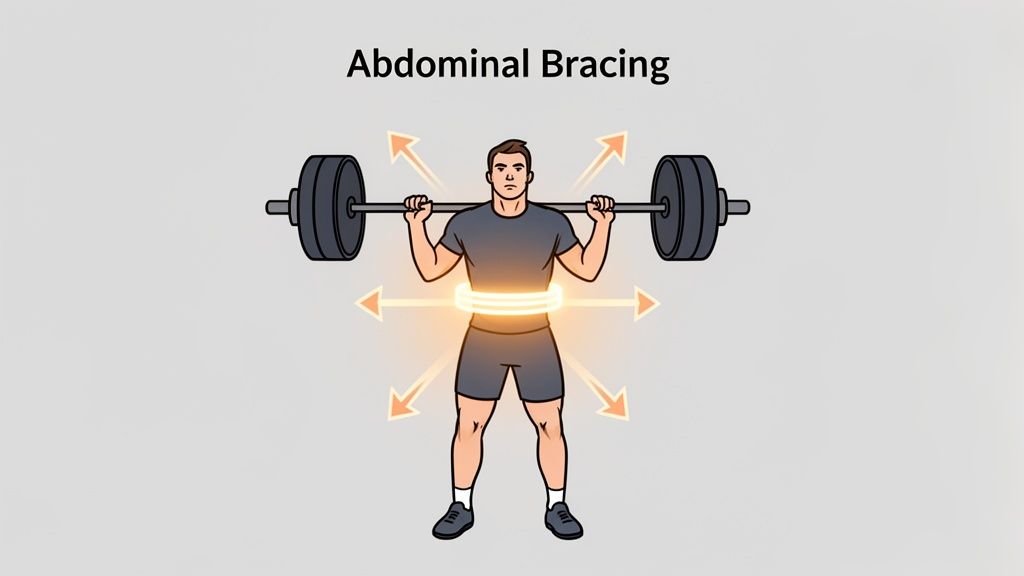
Think of your core as the transmission in a high-performance race car. It doesn't matter how powerful the engine is if the transmission can't transfer that power to the wheels. A weak, unbraced core is just like that—it leaks energy, robbing you of strength and putting you at risk.
Bracing, on the other hand, turns your entire midsection into a solid, unshakeable pillar. It creates a rigid cylinder of muscle that allows you to channel every ounce of force from the ground, through your body, and into the barbell.
This is where most people get it wrong. When a coach yells, "tighten your core!" the most common reaction is to suck your stomach in, trying to make your waist as small as possible. This is called abdominal hollowing.
While hollowing might have some use in specific physical therapy contexts, it's the absolute last thing you want to do when there's a heavy barbell on your back. It actually destabilizes your spine.
Proper bracing is the exact opposite. It's about pushing out in all directions. The best cue I've ever heard? Brace yourself like you’re about to take a punch to the gut from your worst enemy. That instinctive, 360-degree tensing of every muscle in your midsection—that's bracing.
To clear up any confusion, here's a quick breakdown:
| Technique | What It Does | Best For |
|---|---|---|
| Abdominal Bracing | Pushes outward, co-contracting all core muscles (abs, obliques, lower back) to create 360° tension and intra-abdominal pressure. | Heavy lifting (squats, deadlifts), creating maximum spinal stability, and transferring force. |
| Abdominal Hollowing | Sucks inward ("drawing belly button to spine"), primarily activating the deep transverse abdominis (TVA). | Specific rehab exercises, postural awareness, and very low-load movements. Not for strength training. |
In short, hollowing is about looking thin, while bracing is about becoming an immovable object.
Abdominal bracing is an aggressive, powerful action. You are creating a pressurized cylinder of stability around your spine that not only protects it from injury but also sets the stage for massive strength gains. It's not passive; it's a fight.
When you finally nail the abdominal bracing technique, you'll feel an immediate difference in your lifts. This isn't just theory; it's a direct upgrade to your body's ability to handle heavy loads.
Here’s what you get:
Ever wondered what makes a core truly "bulletproof"? It’s not some mystical training secret or a magic pill. The incredible power of an abdominal bracing exercise comes down to pure, beautiful biomechanics. When you brace the right way, you’re essentially turning your entire midsection into an armored cylinder.
And it’s not just about the six-pack muscles everyone chases. While your rectus abdominis (the "six-pack") is part of the team, the real star player for core stability is a much deeper, often-ignored muscle.
The muscles you flex in the mirror are just the tip of the iceberg. The true strength behind a solid brace is the synchronized contraction—or co-contraction—of your entire core crew:
When you brace, you're ordering all of these muscles to fire at once. This creates something called intra-abdominal pressure (IAP). Picture a sealed soda can—if you try to crush it, it’s remarkably rigid. That’s precisely what you're doing to your torso. You're building a super-stiff column that shields your lumbar spine from giving out under a heavy load.
This isn’t just a "feeling," either. It's a real, measurable physiological event that transforms your body into a force-transferring machine. Studies using electromyography (EMG) to track muscle activity show that bracing lights up certain muscles in a way other exercises simply can't.
For instance, research has shown that proper bracing absolutely skyrockets the activation of the internal oblique (IO) muscle, firing it up to a massive 60% of its maximal voluntary contraction. That blows other core muscles away—the rectus abdominis only hits about 18%, and the external oblique just 27%. You can dig into the research on core muscle recruitment yourself to see just how dominant bracing is.
So what does all this science mean when you’re standing under a barbell? It’s simple: a stable core means bigger, safer lifts and a much happier back. In fact, many of the same scientific principles used to build a rock-solid core are also used to naturally relieve lower back pain, which tells you a lot about its protective power.
Every single time you squat, deadlift, or press something heavy overhead, you're challenging your body to move a weight while keeping your spine perfectly neutral. Without a solid brace, your lower back becomes the path of least resistance—it's the first thing to round and get hurt.
Think of it like this: bracing builds an internal weightlifting belt out of your own muscle. It provides 360-degree support that an external belt can only imitate, making you stronger and more resilient from the inside out.
By mastering the abdominal brace, you’re not just picking up another gym trick. You're learning a foundational principle of human movement that will pay you back for years to come with more strength, better performance, and long-term spinal health. Now that you get the "why," let's get into the "how."
Alright, you get the "why" behind bracing, so let's get down to the "how." Learning to nail a perfect abdominal brace isn't rocket science, but it does take some real focus. This is way more than just flexing your abs for the 'gram. We're building a 360-degree muscular corset.
The biggest mistake I see? People hold their breath, turn a lovely shade of purple, and just hope for the best.
The real art is learning to breathe while keeping everything tight. Let's break it down.
We're going to start on the floor. This takes balance and other distractions out of the equation so you can zero in on that mind-muscle connection.
Lie on your back, bend your knees, and plant your feet on the floor. Find a neutral spine—don't jam your lower back into the ground, but don't arch it up, either. A small, natural curve is what you're after.
Now, place your hands on your sides, right above your hips. Let your thumbs wrap around toward your back and your fingers rest on your obliques (your side abs). This is your feedback station.
The key is pushing outward in all directions—front, sides, and back. A good brace isn't about sucking in or just flexing your six-pack. Your fingertips should feel your obliques bulge and harden. If they don't, you're missing out on that crucial 360-degree stability.
It’s surprisingly easy to mess this up at first. But once you know what to look for, you can fix these common blunders on the fly.
This simple diagram shows the powerful sequence of a proper abdominal brace.
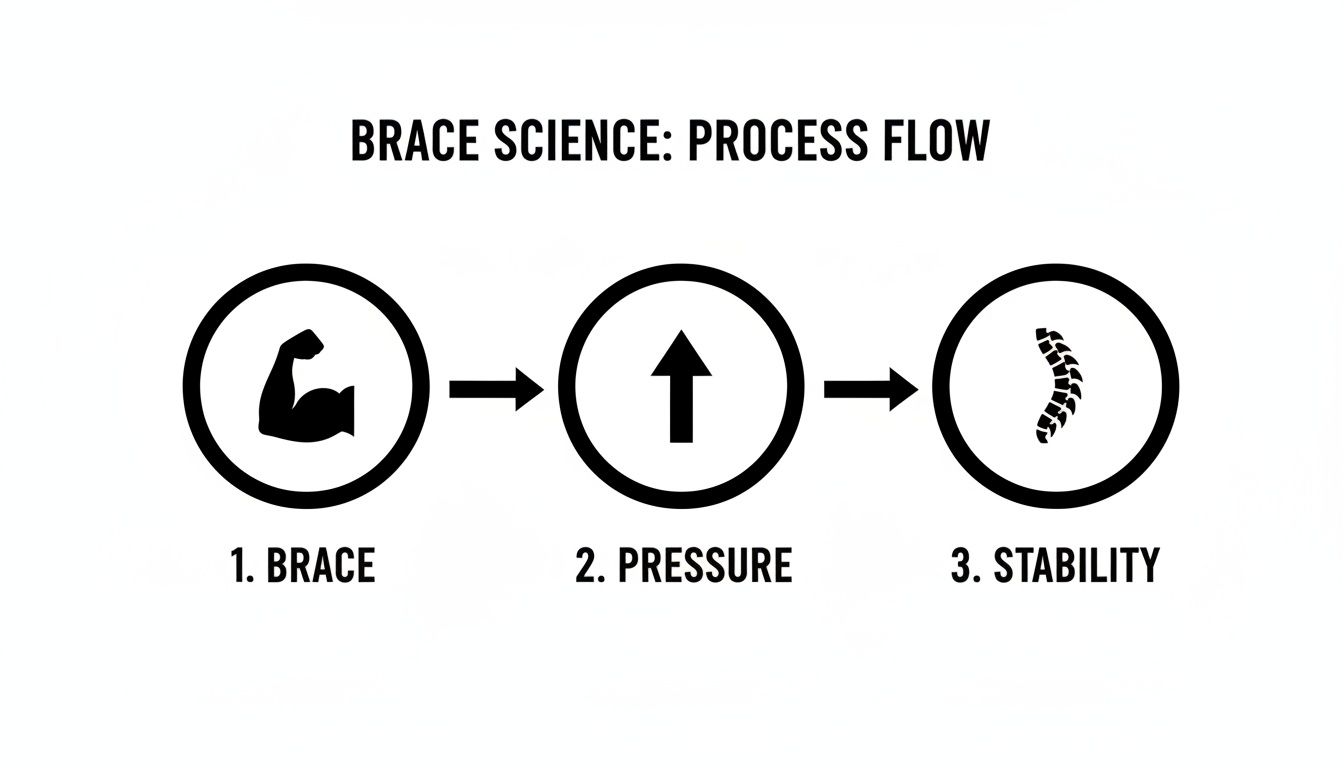
As the visual shows, it’s a simple flow: you consciously brace, which creates internal pressure, and that pressure delivers rock-solid spinal stability.
Once you’ve mastered this on the floor, start practicing it everywhere—while sitting at your desk, standing in line, and especially during your warm-up sets at the gym. Before you know it, bracing will become second nature right before you lift. It's this attention to detail that separates the good lifters from the great ones and keeps you strong and injury-free for years to come.
And if you're looking for an extra edge in your training, check out the awesome supplements to support your goals over at our Crazy Muscle Amazon store.
Alright, you've nailed the technique on the floor. Fantastic. But now it’s time to take that newfound skill off the mat and put it to work where it really counts—the weight room. Knowing how to do the brace is great, but using it to smash your PRs is the real game-changer.
Let's walk through how to make a rock-solid brace an automatic, non-negotiable part of every single rep you do.
You wouldn’t jump straight to your one-rep max, and you shouldn’t treat your brace like an all-or-nothing affair. Think of it more like a volume dial than a simple on/off switch. You need to learn how to adjust the intensity of your brace to match the intensity of the lift.
Warm-up Sets (10-30% Brace): For those first few sets with an empty bar or light weight, you just need a gentle brace. This is barely a squeeze—just enough tension to "wake up" your core and get the mind-muscle connection firing. Your focus here is on smooth movement and perfect breathing.
Working Sets (50-80% Brace): Once the weight starts feeling like work, it's time to crank up that dial. For your challenging sets in the 5-10 rep range, you should be bracing hard. The goal is to create an unshakeable, rigid torso that can handle the load safely and effectively.
Max-Effort Lifts (100%+ Brace): Going for a new one-rep max? This is where you turn the dial all the way to eleven. It's a full-on, "brace for impact" contraction. For these max attempts, you'll likely combine your brace with the Valsalva maneuver to generate the absolute most intra-abdominal pressure for peak stability and spinal safety.
Scaling your brace like this is smart training. It teaches your body to be efficient, preventing unnecessary fatigue on lighter sets so you have more in the tank for the heavy stuff. This is a core component of any effective strength training plan that builds lasting results.
A braced core isn't just for slow, grinding lifts. It’s the secret sauce for generating explosive power. Your core acts as a stiff, rigid platform that allows force to travel efficiently from your lower body to your upper body (and vice versa).
Trying to jump high or throw a ball hard without a braced core is like trying to shoot a cannon from a canoe. All that power just dissipates into the wobble.
Don't just take my word for it. The science is fascinating. A 2016 study on drop-landings found that athletes who pre-braced their abs before jumping actually generated more explosive force upon landing, all while better protecting their knees and hips. It literally makes you a more powerful and resilient athlete.
This wasn't some fluke. The research showed that a moderate abdominal brace fired up the entire core musculature, leading to stiffer and more powerful movements.
Here’s the bottom line: a properly executed abdominal bracing exercise is the foundation for almost everything you do. Whether you're deadlifting 500 pounds, trying to dunk a basketball, or just helping a friend move a couch, a braced core is a strong, safe, and powerful core. Master this skill, and you'll unlock a level of performance you never knew you had.
A rock-solid core isn’t just built with perfect technique; it's fueled by what you put in your body. You can master the abdominal bracing exercise and have the perfect blueprint for an unbreakable midsection, but the right fuel is what helps you actually build it faster and stronger.
Let's talk about connecting that raw power you're generating with some smart performance nutrition.
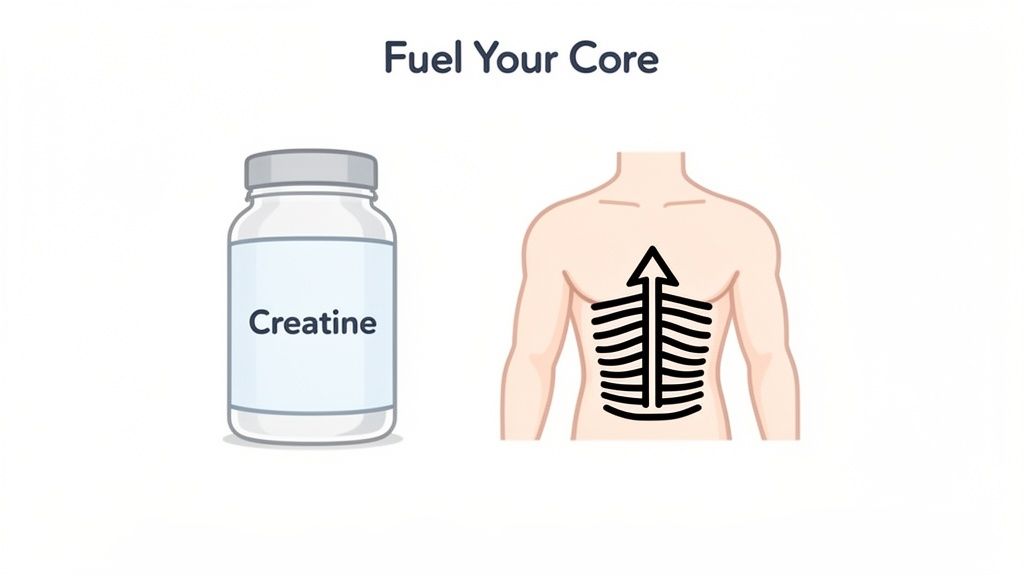
So, you’ve learned how to create that immense, armor-like tension with your brace. Awesome. But holding that kind of high-intensity contraction torches your muscles' primary energy currency, ATP. Think of ATP as the high-octane gas in the tank for every single powerful muscle squeeze. When you run low, your power plummets, your brace falters, and your set is done.
This is where the undisputed king of all supplements, creatine monohydrate, makes its grand entrance.
There's a good reason creatine is the most tested and proven performance supplement on the planet. Its main gig is to rapidly recycle your ATP stores during those all-out, intense efforts.
What does that mean for your abdominal bracing? It means you can hold a much stronger contraction for longer. It means squeezing out those extra, growth-sparking reps on heavy squats and deadlifts when you otherwise would have failed.
Pairing a solid bracing technique with creatine is a potent combination. Creatine supercharges your ATP-recycling system, letting you sustain those gut-busting bracing contractions throughout your workout. The result? Better muscle growth and faster recovery. Studies have shown creatine users can see up to 20% greater strength gains over 12 weeks. That lines up perfectly with bracing's job of keeping your core locked in for big compound lifts.
At Crazy Muscle, our Threeatine capsules deliver pure, research-backed creatine to fuel these exact sessions. It’s helped over 150,000 customers smash through plateaus, earning 92% five-star reviews along the way. Find out more about what creatine does for your muscles and why it's a must-have for any lifter serious about their results.
Don't just build a strong core—supercharge it. By fueling your muscles at the cellular level, you're not just bracing harder; you're creating the very energy needed to sustain that fortress of power through your toughest sets.
Bracing is damn hard work. That kind of intense core training demands serious recovery. If you're looking to truly maximize your core's potential and unlock some next-level strength, think about integrating focused performance supplements into your game plan. This is how you cover all your bases.
Beyond creatine, a couple of other key players can speed up your recovery so you can get back under the bar sooner.
When you combine a killer abdominal bracing exercise technique with a smart supplement stack like our Threeatine creatine, you're creating the ultimate one-two punch. You'll build a core that’s not just for show, but for go.
Alright, you've got the basics down on what abdominal bracing is and how to do it. But I'm willing to bet a few questions are still bouncing around in your head. Let's tackle them right now, no fluff.
I've heard these same questions countless times over the years. Here are the straight-up answers you need to start bracing with complete confidence.
You absolutely can, and frankly, you probably should!
Think of it less like a grueling workout and more like practicing a fundamental skill—like a basketball player shooting free throws. A few minutes of light, non-fatiguing bracing drills each day is a fantastic way to sharpen that mind-muscle connection. It essentially teaches your core to be "on" and ready for action by default.
However, if you're hitting intense bracing exercises like heavy farmer's walks or weighted planks, give your core the respect it deserves. Treat it like any other muscle group and give it a solid 24-48 hours to recover. For the daily practice stuff, just focus on perfect quality, not burning yourself out.
Let's get one thing straight: a visible six-pack comes down to one thing—low body fat. You can forge abs of steel, but if they're hidden under a layer of fluff, no one's going to see them.
That said, abdominal bracing is your secret weapon for building the dense, powerful abdominal wall that will seriously pop once you do get lean.
Endless crunches only really hit that superficial "six-pack" muscle (the rectus abdominis). Bracing, on the other hand, builds your entire core wall—including the deep transverse abdominis and the obliques.
This creates a thicker, more impressive-looking midsection from every angle. Pair consistent bracing with a smart nutrition plan, and you're on the fast track to a core that's as strong as it looks.
This is a fantastic question because these two are often confused. Think of them as partners in crime, but they are definitely not the same thing.
When you're going for a true one-rep max, you'll perform them together to maximize safety and stability. For the other 99% of your training, however, you should be practicing bracing while breathing. Master the brace first; it's the foundation for everything else.
For many people dealing with that nagging, non-acute back pain, abdominal bracing isn't just safe—it's one of the best things you can possibly do.
In fact, a groundbreaking 2014 study found that when patients with recurrent low back pain added bracing to their exercise routine, it dramatically cut down their pain and helped them stick with their programs. The researchers even said it created a “preliminary muscle back belt,” which perfectly captures its powerful stabilizing effect. You can check out the fascinating findings on how bracing prevents LBP for yourself.
The key is to start gently. Focus on perfect, pain-free form. Of course, if you have a serious or acute injury, always get clearance from a doctor or physical therapist first. But for the common aches and pains that come from lifting, learning to brace correctly is an absolute game-changer.
Now that you have the knowledge and the technique, it's time to fuel all that hard work. Don't let your nutrition be the weak link in the chain. Crazy Muscle is here to make sure you have the elite fuel you need to build that unbreakable core and go smash your next PR.
Ready to take your training to the next level? Check out our full line of performance-tested supplements over on our Crazy Muscle Amazon Store.

Sign up and save 10% off your next order