
Top Guide: best micronized creatine for smoother workouts and faster gains
Posted by Maximus
on

Tired of that gritty, sandy sludge cemented to the bottom of your shaker cup? Yeah, we've all been there. For anyone serious about lifting, the best micronized creatine isn't just another supplement—it's a massive upgrade that makes standard creatine feel like a relic from the Stone Age.
This stuff is a game-changer. It's an ultra-fine powder that mixes like a dream and gets absorbed lightning-fast, meaning less gut-wrenching discomfort and more pure fuel shot directly into your muscles. We're talking about real, noticeable gains.
Welcome to the end of wasted scoops and lackluster results. If you're all-in on building serious muscle and hitting new PRs, you've probably heard the hype around micronized creatine. But is it just slick marketing, or is there a genuine edge? Let's cut through the crap and get straight to why this refined powder is a certified winner.
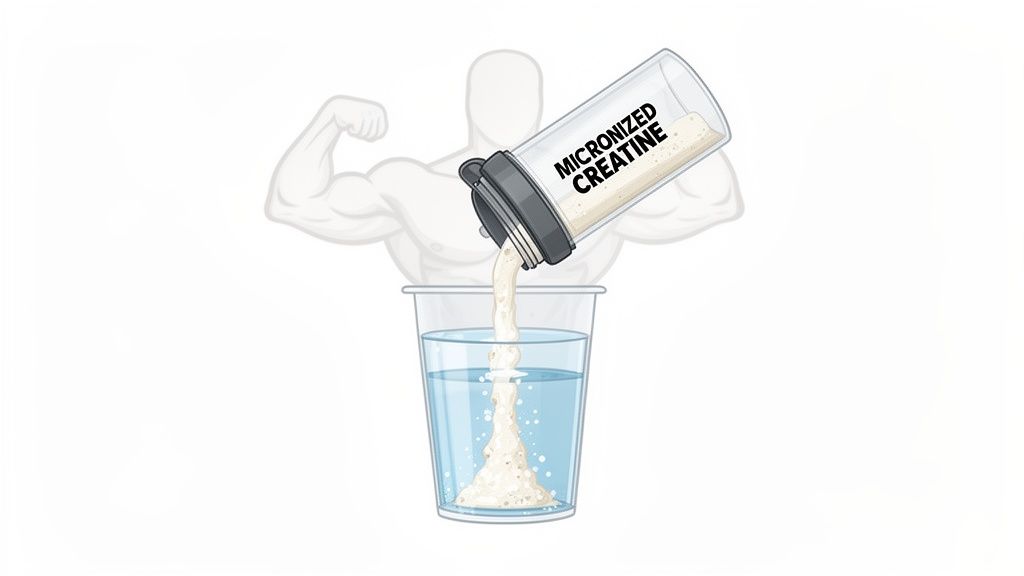
So, what's the deal with the "micronized" tag? It's a fancy term for a high-tech milling process. They take standard creatine monohydrate crystals and pulverize them into microscopic particles up to 20 times smaller.
Picture the difference between a handful of gravel and a scoop of silky, fine-milled flour. That's the leap we're talking about.
This one simple change makes a world of difference. The massively increased surface area is the secret sauce that unlocks a whole new level of performance from one of the most trusted supplements in the game.
The real magic of micronized creatine is in its solubility. When the powder dissolves completely, your body can absorb it way more efficiently. That means less digestive drama and more raw power shuttled straight to your muscles where it belongs.
This is about more than just dodging a chalky texture in your post-workout shake. The real benefits of this advanced processing translate directly into better performance at the gym. Here’s how that tiny tweak makes a huge impact:
Hitting your goals is all about optimizing every part of your routine. While micronized creatine is a huge piece of the puzzle, don't forget the other factors that go into enabling the highest level of performance.
Ultimately, choosing micronized creatine is like upgrading from regular unleaded to high-octane rocket fuel—it's engineered for elite results. This simple switch is exactly why it’s become the go-to for dedicated athletes who demand the absolute best from their supplements and their bodies.
Alright, you've decided to jump on the creatine train to power up your gains. Good call. But as you scroll through endless options, one word keeps showing up: micronized. Is this just some slick marketing term cooked up to get you to spend more money?
Let's cut right to it: not at all. Think of standard creatine monohydrate as the OG—the classic, reliable workhorse that’s built more muscle than just about any other supplement on the planet. It works, period. But micronized creatine? That's the next-gen version, refined and upgraded to solve the very few annoyances of the original.
The magic is all in a process called "micronization." Picture this: you take regular creatine crystals, which are already pretty small, and you blast them through what is essentially a high-tech pulverizer. This process smashes the particles down until they're up to 20 times smaller than the original stuff.
This isn't just about making a finer powder for the sake of it. When you shrink the particle size that drastically, you massively increase the powder's total surface area. It's a simple concept. Imagine an ice cube—it melts slowly, right? But crush that same cube into a fine slush, and it dissolves in a flash. That’s exactly what’s happening with micronized creatine.
This mechanical milling is the secret ingredient that elevates a great supplement into an outstanding one. It directly targets the two biggest complaints people have had about creatine for years: that gritty texture and the potential for stomach upset.
So why does a bigger surface area matter so much? It all comes down to solubility and bioavailability. Because the micronized particles are so incredibly tiny, they dissolve almost perfectly when you mix them into water or your pre-workout. You can finally say goodbye to that sandy sludge at the bottom of your shaker cup.
This isn't just a matter of convenience, either. When creatine actually dissolves properly, your body can absorb it way more efficiently. Better absorption means more of that muscle-fueling goodness actually makes it to your muscle cells, where it's put to work creating explosive energy for your lifts.
There's a reason powdered creatine, especially the micronized kind, absolutely dominates the supplement scene, accounting for 79.3% of the U.S. market. It's a no-brainer: micronized creatine's particle size boosts solubility by a whopping 60%. This virtually eliminates the undissolved grit that can cause stomach issues for the 20-30% of folks who struggle with coarser monohydrate. For serious lifters, this means you can mix it into anything without a second thought. Brands like Crazy Muscle on Amazon have this down to a science, offering products that get to you fast so you never miss a day. If you want to dive deeper into the market data, you can check out the full report on the U.S. creatine market.
Okay, let's bring this back to what you actually care about: your performance in the gym. The scientific advantage of micronized creatine isn't just a cool fact—it leads to real benefits you can feel.
Simply put, micronized creatine isn't a new type of creatine. It's a perfected delivery system. It takes the proven, raw power of creatine monohydrate and makes it more efficient, more effective, and a whole lot easier on your body.
Alright, let's get ready to rumble. In one corner, we have the refined, smooth-mixing champion, Micronized Creatine Monohydrate. In the other corners, you'll find the old-school original, Standard Monohydrate; the flashy newcomer, Creatine HCL; and the highly debated contender, Creatine Ethyl Ester (CEE).
Forget some boring list of pros and cons. We’re throwing these supplements into the ring to see who comes out on top in the real world. We’ll judge them on four things that actually matter: absorption, mixability, side effects, and pure, unadulterated value.
This is the one that started it all—the most studied, most proven sports supplement on the entire planet. Standard creatine monohydrate is effective, it's reliable, and it's dirt cheap. If you don't mind a little grit in your shaker and your stomach is made of steel, it’s a solid choice that has built literal mountains of muscle for decades.
So, what’s the catch? It all comes down to its larger particle size. This is what causes that infamous sandy texture at the bottom of your cup and, for a lot of people, some unwelcome digestive drama like bloating and cramps. Think of it as a trusty old pickup truck: it absolutely gets the job done, but the ride can be a bit bumpy.
Creatine Hydrochloride (HCL) stormed onto the scene with a huge promise: superior solubility. By attaching a hydrochloride group to the creatine molecule, the claim is that it dissolves way better in water. This supposedly means you can take a much smaller "micro-dose" and skip the stomach issues.
Sounds pretty good, right? The problem is the serious lack of long-term human studies to prove it's any better than classic monohydrate. While it definitely mixes well, the evidence that it builds more muscle is thin, and it comes with a much, much higher price tag. For anyone focused on proven results and value, HCL is more of a costly experiment than a reliable staple.
This decision tree breaks it down visually. Standard creatine is the bedrock, but the micronization process refines it into a far superior powder.
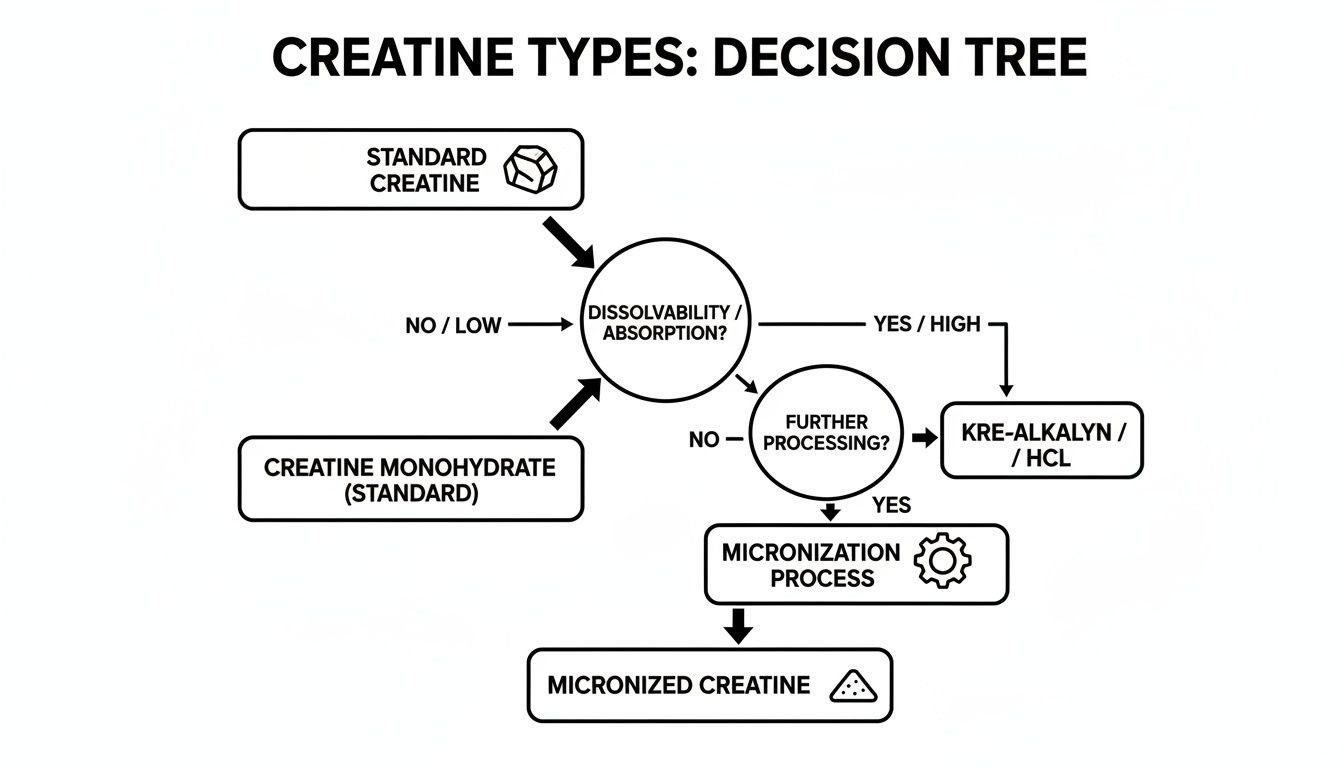
The visual makes it obvious: finding the best micronized creatine is all about understanding this fundamental upgrade in processing, which leads to better results.
Creatine Ethyl Ester (CEE) was marketed as the next big thing, supposedly absorbed directly into muscle cells more efficiently. Unfortunately, the actual science told a very different story. Research has shown that CEE is unstable in the gut and largely converts to a useless waste product called creatinine before it even gets a chance to work.
The result? You get less active creatine for your money, a notoriously awful taste, and no real performance benefit over good old monohydrate. In the supplement world, CEE is a cautionary tale—a perfect example of marketing hype that completely fell apart under scientific scrutiny.
When you cut through all the marketing noise, the evidence is overwhelming. Micronized creatine monohydrate takes the proven power of the original and simply perfects the delivery system. It’s not a different compound; it’s a smarter, more efficient version of what already works.
Now let's break this battle down with a simple, head-to-head comparison. This makes it easy to see why micronized creatine is the clear winner for most athletes.
This table cuts to the chase, comparing the most popular creatine forms on the metrics that count—from how they feel in your shaker to the results you see in the mirror.
| Creatine Type | Key Feature | Best For (User Scenario) | Mixability & Absorption | Our Verdict |
|---|---|---|---|---|
| Micronized | Ultra-fine particles | The lifter who wants proven results without digestive issues or grit. The perfect all-rounder. | Excellent. Dissolves almost instantly, leading to rapid and efficient absorption. | The Undisputed Champ. Offers the best balance of performance, comfort, and value. |
| Standard | Most researched form | The budget-conscious athlete with a rock-solid stomach who doesn't mind a little texture. | Poor to Fair. Often leaves a sandy residue, and absorption can be less efficient. | The Reliable Original. Effective but outdated in terms of user experience. |
| HCL | High solubility claim | The athlete willing to pay a premium to experiment with smaller doses, despite limited evidence. | Excellent. Mixes very easily due to its chemical structure. | The Expensive Gamble. Not enough proof to justify the high cost over micronized. |
| CEE | Disproven absorption theory | Honestly? No one. The science simply doesn't support its use. | Good. Mixes well, but that doesn’t matter if it doesn't work. | The Bust. Stick to forms that are actually proven to deliver results. |
As you can see, when you weigh the evidence, the choice becomes pretty clear.
For an even deeper dive into the specific advantages, feel free to explore our guide comparing micronized vs regular creatine and check out the science for yourself. You need a supplement that’s not just effective but also easy and pleasant to take consistently.
That’s exactly where the best micronized creatine shines. It delivers all the muscle-building, strength-boosting power you expect from creatine, but without any of the classic downsides. It’s the smart, modern choice for anyone who refuses to compromise on quality or results.
Alright, you’re sold on the benefits and ready to find the best micronized creatine money can buy. But one quick search and you're drowning in a sea of tubs, powders, and too-good-to-be-true promises. How do you tell the high-octane fuel from the snake oil?
It’s actually simpler than you think. Let's build a rock-solid checklist so you can spot the premium stuff and leave the pretenders collecting dust on the shelf. This is your guide to investing in pure, potent, and proven gains.
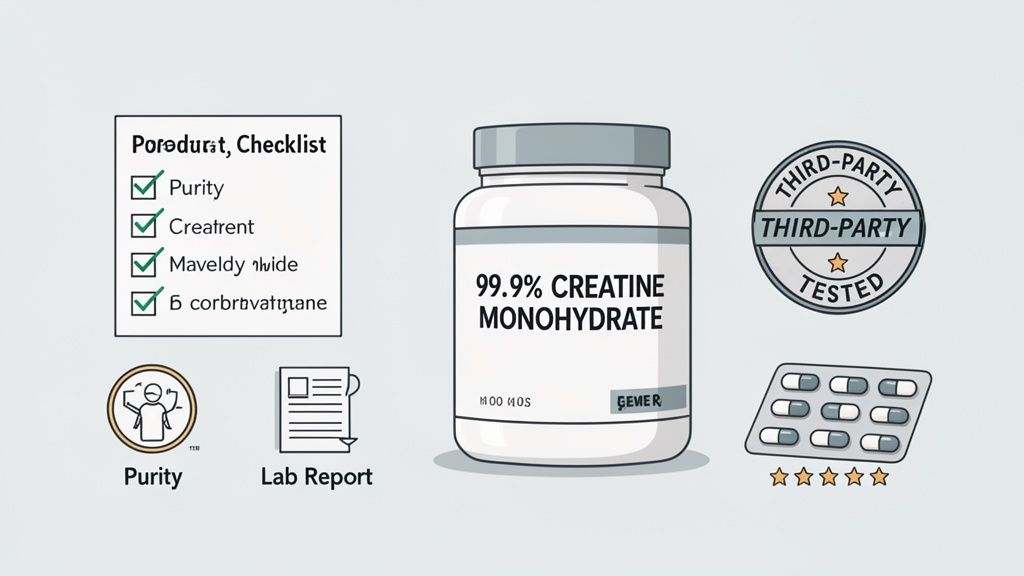
First up, and this is completely non-negotiable: purity. The label on your creatine should be boringly simple, with 99.9%+ pure creatine monohydrate as the main event.
Anything less is a huge red flag. Get ruthless about scanning that ingredients list. If you see unnecessary fillers, binders, or weird chemical names you can’t pronounce, put it back. Your creatine tub should contain creatine. Period.
Remember, the whole point of micronized creatine is its finer particles, which boost bioavailability by up to 20-30% compared to the old-school stuff. This is the key to packing on lean mass without the grit or gut rot. We're talking about a supplement backed by over 500 peer-reviewed papers since the 1990s, all pointing to an 8-14% strength increase and 2-4 pounds of muscle gain in just 4-12 weeks of training.
For any serious lifter, that means heavier sets and faster recovery. It’s exactly why Crazy Muscle boasts a 92% five-star rating from over 150,000 customers who demand nothing less than real results. If you want to dive into the numbers, you can explore the research behind these creatine market facts and see just how potent this stuff is.
In the Wild West of the supplement industry, a company's word just isn't enough. You need proof. That’s where third-party testing comes in—it’s the ultimate seal of approval.
This process sends the product to an independent lab to verify two critical things:
A brand that shells out for third-party testing is a brand that’s confident in its product and has nothing to hide. If you can't easily find a certificate of analysis or a testing seal on their site, just walk away. There are too many great, verified options out there to roll the dice.
Reputation is earned in the trenches, not bought with a flashy ad. A trusted brand like Crazy Muscle builds its reputation one five-star review at a time. When you're picking your creatine, look for companies with a long track record of delivering quality and standing behind their products.
Don’t just glance at the star rating; actually read the reviews. See what thousands of other lifters are saying. Are they praising its mixability? Gushing about their results? Talking about the great customer service? That real-world feedback is priceless.
A solid brand is transparent about its formulas, is easy to get ahold of, and has a loyal following for a reason. They deliver on their promises, every single time.
The last piece of the puzzle is the delivery system. How do you want to get this stuff into your body? It almost always boils down to classic powder versus convenient capsules.
Micronized Creatine Powder
Creatine Capsules
For the ultimate in grab-and-go precision, a high-quality capsule form like Crazy Muscle's Three-Atine, available on Amazon, delivers a perfect dose every time. The choice is yours, but now you're armed with a checklist to confidently pick a product that's pure, proven, and ready to fuel your results.
Alright, you've got your hands on some top-shelf micronized creatine. Now, let's talk strategy. How you use it is the difference between "meh" results and truly turning heads at the gym. Forget all the confusing chatter you've heard online; this is the straightforward, no-BS guide to getting the most out of every gram.

First things first, let's tackle the legendary "loading phase." This is just a fancy term for front-loading your system to saturate your muscles with creatine as quickly as humanly possible. Think of it as hitting the fast-forward button to get to the good part.
The classic playbook looks like this:
This isn't just bro-science. A foundational 1993 study found this method packed muscles with creatine 60% faster than just diet alone. For the trained men in the study, that translated to an 8% strength bump and 2kg of lean mass in just 28 days. It's a result that has been confirmed in over 200 trials since, which is why 70% of pro bodybuilders and 45% of NCAA athletes swear by it.
So, is loading a must? Absolutely not. You can skip it entirely and just start with the 3-5 gram daily dose. It'll take about 3-4 weeks to hit full saturation instead of one. The destination is the same; loading is just the express train.
Now for the question that has fueled a million forum arguments: when is the perfect time to take creatine? The truth is, the science is way less dramatic than the internet would have you believe. While taking it post-workout might have a tiny edge, the real champion is consistency.
Let's look at the facts:
At the end of the day, the difference between taking it before or after a workout is incredibly small. The most important thing—and I can't stress this enough—is to take it every single day, even on rest days. That’s how you keep your creatine tanks full, so the power is always there when you need to dig deep.
If you want to fine-tune your exact daily amount, check out our guide on how much creatine you should take to personalize your plan.
The bottom line is refreshingly simple. Don't tie yourself in knots over it. Just get 3-5 grams of micronized creatine in your body every day. Toss it in your morning shake, your pre-workout, or your glass of water. The best time to take it is whenever you'll remember to take it consistently. That simple habit is the real secret.
Alright, let's cut through the crap. The gym floor is a rumor mill, and internet forums are even worse when it comes to creatine. You'll hear all sorts of myths and just plain bad advice. We’re here to give you the straight-up, no-nonsense answers to the questions that pop up constantly. Think of this as your official myth-busting session.
You’ve got the background, you know what to look for, and now it’s time to put those nagging doubts to rest. Let's get you focused on what actually matters—absolutely demolishing your workouts.
Let's tackle the biggest boogeyman in the creatine closet: the dreaded bloat. Here's the real deal: creatine works by pulling water into your muscle cells. This is called intracellular hydration, and trust me, it’s a good thing. It’s what gives you that fuller, more pumped look and directly fuels your performance.
This is completely different from that puffy, under-the-skin look people call "bloat." That problem usually comes from cheap, gritty creatine that doesn't dissolve properly. It just sits in your gut, drawing water there and causing a digestive mess.
Because the best micronized creatine dissolves so well, it sidesteps all that gut drama and dramatically reduces the risk of bloating. Any initial weight you see on the scale is just functional muscle volume—water inside the muscle, not fat or puffiness.
One word: absolutely. The science on this is about as solid as it gets. Creatine monohydrate is easily one of the most researched sports supplements on the entire planet. Decades of studies have shown time and time again that it's incredibly safe for long-term use in healthy people.
Obviously, you need to stick to the recommended dosages—don't go scooping it like it's ice cream. But for the average person in the gym trying to make consistent progress, the scientific verdict is crystal clear: creatine is safe, it works, and it's a trusty tool for your arsenal.
If you're curious about what happens if you stop taking it or other common concerns, we've got a whole guide that dives deep into potential creatine side effects.
Let's put this old-school myth to bed once and for all. The whole idea of "cycling" creatine—taking it for a few weeks, then taking a break—is a leftover from the supplement stone age. Modern research has clearly shown there is no scientific benefit to cycling creatine.
In fact, it's just shooting yourself in the foot. The entire goal is to keep your muscle creatine stores topped off and ready to go at a moment's notice.
Yes, and you totally should! This is one of the best things about a quality micronized creatine. It’s practically tasteless and vanishes when you mix it, making it the perfect sidekick for your other supplements. No clumps, no grit, no ruining your favorite protein shake.
A pro move is to toss it right into your post-workout protein shake, especially if it has some carbs. That little insulin spike from the carbs can help push the creatine into your muscles even faster, kickstarting your recovery and growth immediately.
It's this easy integration that makes micronized creatine a no-brainer. It slots right into your existing routine and boosts your results without making your life more complicated. All the power, none of the hassle.
Ready to feel the difference for yourself? Crazy Muscle offers premium, third-party tested creatine designed for maximum purity and mixability. Stop settling for gritty, ineffective supplements and fuel your gains with a product trusted by over 150,000 athletes. Find the perfect creatine for your goals on our Crazy Muscle Amazon store and get ready to unlock your true potential.

Sign up and save 10% off your next order