
Creatine Monohydrate Side Effects Uncovered What Science Says
Posted by Maximus
on

You've heard the whispers in the gym locker room and probably seen some wild headlines online. The conversation around creatine monohydrate side effects is often packed with more fiction than a superhero movie.
But here’s the real scoop: for most healthy people, creatine is one of the safest and most scientifically-backed supplements you can get your hands on. Period.
Let's cut right to the chase. You want to build muscle, smash your PRs, and get every ounce of benefit from your hard work. You've heard creatine is the ticket, but you're understandably hesitant about the potential horror stories.
Does it trash your kidneys? Is it going to leave you dehydrated and cramping mid-set? Are you going to wake up looking like the Michelin Man?
The answer, overwhelmingly, is a big, fat "no." Those fears are almost entirely rooted in ancient, debunked ideas, simple misunderstandings, or just plain old gym lore.
For decades, scientists have put creatine under the microscope from every possible angle, and it consistently comes out with a sparkling safety record. It's not some strange chemical brew; think of it more like a supercharged version of an energy source your own body naturally produces.
Before we dive deep, let's clear the air with a quick side-by-side comparison of the most common tall tales you've probably heard.
| Common Myth | Scientific Reality | What It Means For You |
|---|---|---|
| "Creatine will destroy your kidneys and liver!" | Decades of research on healthy individuals show no harm to kidney or liver function. | As long as you don't have a pre-existing kidney condition, you're in the clear. |
| "It causes severe dehydration and cramping." | Creatine actually increases water content inside your muscle cells, improving hydration. | Stay hydrated like you normally would. Cramping is more likely due to electrolyte imbalance or fatigue, not creatine. |
| "Creatine makes you bald." | This is based on a single, small study from 2009 that has never been replicated. | There's no solid scientific evidence linking creatine to hair loss. Your hairline is safe. |
| "It's a steroid." | Nope. Not even close. Creatine is a naturally occurring amino acid compound; steroids are synthetic hormones. | Creatine is legal, safe, and works by boosting your body's natural energy cycle, not by manipulating hormones. |
| "You'll gain a ton of fat." | The initial weight gain is water being pulled into your muscles (a good thing!), not fat. | You'll look fuller and more muscular, not softer. The scale might go up, but your body composition will improve. |
This table is just the tip of the iceberg, but it shows how thoroughly these myths have been busted. The "dangers" just don't stand up to real science.
You don't just have to take my word for it—the data is ridiculously clear.
A massive analysis looked at 685 clinical trials with over 26,000 participants. The result? Only 4.6% of creatine users reported any side effects at all. And the placebo group? 4.2% of them reported side effects. That difference is so small it’s basically a statistical rounding error. You can read the full research about these findings yourself to see just how solid the evidence is.
That means someone taking a harmless sugar pill was just as likely to complain about an issue as someone taking actual creatine. The biggest "side effect" is usually what you want: more strength and fuller-looking muscles.
The overwhelming scientific consensus is that creatine, when used as directed by healthy individuals, is exceptionally safe. The laundry list of rumored side effects simply doesn’t hold up under scientific scrutiny.
So, what does this all mean for you in the real world? It means you can supplement with total confidence.
This guide is going to walk you through every common concern, one by one, and replace that fear with facts. We'll show you why this powerhouse supplement has earned its top-tier reputation—not just for its incredible benefits, but for its remarkable safety.
Ready to unlock your potential without the worry? Let's dive in and get you the gains you're after with a top-tier product from our Crazy Muscle Amazon store.
Let's get right into it and tackle the two most stubborn, zombie-like myths about creatine that just won't die: that it'll leave you cramping on the floor and as dehydrated as a forgotten houseplant. If you've heard these tales, you're not alone. They’re the old-school boogeymen of the supplement world, usually born from outdated thinking and a big misunderstanding of how creatine actually works.
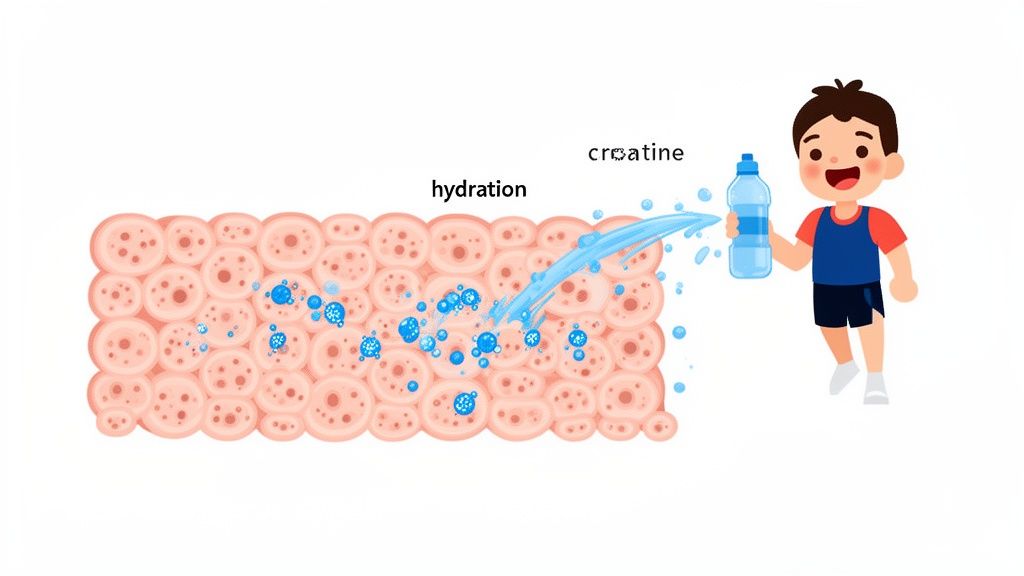
The fear goes something like this: creatine pulls water into your muscles, so it must be stealing that water from the rest of your body, right? On the surface, it sounds logical. But it’s a classic case of seeing one tiny piece of the puzzle and missing the bigger, much cooler picture.
It’s time to flip that fear on its head. The science is crystal clear: creatine doesn't cause dehydration. In fact, it actually improves your hydration status where it matters most—inside your muscle cells.
So, what's really going on in there? When you take creatine, it heads straight for your muscles and starts to build up. Because creatine is what’s known as an osmotically active substance, it pulls water in along with it.
Imagine your muscle cells are tiny, high-performance engines. Creatine helps them draw in more fluid, a process called cell volumization. This isn't a problem; it's a massive performance upgrade!
This extra water inside your cells does a few awesome things:
So, instead of seeing creatine as a water thief, think of it as a VIP escort service, delivering water directly where you need it for peak performance and growth. You're not getting dehydrated; your muscles are getting super-hydrated.
The idea that creatine causes dehydration is a complete misinterpretation of its mechanism. It pulls water into muscle cells, which is a key part of how it improves performance and stimulates growth.
Alright, but what about the muscle cramps? This myth is usually the sidekick to the dehydration rumor. The thinking is, if you're dehydrated, you're more likely to cramp. Since the dehydration part is flat-out wrong, the foundation for the cramping myth crumbles right along with it.
But we don’t have to rely on logic alone. We have fantastic, real-world data that slams the door on this myth for good.
One of the best studies on this followed collegiate football players through an entire grueling season. The results were stunning. Not only were the concerns about cramps and dehydration debunked, but the creatine users actually experienced significantly fewer cramps, muscle strains, and total injuries compared to the players who weren't taking it. They also showed no difference in dehydration or heat illness. Discover more insights about these findings and see how the science clears creatine's name once and for all.
This means that far from being a risk, creatine supplementation—when you're also being smart about your hydration—appears to be protective. It helps your muscles perform better under stress and may even reduce your risk of getting hurt.
The bottom line is simple: stay on top of your water intake, just as any dedicated athlete should. When you do that, creatine won't cause dehydration or cramps. Instead, it will help you build stronger, fuller, and more resilient muscles. Ready to feel the difference? Grab some of our premium Three-Atine creatine on Amazon and get to work.
Alright, let’s tackle the elephant in the room—or, more accurately, the number on the scale. You start taking creatine, and a week later, boom, you’re up a few pounds. Cue the panic, right?
Not so fast. This is the one "side effect" you should actually be happy about. It’s the first clear sign that the creatine is working exactly like it's supposed to.
This initial jump in weight isn't fat. It's water, but not the puffy, soft kind you're thinking of. This is muscle volumization, and it's the launchpad for building real, permanent muscle.
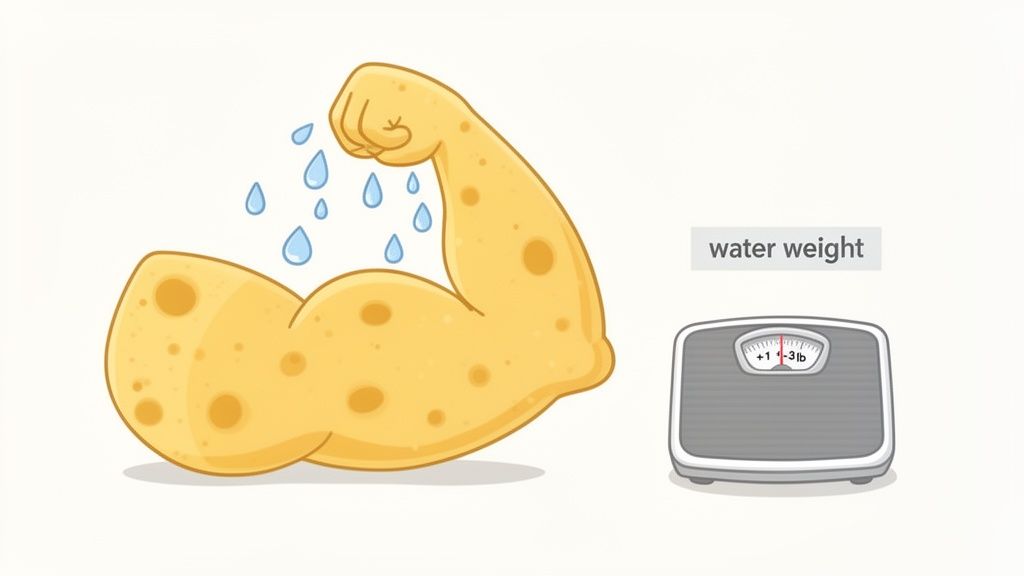
Here’s an easy way to picture what’s happening. Imagine your muscle cells are like tiny, compressed sponges. They're strong, sure, but they don't have a lot of size.
When you take creatine, it heads straight for those muscle cells and gets stored inside. Think of creatine as a water magnet. As it builds up, it pulls water right in along with it, forcing those "sponges" to soak up fluid and expand.
This process is called osmosis—water moving to where the party's at (in this case, where the creatine is). Suddenly, your muscles look and feel fuller, denser, and have that awesome "pumped" look. This is the good stuff.
You can expect this initial water retention to add 1 to 3 pounds to the scale in the first week. See it for what it is: a fantastic sign that your muscles are primed and ready for serious growth.
Now, it’s super important to know the difference between this healthy muscle hydration and the dreaded stomach bloat. They are not the same thing.
The water we're talking about is drawn inside your muscle cells (intracellular). This is exactly where you want it. It's completely different from the subcutaneous water (under the skin) or gut bloating that can make you feel soft and sluggish.
People mix these two up all the time. If your stomach feels off, that's a product quality issue, not a normal function of creatine. You can get the full scoop on this by checking out our guide on whether creatine makes you bloated.
The weight gain from creatine is your muscles becoming super-hydrated and volumized. It's a powerful physiological effect that creates a more anabolic environment, setting the stage for long-term lean muscle gain.
So, how does this temporary water weight lead to permanent gains? Simple. That extra water inside your muscles does more than just make them look bigger.
First, it literally improves your leverage and strength in the gym. This lets you push heavier weight for more reps—and that increased workload is the number one driver of muscle growth.
Second, the cell swelling itself sends an anabolic signal to your body, basically screaming, "Build more muscle!" This kicks protein synthesis into high gear.
It's the perfect one-two punch. The water gives you an immediate boost in size and strength, and that newfound strength is what you use to build lasting muscle mass over time. The water weight is the catalyst, not the final product.
Of all the boogeymen lurking in the supplement aisle, the idea that creatine wrecks your kidneys is probably the scariest. It’s the kind of rumor that has you second-guessing your pre-workout scoop, picturing a future of dialysis instead of deadlifts.
Let’s put this fear to bed, once and for all. This myth is built on a massive—and frankly, simple—misunderstanding.
The whole panic boils down to a classic case of mistaken identity between two words that sound almost the same: creatine and creatinine. It's like confusing Thor, the god of thunder, with some random guy named Thor from accounting. They share a name, but their jobs are very different.
You don't need a PhD in biochemistry to get this. Let's use an analogy.
Think of your muscles as a high-performance engine.
When you take creatine, you're just giving your engine a better fuel source. Naturally, a more powerful, harder-working engine is going to produce a little more exhaust. It's a sign that things are running great, not that the engine is about to blow a gasket.
This is where the wires get crossed. To check kidney function, doctors measure creatinine levels in your blood. High levels can be a sign that your kidneys (the body's filtration system) aren't clearing out waste properly.
So, when a lifter who takes creatine gets a routine blood test, their creatinine might come back a bit elevated. An uninformed doctor or a quick Google search might scream, "Kidney damage!"
But they'd be dead wrong. The levels are up for two perfectly harmless reasons:
This slight bump isn't a red flag; it's a predictable consequence of being strong and supplementing smart. Countless studies, some lasting up to five years, have hammered this point home: for healthy people, creatine poses no threat to kidney function. Your kidneys are more than equipped to handle the tiny extra workload.
An elevated creatinine level in someone who lifts and takes creatine is usually a sign of bigger muscles and effective supplementation—not failing kidneys. It’s a mathematical side effect, not a medical crisis.
Okay, let's be responsible here. This all-clear safety profile is for people with healthy, functioning kidneys.
If you have a pre-existing kidney condition or a strong family history of renal disease, the game changes. Your body's filtration system is already working with a handicap. In that case, adding any extra variable without a doctor's supervision is a bad move. You must talk to your physician before even looking at a tub of creatine.
For the other 99% of us? You can relax. Your kidneys are fine. Myth busted.
Now you can get back to focusing on what creatine actually does—helping you get stronger and more powerful with one of the most proven supplements ever. Feel free to check out some top-tier options on our Crazy Muscle Amazon store.
Alright, we’ve kicked the myths to the curb and laid out the science. Now for the fun part: actually using creatine to get stronger, build muscle, and leave any worries in the dust. This is your no-nonsense playbook for getting it right from day one.
Forget about over-the-top protocols or confusing bro-science. Using creatine the right way is almost laughably simple. It all boils down to a couple of key choices and sticking to the basics—dosing, timing, and the number one rule you can't ignore: hydration.
The first question that pops into everyone’s head is, “Do I have to do a loading phase?” This is where you take a bigger dose, usually 20 grams per day (split into four 5-gram servings), for about 5-7 days before dropping to a smaller “maintenance” dose.
The whole point of loading is to cram your muscles full of creatine as quickly as possible. It works, and you'll feel the effects faster. But, it's also the main reason some people feel a little bloated or get an upset stomach at the start.
Then there’s the slow-and-steady route. You just skip the loading phase and jump straight into the standard 3-5 grams per day. It takes longer to fully saturate your muscles—think three or four weeks—but the final destination is exactly the same. You just bypass any potential for those initial tummy grumbles.
So, which path is for you?
Honestly, the maintenance dose is the way to go for most people. It's easier, gentler on your system, and you'll end up in the exact same place.
Once you’ve picked your starting strategy, your daily routine becomes incredibly simple. Nailing these fundamentals is what separates killer results from "meh" results.
Here’s your step-by-step guide:
This simple decision tree nails the most critical safety question for anyone on the fence about creatine.
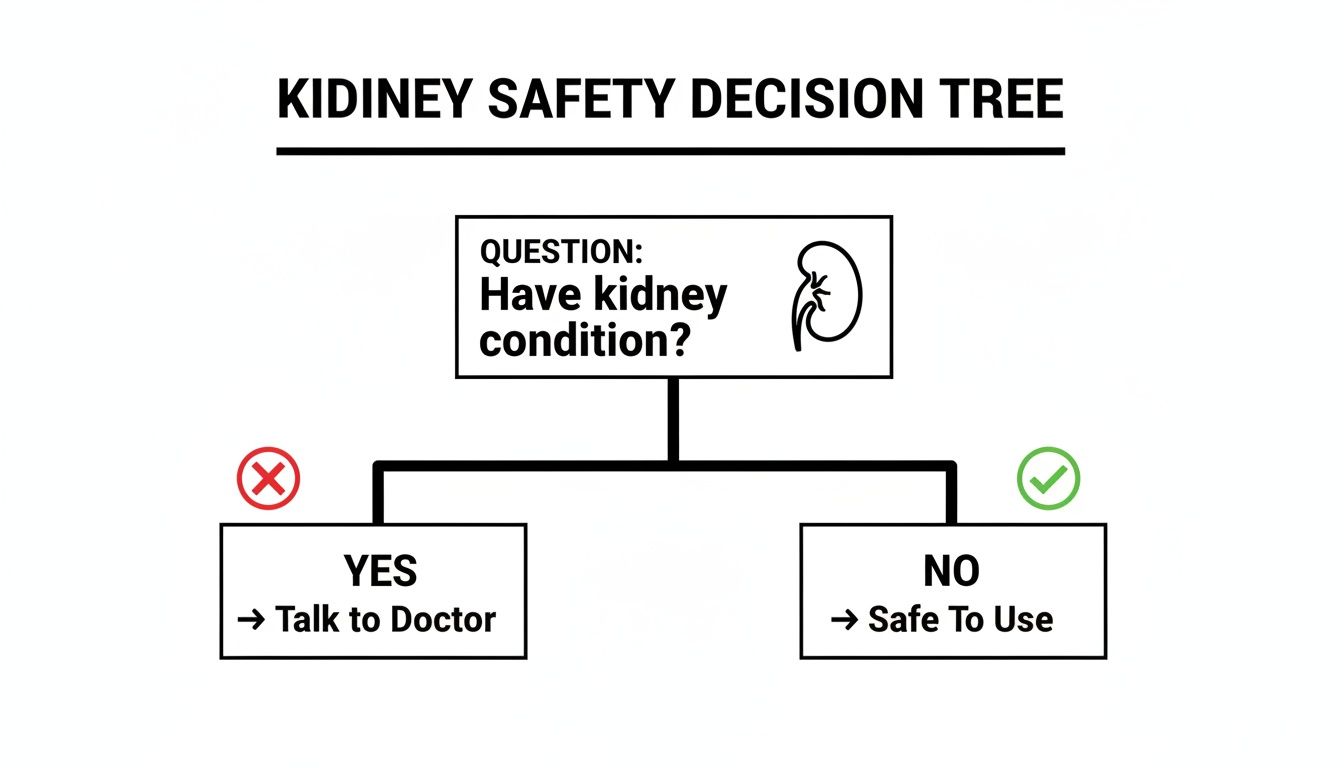
The takeaway is crystal clear: for anyone with healthy kidneys, creatine is a proven and safe tool. But if you have any pre-existing kidney issues, a chat with your doctor is a non-negotiable first step.
By following this simple plan, you’re putting yourself in the express lane for gains. And when it comes to adding this powerhouse to your routine, quality matters. For those looking to build a complete supplement plan, checking out the best supplements for bodybuilding can give you the bigger picture.
When you're ready to feel the difference a premium product makes, grab your bottle of our Crazy Muscle Three-Atine Creatine right here on Amazon and start building the strength you've been working for.
Alright, we’ve tackled the big stuff—kidneys, bloating, you name it. We've separated fact from fiction and hopefully put your major concerns out to pasture. But there are always a few lingering questions that pop up, the kind you might type into Google late at night.
Consider this the lightning round. We’re here to give you quick, straight-up answers to those last nagging queries so you can move forward with 100% confidence.
Let's get this one out of the way, because it's probably the most stubborn creatine myth on the internet. The entire "creatine causes baldness" scare is built on the shakiest of foundations: a single, small study from all the way back in 2009.
That one study noticed that creatine might nudge up levels of DHT, a hormone linked to male pattern baldness. Here's the kicker: the study never actually measured hair loss. Not even once. It was a tiny clue in a puzzle that didn't even show the full picture.
Since then, over a dozen more direct studies have searched for a real-world link and have come up completely empty-handed. They've consistently found no significant change in testosterone or DHT levels, and zero connection to increased hair loss. For the vast majority of us, your hairline is perfectly safe. If you want to bury this myth for good, check out our full deep-dive on creatine and hair loss.
This is a fantastic question, and it deserves a careful answer. While most creatine research focuses on adults, a growing body of evidence on adolescent athletes shows it’s both safe and effective when used responsibly.
But "responsibly" is the key word here. For a younger athlete, there are a few non-negotiables:
The International Society of Sports Nutrition—a real authority in this space—agrees that creatine can be a fine choice for teen athletes under these circumstances. But the golden rule is this: a teenager should always, always talk to a doctor or registered dietitian before starting creatine. It’s the only way to be sure it’s the right call for their specific body and goals.
For young athletes in competitive, coached sports, creatine has a strong safety profile. But this decision should always be made with a healthcare professional to ensure it’s appropriate.
Nope! This is a classic case of old-school supplement logic being misapplied. The whole idea of "cycling" came from things like stimulants or hormonal products, where your body might build up a tolerance or where constant use could mess with its natural production.
Creatine is a different beast entirely. Your body doesn't "get used to it," and it doesn't shut down its own creatine production in any harmful way.
In fact, long-term studies—some running for as long as five years—show that taking creatine continuously every day is perfectly safe and effective. Taking a break doesn't "reset" its power; it just lets your creatine levels drop back to your normal baseline. To keep your muscles fully saturated and reaping the rewards, just stick with your daily 3-5 gram dose. No need to overcomplicate it.
Honestly? Nothing. Don't sweat it for a second.
Think of your muscle creatine stores like your phone's battery. Your daily dose is what keeps it topped off at 100%. If you miss a day, the battery just dips a tiny bit, maybe down to 95%. It would take a solid 3 to 4 weeks of taking nothing at all for that battery to drain completely back to its starting point.
So, if you forget a dose, just get back on the horse the next day with your regular 3-5 gram scoop. There's zero need to "double up" or do some weird mini-loading phase to play catch-up. Consistency over the long haul is what matters, and one missed day is just a tiny blip on the radar. Relax and stick to the plan.
You've made it. You've waded through the myths, the science, and the real-world advice. You now know the truth: creatine monohydrate is one of the safest and most proven tools you can have in your fitness arsenal. The scary side effects are almost entirely myth or incredibly minor. You’re ready to build muscle, smash PRs, and do it with complete peace of mind. To make sure you’re fueling that journey with the best, trust the brand over 150,000 customers rely on. Grab your Crazy Muscle creatine from our official Amazon store and feel what a difference quality makes.

Sign up and save 10% off your next order