
Does Creatine Expire? The Cold, Hard Truth About Its Shelf Life
Posted by Maximus
on

You're staring at a tub of creatine, the date has long passed, and you're wondering—is this expensive dust or is it still pure muscle fuel? Let’s cut the BS. I’ve got ridiculously good news for you: high-quality creatine monohydrate is unbelievably stable.
Think of it less like a carton of milk and more like a jar of honey. It’s built to last for years, not weeks.
Let’s be real. You found that half-used tub of creatine hiding behind the protein powder, glanced at the date, and had a minor panic attack. Don't you dare toss it.
That "best by" or "expiration" date isn't a magical kill switch. It’s the manufacturer's CYA move to guarantee peak quality and potency up to that point. It's a ridiculously conservative estimate, usually set about two years after the stuff was made.
But here’s the secret the supplement industry doesn't always broadcast: creatine monohydrate is a chemical rockstar. Its molecular structure is tougher than a two-dollar steak and doesn't just fall apart. As long as you treat it right, it sticks around.
The chart below really drives this point home, showing just how stupidly resilient creatine is under different storage conditions.
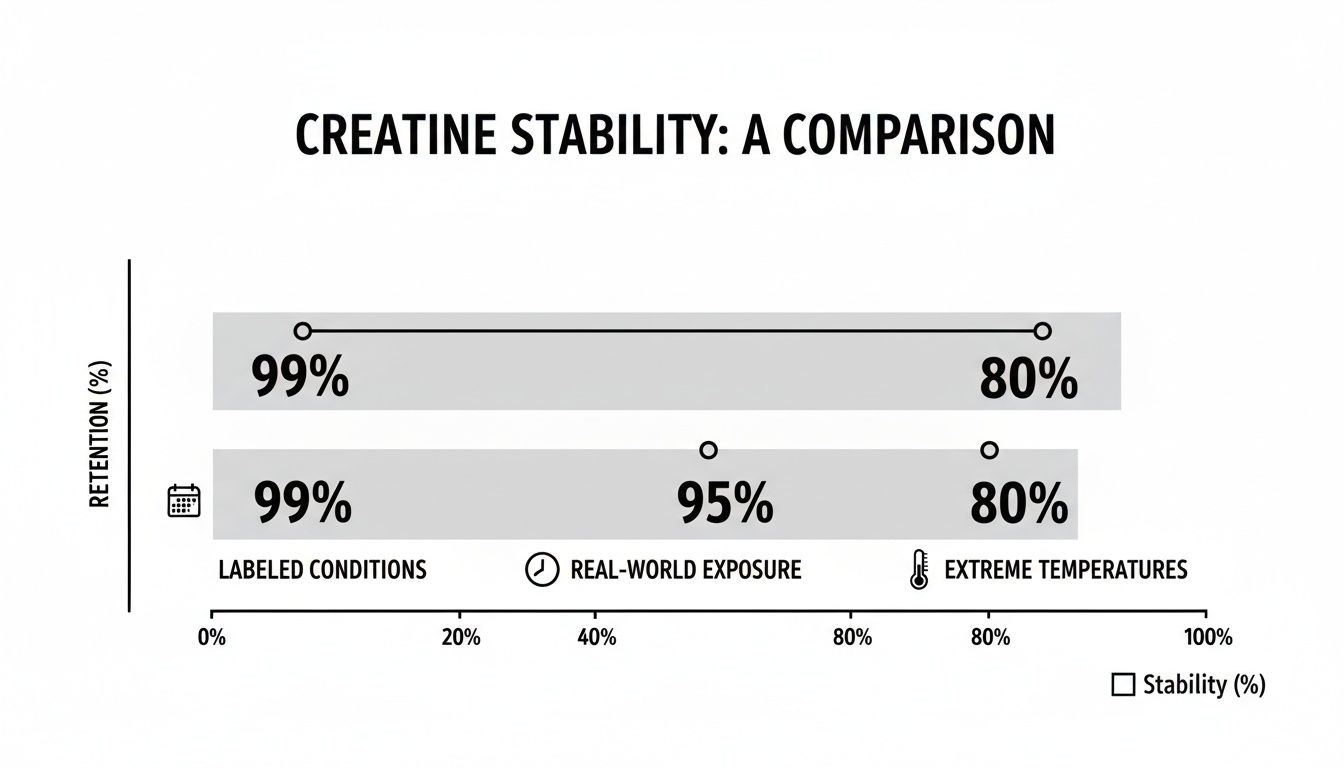
As you can see, creatine keeps nearly all its muscle-building punch way past the date on the label, even when things get a little warm.
So, what's the real story? Here's a quick and dirty breakdown of what the label whispers versus what science screams from the rooftops.
| Factor | What the Label Suggests | What Science Confirms |
|---|---|---|
| Shelf Life | A very safe 2-3 years after the manufacturing date. | High-quality creatine monohydrate remains stable and effective for 3 years or even longer. No joke. |
| Degradation | Implies rapid loss of potency after the expiration date. | Extremely slow degradation. It takes years of abuse for any significant breakdown to occur. |
| Safety | Suggests potential safety risks after the printed date. | As long as it hasn't turned into a moldy science experiment, it's considered perfectly safe well past its "best by" date. |
The bottom line? The dates on your tub are more of a "best quality" guideline than a strict expiration.
Creatine’s only true kryptonite is moisture and extreme heat over a long, long time. Keep it sealed and dry, and it holds its ground like a champ.
How do we know this? Because scientists in lab coats love to torture supplements. Rigorous stability studies have put it to the test. The research shows that creatine monohydrate can hang out at temperatures up to 104°F (40°C) for 3-4 years or more with no significant breakdown into its useless byproduct, creatinine. That's some serious staying power.
The key takeaway is simple: as long as your creatine powder has been stored in a cool, dry place and looks, smells, and feels like it should, it's almost certainly safe and effective.
So, what does this mean for that "expired" tub in your cabinet? You can be confident you’re not just scooping worthless powder. The true power of creatine comes from its simple, stable nature—which is exactly why it’s a non-negotiable staple for athletes everywhere.
To get a better grasp on why this simple molecule is so vital for your workouts, check out our guide on how creatine works to fuel your muscles.
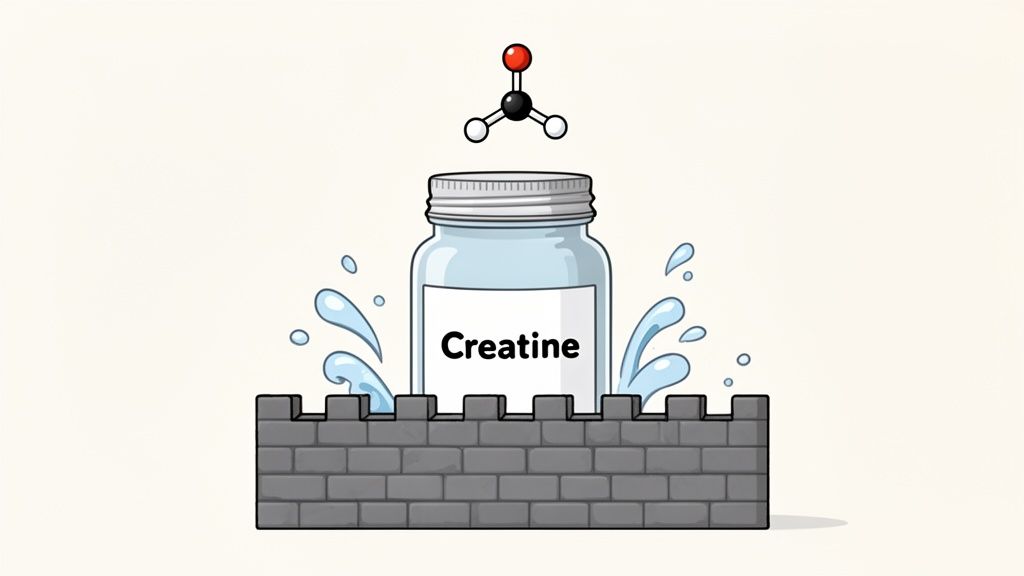
So, what’s the secret sauce that gives creatine its incredible shelf life? It’s not some lab-brewed magic, just rugged, simple chemistry. The real hero here is the molecular structure of creatine monohydrate, which just so happens to be the most proven and trusted form you can get.
Picture each creatine molecule as a tiny, well-built fortress. It’s naturally engineered to be tough and resist breaking down. Unlike more delicate compounds, it doesn't just fall apart while sitting on your shelf.
This built-in stability is why a tub of good creatine powder is such a solid investment for your training. Its only job is to get to your muscles and fuel your performance, not to degrade in the container. If you want to dive deeper into the basics of this awesome supplement, check out our guide on what creatine monohydrate is.
Every superhero has a weakness, and for creatine, it's plain old water. When creatine powder is exposed to moisture for a long time, it kicks off a slow conversion process.
Basically, the potent creatine starts turning into its lazy, useless cousin, creatinine. While creatinine is a harmless waste product your body just flushes out, it’s not going to do squat for you when you’re trying to hit a new PR.
The bottom line is simple: as long as your creatine powder stays dry, it stays powerful. You win the battle by keeping the lid on tight and storing it far away from humid spots like a steamy bathroom. Seriously, don't store it in the bathroom.
This is exactly why the form of the supplement matters so much. Powdered creatine, like the kind we make at Crazy Muscle, is designed from the ground up for maximum stability and a long shelf life, so you can scoop with confidence.
What about heat? We all get a little nervous about leaving supplements in a warm car or a stuffy garage. While you should absolutely aim for a cool, dry storage spot, creatine is way tougher against heat than you’d expect.
Manufacturers usually slap a "best by" date on the tub that’s about two years from production, but that's them playing it safe for the lawyers. Stability testing tells a much more impressive story. Research shows creatine monohydrate can stay perfectly stable for 1-2 years longer than its printed date if stored correctly.
It can even take some serious heat without turning toxic. One study found that even at a blistering 140°F, it took 44 months before any significant amount of creatinine showed up. That’s almost four years of baking!
This scientific evidence confirms that your creatine is a seriously durable ally. It's interesting to see how different products are designed for longevity, from workout supplements to things like vegan shelf-stable protein snacks. By starting with a quality product and storing it right, you can be sure every single scoop is as effective as the first.

While creatine is ridiculously stable, it's not invincible. Its kryptonite? Moisture. That’s the big one. So, how can you tell if your trusty tub of gains fuel has taken a hit and turned into a clumpy, useless brick?
Forget the chemistry set and lab coat. All you need are your own built-in sensors. We call it the "Look, Smell, Feel" test—a quick, three-step checkup that tells you everything you need to know. Think of it as your personal quality control to make sure every scoop is as effective as the first.
It's time to play detective. The prime suspect is always moisture, and it leaves behind some pretty obvious clues. The good news? You don't need Sherlock Holmes to solve this case.
First things first, pop that lid and take a good, hard look inside. Fresh, top-shelf creatine monohydrate should be a fine, consistent white powder. A few small, soft clumps that break apart with a gentle nudge are perfectly normal—that's just from settling. You’re on the hunt for much bigger problems.
Here’s what you're looking for:
These visual hints are your most reliable indicators that your creatine has been compromised. The difference between product types, like we break down in our micronized creatine vs. regular creatine article, is subtle—but spoilage is anything but.
Next, the smell test. This one couldn't be simpler: good creatine should have no smell at all. If you take a sniff and get a whiff of anything musty, sour, or funky, something has gone wrong. A strange odor is a dead giveaway that moisture has invited some unwanted bacterial party guests.
Finally, get a feel for it. Scoop a little bit out. It should feel like fine sand or a soft powder. If it feels damp, sticky, or has a weird, gritty texture, you've got more proof of moisture contamination.
The bottom line is simple: Does it look, smell, and feel the same as it did when you first opened it? If the answer is a resounding "yes," you're good to go. If not, it's time to get a fresh tub.
Protecting your investment is a piece of cake. Just store your Crazy Muscle creatine in a cool, dry place like a pantry—and for the love of gains, keep it out of the steamy bathroom. Always screw the lid on tight after every single use. That's it. Keep the moisture out, and you'll keep your creatine pure and powerful for years.
Alright, let's talk about that little date stamped on the bottom of your creatine tub. You know the one. You squint, turn it to catch the light, and wonder if it's a hard deadline for your gains. Is your creatine about to self-destruct?
Relax. It's not a ticking time bomb. But those dates can be confusing, so let's clear things up once and for all.
You'll typically see one of three things printed on the label:
Here’s the big takeaway: these dates are all about quality, not safety.
So why the conservative dates? Simple: manufacturers would rather err on the side of caution.
They usually stamp a date about two years out from production because they have to account for the worst possible journey your tub could take. Imagine it sitting in a sweltering warehouse in Arizona or a damp stockroom in Florida before finally making its way to you. They set the date to ensure that even under those less-than-ideal conditions, you still get a top-notch product.
But as we've established, pure creatine monohydrate is a beast. It practically scoffs at these conservative estimates.
The date on the tub is a guideline for peak freshness, not a magical cut-off point where your creatine suddenly stops working or becomes harmful.
This simple fact puts the power back in your hands. You don't have to panic and toss a tub just because it's a month or two past its "best by" date. Instead, you can use your own senses—the look, smell, and feel test we went over—to make a smart call.
Ultimately, reading the label is easy once you know the code. The date is just the company's promise of perfection, but science tells us your creatine has a much, much longer life. When you grab a high-quality product from our Crazy Muscle Amazon store, you're getting a supplement that's built to last, giving you peace of mind that every scoop is money well spent.
It’s a moment every lifter knows and dreads. You pop the lid off your creatine tub, ready to fuel up, only to find a solid, white brick where a fine powder used to be. Your first instinct might be to sigh, curse the supplement gods, and toss the whole thing in the trash.
Hold up. Don’t you dare do it.
That clumpy creatine is not a lost cause—not even close. This is probably the most common "problem" people run into, but it’s also the most misunderstood. It isn’t a sign that your creatine has spoiled, gotten contaminated, or magically gone bad. It’s just one thing: moisture.
Creatine monohydrate is hydrophilic, which is just a fancy science term for saying it loves water. It eagerly pulls moisture from the air, and when those tiny powder particles get a little damp, they cling to each other for dear life. That's it. There’s no scary chemical reaction happening, and there's no loss of muscle-building power.
Think of it like brown sugar turning into a rock in your pantry. Is it a little annoying? Sure. Does it mean the sugar is bad? Absolutely not. Clumpy creatine is just powder that’s gotten a little too cozy and is waiting to be broken up and put to work.
The potency and safety are completely unaffected. Each gram of that creatine brick still packs the same performance-boosting punch you paid for. Throwing it out is like throwing away perfectly good cash just because the bills got a little wrinkled. It makes zero sense.
Here's the bottom line: clumping is a physical change, not a chemical one. As long as your tub doesn't have any other red flags—like a weird smell or strange discoloration—those clumps are perfectly safe and effective to use.
So, the next time you find a creatine rock, you can skip the panic and just get to work.
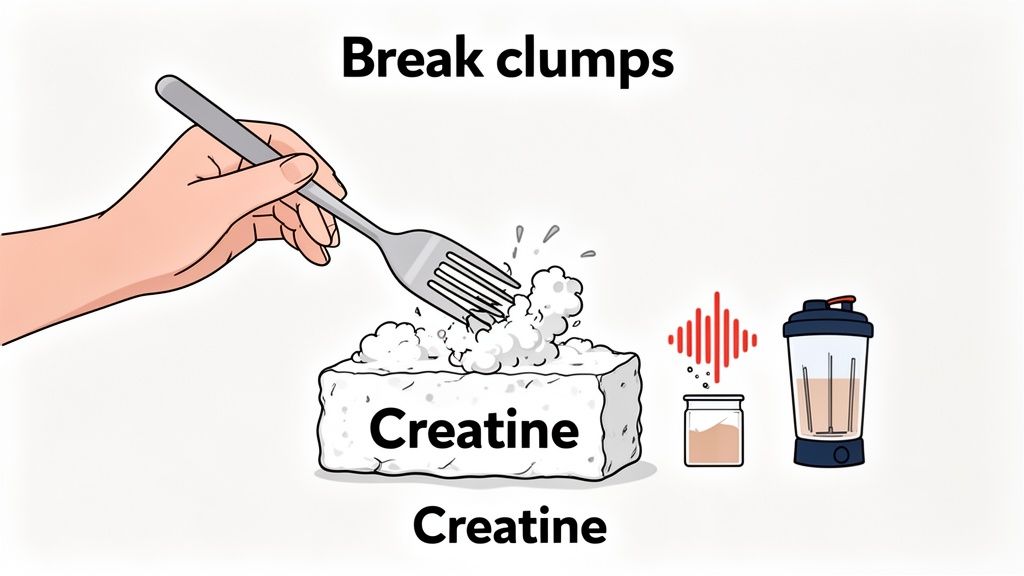
Ready to rescue your gains? Breaking up clumpy creatine is way easier than hitting a new deadlift PR. You don't need any special equipment, just a bit of elbow grease. Here are a few dead-simple ways to turn that rock back into powder:
Once you’ve broken it up, your creatine is ready for action. And hey, if you’re tired of dealing with clumps and want a consistently pure powder that mixes like a dream, you know where to look. Check out our top-rated Crazy Muscle creatine on Amazon. Your muscles will thank you.
So, you're now a bona fide expert on creatine's incredible shelf life. You get it: quality is king, proper storage is your best friend, and that "best by" date is more of a gentle suggestion than a hard-and-fast rule.
The final piece of the puzzle? Starting with the best possible creatine you can get your hands on.
That’s where we come in. At Crazy Muscle, we live and breathe this stuff. We know that the bedrock of any killer supplement is purity. Our Crazy Muscle Creatine Monohydrate is the gold standard—a clean, no-frills powder engineered for maximum impact and zero junk. And for those who live life on the go, our Three-Atine capsules deliver a powerful, precise dose you can pop anywhere, anytime.
We're borderline obsessed with getting you the freshest product imaginable. Trusted by over 150,000 lifters, we run a tight ship. Our inventory turns over fast, and our same-day shipping means your creatine is practically teleported from our warehouse to your doorstep.
Want to put storage worries and running out on permanent vacation? Set up a subscription on our Amazon store. A fresh batch lands on your doorstep right when you need it, ensuring every single scoop is as potent as the very first.
Of course, top-tier creatine is just one part of the equation. It's always smart to explore other strategies for building muscle, especially those that work for you even outside the gym.
It’s time to stop second-guessing what’s in your shaker cup. Fuel your journey with a brand that’s all about proven results, without any of the nonsense.
Ready to feel the difference? Grab your Crazy Muscle creatine today and join a community that trains hard and trusts the best.
Still got a few things on your mind? Good. Let's clear up some of the most common questions so you can use your creatine with total confidence.
Let's cut right to the chase: if you stored your creatine properly (away from heat and moisture) and it still looks, smells, and mixes like it should, taking it a bit past its "best by" date is highly unlikely to hurt you.
The real risk isn't that it turns into some toxic sludge. It's simply that, over a very long time, it might lose a fraction of its power. High-quality creatine monohydrate is an incredibly stable molecule; it doesn't just spoil and become dangerous overnight.
You bet it is, and the difference is huge. Powdered creatine monohydrate is the king of shelf life, easily lasting for years. But the second you mix that powder into a liquid, the clock starts ticking.
Once dissolved, creatine begins to break down into its useless byproduct, creatinine. This is precisely why powdered creatine is always the smarter, more stable choice. You get what you pay for, every single scoop.
The bottom line is simple: Mix your creatine right before you chug it down. Don't let it sit pre-mixed for hours, or you’re just pouring your gains down the drain.
We're obsessed with getting you the freshest product, fast. Our same-day shipping policy means your tub is on its way to you almost as soon as you click "buy." We keep our inventory moving, so you're never getting something that's been sitting on a shelf for ages.
Want to completely automate your freshness? Set up a subscription on our Amazon store. A new tub arrives right when you need it, ensuring you’re always fueled by a potent, top-quality supply. No more guesswork, just consistent gains.
Ready to stop worrying and start lifting? With Crazy Muscle, you get pure, potent creatine delivered fast. Grab your tub of Crazy Muscle Creatine on Amazon and fuel your workouts with confidence.

Sign up and save 10% off your next order