
Does Creatine Help You Lose Fat? The Real Story
Posted by Maximus
on

Alright, let's cut through the noise and get straight to it: Does creatine actually help you lose fat?
The short answer is a resounding yes, but it’s probably not for the reason you think. Creatine isn’t some magic diet pill that melts fat while you binge-watch your favorite show. Think of it more like the ultimate sidekick in your fat-loss mission—the Alfred to your Batman—a powerful ally that works behind the scenes to crank up your results and make you a hero in the gym.
So, you’re busting your butt at the gym, you’re trying to eat clean, and you’re looking for that secret weapon to finally get lean. You’ve definitely heard the hype about creatine for packing on muscle, but its connection to fat loss is where things get a little fuzzy for most people.
Let’s clear the air once and for all.
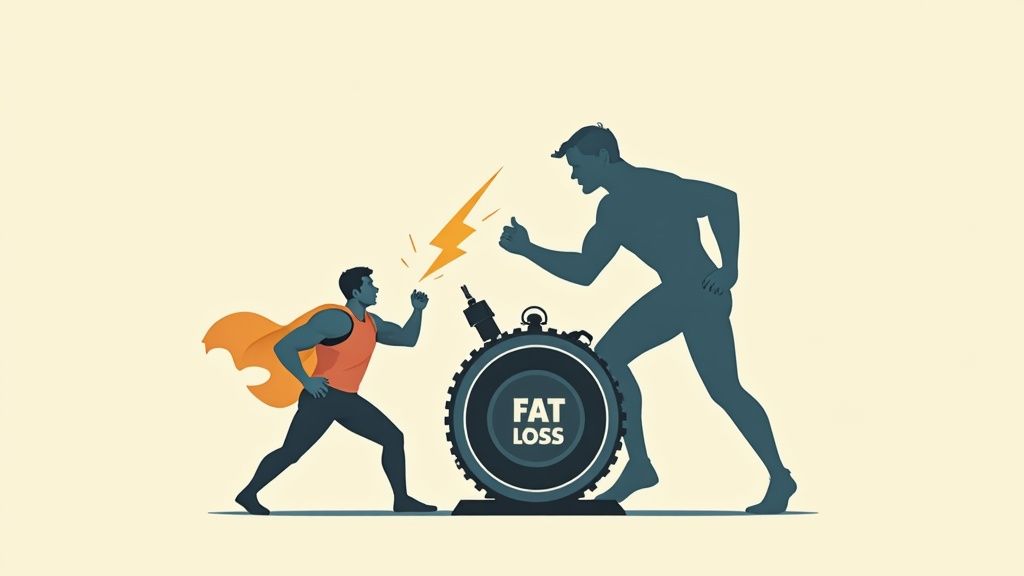
Imagine your body’s fat-loss efforts are like a high-performance race car. Your diet and cardio are the high-octane fuel, but creatine? That’s the turbocharger. It doesn’t create the energy itself, but it takes the fuel you’re already using and makes the entire engine roar with way more power and efficiency.
Creatine doesn't directly wage war on your fat cells, but it creates the perfect environment for your body to do the dirty work for you.
Creatine's real magic comes from its ability to supercharge your performance in the gym. It helps your muscles churn out energy (ATP, for you science nerds) way faster during those short, intense bursts of pure effort. This means you can squeeze out those last few agonizing reps, add another 5 pounds to the bar, or go full beast-mode on your sprints.
This boost in intensity kicks off a chain reaction that directly supports fat loss:
And listen, this isn't just some gym-bro theory whispered between sets. The evidence is solid. A massive 2023 review of multiple studies found that people who took creatine while resistance training saw a statistically significant drop in body fat percentage compared to folks who just lifted weights without it. You can check out the full research on these findings for yourself.
The Bottom Line: Creatine makes you stronger and more powerful. That strength helps you build the lean muscle mass that is absolutely essential for a fast, efficient metabolism.
Let's quickly get on the same page about what creatine does and doesn't do. To make it crystal clear, here’s a quick breakdown.
| What Creatine DOES for Fat Loss (Indirectly) | What Creatine DOES NOT Do for Fat Loss (Directly) |
|---|---|
| Increases workout intensity and volume | Does not act as a thermogenic or "fat burner" |
| Helps build and preserve lean muscle mass | Will not "melt" away fat on its own |
| Boosts your resting metabolic rate (via muscle) | Cannot make up for a poor diet or lack of exercise |
| Improves overall body composition | Does not directly target or mobilize fat cells |
It's crucial to get this straight. Creatine won’t magically erase the effects of a weekend pizza binge or skipped gym sessions. But when you pair it with a smart training plan and a solid diet, it can put your progress into overdrive and help you carve out a leaner, more defined physique.
If you’re just getting started with this powerhouse supplement, we’ve covered all the basics in our complete guide on everything you need to know about creatine.
Now that you've got the big picture, let's bust one of the biggest myths that scares people away from using creatine during a cut: the dreaded water weight.
Alright, let's talk about the big one. The scale. That dreaded little square in your bathroom that can make or break your entire day.
You start taking creatine, you’re feeling stronger in the gym, and then you step on it. The number is up. Three, four, maybe even five pounds in the first week. Cue the internal screaming and the urge to yeet that creatine tub straight into the garbage.
Slow down. Take a breath. This is where so many people get it twisted.
That initial bump on the scale isn't fat. It’s not a step backward. It’s actually the very first sign that the creatine is doing its job. You’re seeing intracellular water retention, which is just the fancy term for creatine pulling water directly into your muscle cells.
Think of your muscle cells as tiny, slightly deflated balloons. Before creatine, they’re just hanging out. But when you start supplementing, creatine molecules rush into those cells and drag water in right behind them. This inflates the balloons, a process called cell volumization.
This is completely different from the soft, puffy feeling you get after a super salty pizza binge. That’s subcutaneous water, sitting under your skin. The water creatine pulls in is inside the muscle itself, and that’s a game-changer for two big reasons:
So, when the scale ticks up in that first week, don't panic. Your muscles are just getting "juiced up" and super-hydrated. It’s a sign you’re primed for progress, not that you’re failing your fat loss goals. Trust what you see in the mirror over a number that can't tell muscle from fat.
Picture a dry kitchen sponge. It’s light, brittle, and kind of pathetic. Now, run it under the faucet. It gets heavier, plumps up, and becomes a much more useful tool. That’s exactly what creatine is doing to your muscles. You're not adding fat; you're adding "performance weight."
This new, hydrated state is the launchpad for you to lift heavier and bang out more reps, which is the real secret to torching fat long-term. To get this effect dialed in perfectly, you'll want a high-absorption formula like our Crazy Muscle Three-Atine Creatine, designed to get into your muscles and start working, fast.
Alright, so we’ve cleared the air: creatine doesn't make you fat. That initial bump on the scale is just water weight, and it's a good thing. Now, let's get to the exciting part—how this powerhouse supplement actually helps you get lean.
If creatine isn't a magic fat-burning pill, what's its secret? It’s all about performance and muscle.
Think of your muscles' energy for short, explosive efforts—like a heavy squat or a full-tilt sprint—as a tiny, high-octane fuel tank called ATP (adenosine triphosphate). The catch? This tank runs dry after just a few seconds of all-out work. It’s why your first rep feels powerful, but that last one is a struggle against gravity itself.
This is where creatine swoops in. It's like having an on-demand pit crew for your muscles, rapidly refueling those ATP tanks. It helps regenerate ATP almost instantly, giving your muscles the juice they need to keep firing with maximum force.
So what does that feel like in the gym?
This boost in performance is the first domino in a chain reaction that accelerates fat loss. Pushing harder burns more calories during your workout, obviously. But the real game-changer is what happens next. This improved performance is the single best way to build and—crucially, when you're dieting—preserve your hard-earned muscle. For a more detailed breakdown of the science, check out our guide on how creatine works.
Here's the concept that changes everything: muscle is your body's metabolic engine. The more lean muscle you have, the more calories your body torches 24/7, even when you're just chilling on the couch.
When you're cutting calories to lose fat, your body often cannibalizes muscle tissue for energy right alongside fat. Creatine acts as a shield for that precious muscle, keeping your metabolism humming along at a higher speed.
This infographic nails the process: creatine supports bigger, stronger muscles, which naturally hold more water. This leads to that initial (and temporary!) weight gain on the scale.

The takeaway is simple: the weight gain is from hydrated, well-fueled muscles, not flab. By letting you train like a beast, creatine helps you build a bigger, more efficient fat-burning machine from the inside out. That makes it an indispensable ally in your journey to get shredded.
Losing fat while keeping—or even building—muscle is the holy grail of fitness. It’s the dream, right? But it's also a heck of a challenge. When you drop into a calorie deficit to get lean, your body gets hungry for energy. The problem is, it doesn’t just grab from your fat stores; it’s perfectly happy to snack on your hard-earned muscle, too.
This is where creatine steps in. Think of it as a personal bodyguard for your gains.
When you're cutting, your body can flip into a catabolic state. That's just a fancy way of saying it’s breaking down tissue—like your precious muscle—for fuel. After all those hours in the gym, the last thing you want is to end up as a smaller, softer version of yourself. You're aiming to reveal a lean, chiseled physique, not lose it.
Creatine flips the script. It helps create a more anabolic (muscle-building) environment, even when your calories are low. By keeping your muscles swimming in that high-octane ATP energy we talked about earlier, it lets you continue lifting heavy and training with real intensity.
This sends a clear message to your body: "Hey, we still need this muscle! Don't you dare burn it for fuel!"
That performance boost is your first line of defense, but creatine has another trick up its sleeve.
The "cell volumization" effect—where creatine pulls water into your muscle cells—does more than just give you a fuller, more pumped look. This hydrated state actually helps protect muscle proteins from being broken down, acting like a shield against the catabolic damage of dieting.
To really lock in that muscle while cutting, pairing creatine with essential strength training exercises is non-negotiable. Creatine gives you the power to perform those lifts with proper form and intensity, which forces your body to prioritize fat as its primary fuel source.
You don't have to watch your progress evaporate just because the calories are down. With creatine in your corner, you can focus on torching fat while your muscle stays put, ready for the big reveal. For a full game plan on this, check out our guide on how to maintain muscle while cutting.
Alright, enough with the science talk. Theory is cool, but seeing real changes in the mirror is what we're all after. It's time to stop wondering if creatine can help you get lean and start using it to make it happen.
Let's put together a simple, no-fluff playbook to get the absolute most out of every scoop while you're grinding to get shredded.
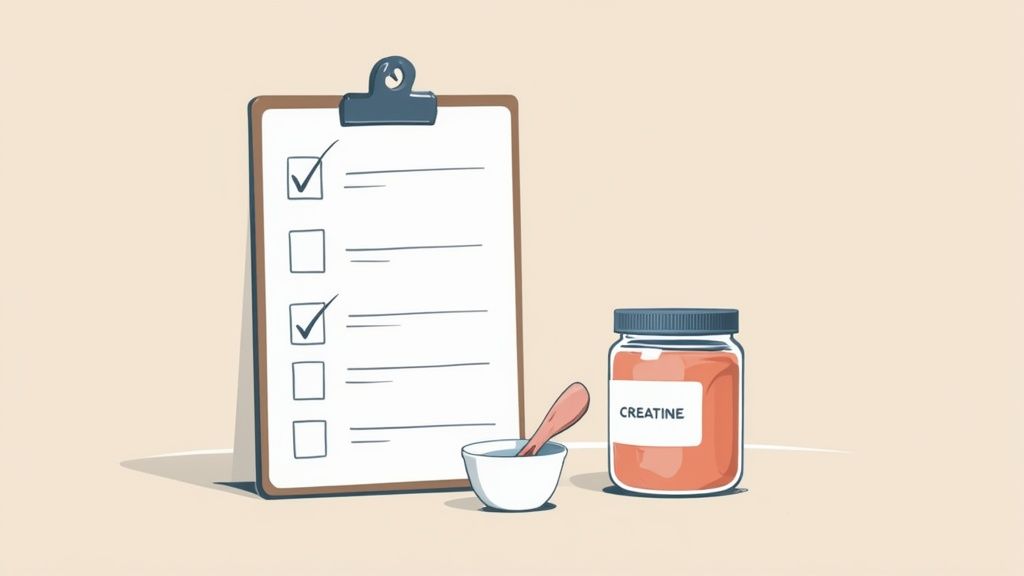
Don't get lost in the weeds with complicated protocols. The science is surprisingly straightforward on what works best, and it's dead simple to follow.
Your Daily Dose: Just stick to 3-5 grams per day. That’s it. This is the sweet spot—the proven dose to fully saturate your muscles and keep them fueled for battle. Anything more is probably just making for expensive pee.
Now, what about the famous "loading phase" where you take 20 grams a day for a week? You can do it, and it'll top off your muscles a little quicker. But it's also more likely to cause some stomach rumbles, and honestly, it’s not necessary. Sticking with a consistent 3-5 grams daily gets you to the exact same place in about three weeks. We say skip the load, save your money, and just focus on being consistent.
As for when to take it? Stop overthinking it. Seriously. The most critical factor is consistency. Just take it every single day, even on rest days. Pick a time you won't forget—with breakfast, tossed in your pre-workout, whatever—and just lock it in.
Consistency trumps timing. The real magic happens when your muscles stay saturated with creatine over weeks, not from one perfectly timed dose.
So, how do you put this all together for your cut? Here’s a simple checklist to keep you on track.
| Step | Action | Why It Matters |
|---|---|---|
| 1. Morning Dose | Take 3-5 grams of creatine with a glass of water first thing. | Gets it out of the way so you can't forget. Consistency is king for muscle saturation. |
| 2. Stay Hydrated | Drink plenty of water throughout the day. | Creatine pulls water into your muscles. Staying hydrated supports this process and overall performance. |
| 3. Nail Your Workout | Hit the weights hard. Focus on intensity and progressive overload. | Creatine gives you the power to train harder, which is the signal your body needs to keep muscle while in a calorie deficit. |
| 4. Eat Your Protein | Prioritize your protein intake at every meal. | Protein provides the building blocks. Creatine provides the horsepower. You need both to protect your hard-earned muscle. |
| 5. Repeat Daily | Don't skip your dose, especially on rest days. | Rest days are when you recover and grow. Keeping creatine levels high ensures your muscles are primed 24/7. |
Follow these steps, and you’re giving your body everything it needs to protect muscle and torch fat.
Look, not all creatine is created equal. Standard monohydrate is solid—it works. But when you're cutting, every little edge counts. You’re optimizing your diet and your training, so why not optimize your supplements?
This is where our Crazy Muscle Three-Atine Creatine gives you an advantage. We blended three different forms of creatine—monohydrate, alphaketoglutarate, and pyruvate—to boost absorption and get more of it into your muscle cells where it belongs. Better absorption means less waste and more raw power.
To really dial things in, pairing smart supplementation with effective high-impact exercises is a killer combo for protecting muscle and carving out that defined look you're after.
You’re already putting in the hard work. Give your body the best tools to finish the job.
Alright, let's get down to brass tacks. You've got questions about mixing creatine into your fat-loss plan, and I've got the straight-up, no-nonsense answers. We'll rapid-fire through the most common concerns to clear the air.
This is probably the #1 myth I hear, and it’s time to put it to bed for good. When people think "bloat," they're picturing that soft, under-the-skin water retention you get from a salty meal. That's not what creatine does.
Creatine pulls water into the muscle cell itself. Think of it like inflating a tire—it gets bigger, harder, and more solid. This gives your muscles a fuller, denser look, not a soft, puffy one. So, will you look bloated? No. Will you look more jacked? You bet your life you will.
Not only should you, but it’s one of the smartest things you can do. A "cut" is all about being in a calorie deficit, but that deficit puts your hard-earned muscle at risk. Your body, desperate for energy, might start catabolizing muscle tissue.
This is where creatine steps in like a bodyguard for your biceps. It helps you keep your strength up in the gym, which signals to your body, "Hey, we still need this muscle! Burn the fat instead!"
A successful cut isn't just about the number on the scale dropping; it's about revealing a leaner, more muscular physique. Creatine is your insurance policy to make sure you're losing fat, not gains.
Haha, don't worry, you won't turn into a puddle on the floor. If you decide to cycle off creatine, the extra water in your muscles will slowly leave over a few weeks. You'll likely notice a small dip in your peak strength and that last rep might feel a bit tougher, but that's just your energy systems returning to their normal baseline.
The best part? The actual, real muscle you built is yours to keep. It doesn’t vanish. As long as you keep lifting and eating enough protein, those gains are sticking around. You can always hop back on creatine later to reclaim that performance boost.
You’ve got the science, you've got the answers. Now it's time to execute. Stop wondering "what if" and start building a physique that proves your hard work is paying off.
If you’re ready to protect your muscle and incinerate fat, give your body the premium fuel it needs to get the job done.
Grab a bottle of Crazy Muscle Three-Atine Creatine on Amazon and make this cut your most successful one yet.

Sign up and save 10% off your next order