
How to Maintain Muscle While Cutting: Your Ultimate Guide to Getting Shredded Without Shrinking
Posted by Maximus
on

Figuring out how to maintain muscle while cutting is the holy grail of fitness. It’s a delicate dance between lifting heavy, absolutely crushing your protein goals, and sticking to a smart calorie deficit. Nail these three, and you'll torch fat while clinging to every last ounce of that muscle you busted your ass for.
This isn't about some miserable starvation diet or living on a treadmill. This is about being tactical.
So, you want to get absolutely peeled without deflating like a sad, forgotten birthday balloon? Welcome to the club, my friend. This is the one fear that keeps every dedicated lifter staring at the ceiling at 2 AM. You've poured months, maybe even years, of sweat and grit into building a respectable physique, and the very idea of a "cut" sounds like you're about to light a match and burn it all down.
Let's get brutally honest about why this is so damn difficult. When you're in a calorie deficit, your body freaks out a little. It flips a switch into what's called a catabolic state, which is just a science-y way of saying it starts cannibalizing its own tissue for energy. And guess what? It doesn't always politely go for the fat first. If you give it a chance, it'll gleefully start munching on your precious, hard-earned muscle.
This guide is your battle plan to outsmart your own biology.
Forget everything you’ve heard about starving yourself and becoming a cardio bunny. Winning the war against muscle loss is about working smarter, not just harder. Our entire strategy is built on three pillars that create an iron-clad defense for your gains.
Here’s a quick look at the core principles we’re about to drill into your brain.
| Pillar | Core Principle | What It Means For You |
|---|---|---|
| Smart Training | "Use it or lose it." | Lifting heavy is a primal signal to your body that this muscle is essential for survival. It's non-negotiable. |
| Tactical Nutrition | Fuel the muscle, starve the fat. | Your kitchen is mission control. High protein, smart carb timing, and a deficit that doesn't trigger panic mode are your weapons. |
| Strategic Supplementation | Reinforce your efforts. | Think of supplements as your elite special forces. Creatine, in particular, is the hero that keeps your strength from tanking. |
This isn't just another diet. It’s a complete roadmap designed to convince your body to burn that ugly stored fat for fuel, leaving your glorious muscle completely untouched.
We’re going to cover everything from your training split to exactly what to pile on your plate, plus the supplements that actually move the needle. You can find some of our go-to products in our Amazon store.
Let's walk this tightrope together. By the end, you’ll be leaner, just as strong, and more defined than you've ever been.
Let's get one thing straight right now. The biggest, most destructive myth that torpedoes people's progress is the idea that you need to switch to high-rep, "toning" workouts when you start cutting. That's a one-way ticket to losing the muscle and strength you just fought tooth and nail to build.
If you want to know how to maintain muscle while cutting, you have to send your body a powerful, undeniable message. Lifting those cute little pink dumbbells ain’t it.
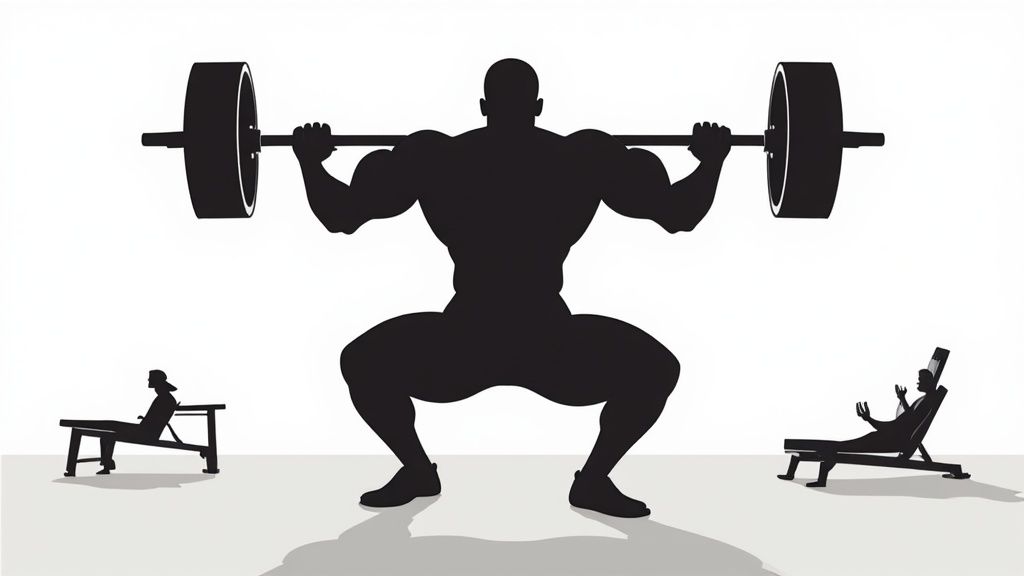
Think of your body as a brutally efficient survival machine. When calories get scarce, it starts looking for things it can ditch to save energy. Guess what's at the top of that list? Your metabolically expensive muscle tissue. Lifting heavy is the loudest signal you can send that screams, "HEY! I NEED THIS MUSCLE TO SURVIVE. GO BURN THAT USELESS BODY FAT INSTEAD!"
Here's the secret: your cutting workout should look almost identical to your bulking one. Your number one goal is to maintain—or even inch up—your strength on the big, key lifts. This means pouring your limited energy into the compound movements that give you the most bang for your buck.
These are your non-negotiables, the Mount Rushmore of your training:
By keeping these lifts at the core of your program, you’re forcing your body to recruit a massive amount of muscle fiber. That's the stimulus it needs to justify holding onto muscle. You can still add some targeted isolation work, and we've got some great tips on that in our guide on small tweaks for big impact muscle isolation, but always, always do the big lifts first when you're fresh.
While the intensity—the weight on the bar—needs to stay high, your ability to recover from a ton of work is going to be lower. You're in a calorie deficit, after all. This is where you have to train smarter.
Think of it this way: your strength is the signal to keep muscle, but your recovery is the process that actually preserves it. If you bury yourself with too much volume, you’ll dig a recovery hole so deep you can't climb out, leading to burnout and muscle loss.
So, instead of hammering your chest with five different exercises, nail one or two heavy presses and maybe a single fly variation. Your mission isn't to obliterate every muscle group; it's to stimulate it just enough to convince it to stick around. A great place to start is by cutting your total sets per workout by about 20-30% from what you were doing in your surplus.
Don't make the mistake of thinking progressive overload goes out the window when you're cutting. It's the entire foundation of getting and keeping results! The only thing that changes is how you define "progress."
Instead of slapping another 10 pounds on your squat every week, progress on a cut might look a little different:
This constant push to challenge your limits is what separates those who hold their muscle from those who watch it fade away.
If lifting heavy is the architect’s plan telling your body to keep its muscle, then your diet is the truckload of high-quality bricks and mortar that makes it happen. Let's be real: you can’t out-train a garbage diet. This is where we get smart, fueling our muscles for brutal workouts while gently nudging our body to start burning fat for energy.
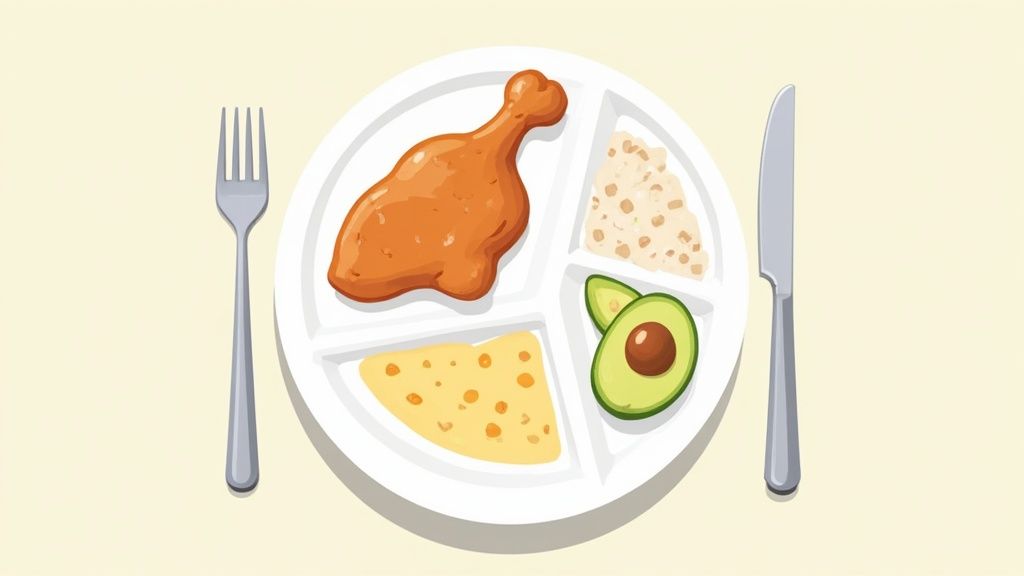
And no, this doesn't mean you're doomed to 12 weeks of unseasoned chicken and limp broccoli. Forget that nonsense. We're building a flexible, satisfying eating plan that keeps you energized, crushes ravenous hunger, and creates the perfect environment to protect that hard-earned muscle.
Let’s get into the nitty-gritty.
To drop fat, you have to be in a calorie deficit. There’s just no getting around that law of thermodynamics. But the classic rookie mistake is slashing calories with the subtlety of a chainsaw. Sure, a massive deficit will make the scale number plummet, but a huge chunk of that will be water and—you guessed it—your precious muscle.
Your mission is to create a moderate, sustainable deficit. Aim to lose 0.5% to 1% of your body weight each week. So, for a 200-pound person, that’s a sensible 1-2 pounds. This slower, more calculated pace is the sweet spot for torching body fat while holding onto muscle.
A great starting point is a deficit of 300-500 calories below what you need to maintain your current weight.
This controlled approach convinces your body to tap into fat stores for fuel instead of panicking and cannibalizing your metabolically active muscle tissue. Patience here pays off big time.
When you're in a calorie deficit, protein isn't just a macro. It's your bodyguard. It's your number one defense against muscle breakdown (catabolism). A high-protein diet also keeps you feeling full—a total lifesaver when calories are low—and it even boosts your metabolism slightly because your body burns more calories just digesting it.
So how much do you need? Forget the old-school, low-ball numbers. You're training hard. You need more. Aim for 0.8 to 1.2 grams of protein per pound of body weight.
For that same 200-pound lifter, we’re talking 160-240 grams of protein every single day. The evidence is clear: combining resistance training with a higher protein intake is a game-changer for preserving lean mass during a fat loss phase. It’s the not-so-secret secret to how people finish a cut looking lean and muscular, not just skinny. Dig into the science with these protein findings for muscle preservation.
Carbs are not the enemy! They are your body’s go-to fuel for high-intensity training. The trick isn't to eliminate them, but to be strategic. Time the bulk of your daily carbs around your workouts—in the meals before and after you hit the weights.
Healthy fats are just as crucial. They're vital for hormone production—including testosterone, which you definitely want to keep optimized for muscle maintenance. Never let your fat intake drop into the gutter. Aim to get 20-30% of your total daily calories from awesome sources like avocados, nuts, seeds, and olive oil. Slashing fats too low is a surefire way to feel like crap, wreck your hormones, and completely sabotage your cut.
Ready for what feels like a total cheat code? Look, your hard work in the gym and discipline in the kitchen are the undisputed heavyweights of a successful cut. No doubt about it. But the right supplements? That’s the ace up your sleeve. They aren’t magic pills, but they can feel pretty damn close when your energy is tanking and the weights feel like they’re glued to the floor.
Let's cut through all the industry noise and put the spotlight on the undisputed MVP of muscle maintenance: Creatine Monohydrate.
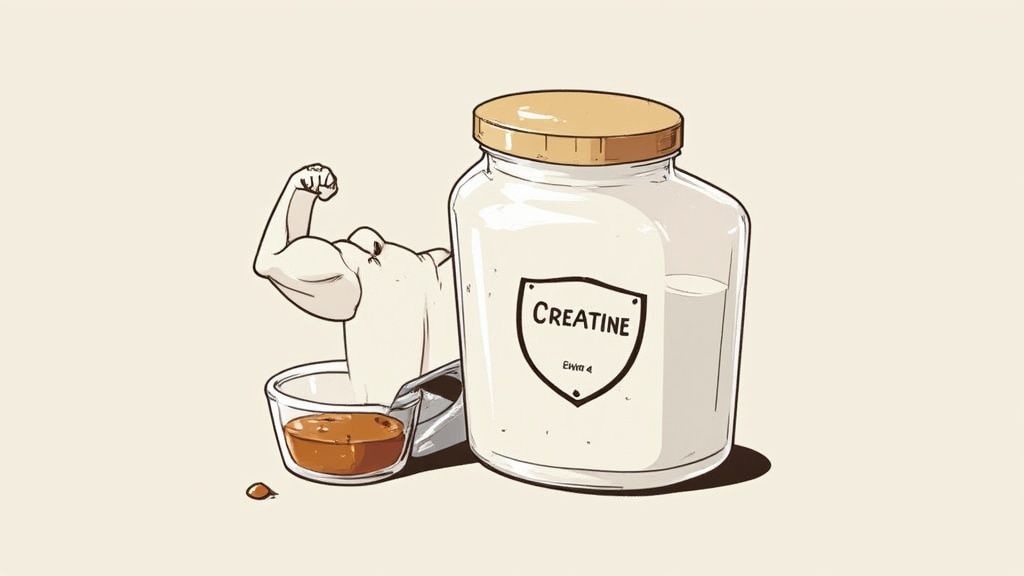
I’m not just pushing another powder here. Creatine is probably the most researched, battle-tested performance supplement on the planet. Its main job is to help your body rapidly regenerate its primary fuel for explosive energy, a little molecule called ATP.
When you’re in a calorie deficit, your body's ability to churn out ATP takes a nosedive. What happens next? Your strength in the gym suffers. And a drop in strength is the very first domino to fall in the dreaded muscle-loss chain reaction.
This is where creatine swoops in like a superhero. It keeps your muscles saturated with the fuel they need to crank out those heavy, muscle-preserving sets. It helps you keep your performance high, even when your food intake is low.
Think of it as a dedicated power reserve just for your muscles. This allows you to keep sending that all-important signal to your body: "Hey! Don't you dare get rid of this muscle, I still need it!"
Let’s bust a huge myth right now: the idea that creatine makes you look "bloated" or "puffy." That's just not how it works. High-quality creatine monohydrate pulls water into the muscle cell itself, not under your skin. This process, known as cell volumization, actually gives your muscles a fuller, harder appearance—which is exactly the look we're chasing on a cut.
Honestly, it’s your non-negotiable partner in crime for this entire journey. It directly props up your strength, which is the absolute cornerstone of how to maintain muscle while cutting.
With creatine locked in as your foundation, a few other key players can make your life a whole lot easier. Think of them as the supporting cast that helps the star shine.
Protein Powder: This isn't some mystical muscle-builder, but it is the undisputed king of convenience. Hitting that high protein target—remember our goal of 0.8-1.2g per pound of bodyweight?—can be a real grind some days. A good whey or plant-based protein shake is a stupidly easy way to hit your numbers without having to grill another chicken breast.
Caffeine: Let's be real. Some days during a deficit, you're going to feel like a zombie. A shot of caffeine, whether from a strong coffee or a pre-workout, can be the kick in the pants you need to get to the gym and actually have a productive session. It sharpens your focus and can even give you a slight bump in power output.
Beyond the usual gym supplements, some people find that certain compounds can seriously boost their mental drive and concentration. If you want to dive deeper into that world, you can find great info on focus supplements for adults.
The name of the game is to keep things simple and effective. Creatine is the must-have, protein powder is for convenience, and caffeine is for getting your butt in gear.
Our Three-Atine Creatine is specifically formulated to back you up when you're pushing for strength and performance during a cut. Check it out on Amazon and give your muscles the research-backed fuel they deserve.
You can have the most dialed-in training plan in the world and a diet so perfect it could make a nutritionist weep with joy. But if you're sleeping four hours a night and running on pure stress, you're just spinning your wheels and setting yourself up to lose muscle.
This is the stuff nobody wants to talk about. It’s not as sexy as a new deadlift PR, but it's often the secret ingredient that separates a successful cut from a miserable, muscle-losing grind.
https://www.youtube.com/embed/juD99_sPWGU
Think of your body like a high-performance engine. Lifting and dieting are you hitting the gas, but recovery is when the pit crew comes out to repair and rebuild. When you're constantly stressed or sleep-deprived, your body pumps out a hormone called cortisol.
This hormone is a certified muscle-eater. It actively works against you by breaking down precious muscle tissue and encouraging your body to store fat, especially around your stomach. Fun, right?
The bottom line is simple: Poor recovery directly sabotages all your hard work in the gym and kitchen. You can't just power through it; you have to actively manage it as part of your game plan for how to maintain muscle while cutting.
Look, managing your recovery isn't about chanting at the moon or completely overhauling your life overnight. It's about building small, consistent habits that pay massive dividends for your physique.
Here are a few real-world tips you can actually stick with:
I can't overstate how critical this is. A successful cut is only possible when recovery is treated as a top priority right alongside training and nutrition. Consider these lifestyle factors your secret weapons for carving out the lean, strong physique you're working for.
Even the most dialed-in cutting plan can throw you a curveball. It’s totally normal to second-guess yourself when you’re deep in a deficit. So, let's tackle some of the biggest questions that pop up when you're laser-focused on how to maintain muscle while cutting.
I've been there, and I've heard it all. Here are the straight-up, no-fluff answers you need to stay the course.
Slow your roll. The number one mistake I see people make is rushing the process. The sweet spot for fat loss without torching your hard-earned muscle is losing between 0.5% to 1% of your body weight per week.
If you push it any harder, you're creating a massive calorie deficit that practically forces your body to start breaking down muscle tissue for energy. Nobody wants that. For a 200-pound guy, that's a steady 1-2 pounds a week. Trust me, patience is your secret weapon here. A slower, more methodical cut always results in a better, more chiseled physique in the end.
Let's get one thing straight: cardio is a scalpel, not a sledgehammer. Its only job is to help you widen the calorie deficit. It does absolutely nothing to signal your body to keep muscle around—that’s the iron's job.
In fact, going overboard with cardio, especially gut-busting HIIT sessions, can seriously sabotage your recovery from lifting. You'll be too gassed to hit the weights with the intensity needed to preserve muscle.
Here's your non-negotiable priority list for a successful cut:
- Lift heavy. This is the signal that tells your muscles, "Hey, we still need you!"
- Nail your nutrition. Protein and calories are king for fueling and repairing that muscle.
- Add cardio strategically. Only bring in 2-3 low-to-moderate sessions a week if you need an extra push for fat loss.
Don't let the treadmill steal the thunder from the squat rack.
This is the zombie myth of the fitness world—it just won't die. Let's kill it for good.
Creatine pulls water inside your muscle cells. This isn't the same as the subcutaneous water retention that makes you look soft and puffy. This process, called cell volumization, is a good thing! It makes your muscles look fuller, harder, and more defined. It’s literally the opposite of bloated. That dreaded "puffy" look people talk about is usually linked to old-school, impure creatine formulas, not the high-quality creatine monohydrate we have today.
Stop letting myths sabotage your results. Your muscles need proven support to stay full and strong while you get lean. Crazy Muscle's Three-Atine Creatine is designed specifically for performance, giving you the edge you need to protect every ounce of muscle you've worked for.

Sign up and save 10% off your next order