
Dumbbell Chest Workouts For A Chiseled Chest
Posted by Maximus
on

If you're serious about building a bigger, stronger chest, it's time to rethink your relationship with the barbell. Dumbbells are your ticket to unlocking serious size and strength because they give you a much bigger range of motion and force each side of your body to pull its own weight. This is how you build a balanced, powerful chest that actually looks three-dimensional.
It’s about training smarter, not just heavier.
Let's cut right to it. You’ve seen that person in the gym, week after week, glued to the flat barbell bench, wondering why their chest isn't popping. The problem isn't their effort; it's the tool. While the barbell certainly has its place, dumbbells are the undisputed champions for sculpting a chest that commands attention.
Why? It all comes down to freedom of movement and balanced development.
Think about a barbell press for a second. Your hands are locked into a fixed position, forcing your body down a single, rigid path. Dumbbells, on the other hand, set you free. That freedom is precisely what makes dumbbell chest workouts so ridiculously effective.
When you press with dumbbells, you’re doing what’s called unilateral training—each arm has to stabilize and lift its own weight. There’s no strong side taking over for a weaker one. This is an absolute game-changer. It immediately puts any muscle imbalances you have on blast, forcing your weaker side to finally catch up.
The result is a triple-threat of benefits:
Dumbbells let you get a much deeper stretch than a barbell ever could. At the bottom of a dumbbell press or fly, you can bring the weights lower, putting a massive stretch on your pectoral fibers. This increased stretch creates more of those tiny microscopic tears in the muscle tissue—and that's the primary trigger for hypertrophy (a.k.a. muscle growth).
A deeper stretch under tension equals more muscle damage. When your body repairs that damage, it builds back bigger and stronger pecs. It’s a simple but powerful formula for growth that barbells just can't match.
A truly chiseled chest isn't built with just one exercise. You need a smart combination of two key movement patterns, both of which are perfected with dumbbells.
To get the full picture, let's break down the core movements you'll be using.
| Movement Type | Primary Chest Target | Why It's Essential |
|---|---|---|
| Presses | Overall Mass (Upper, Middle, Lower) | These are your heavy hitters. Think of flat and incline presses as the foundation for building raw strength and thickness. |
| Flyes | Outer & Inner Pecs (Width & Separation) | These are your sculpting tools. The fly isolates the chest, creating that deep stretch and defined line down the middle. |
These two movements are the bread and butter of any effective dumbbell chest routine.
Combining these ensures you're hitting every single fiber from every possible angle, leading to complete and total chest development. To really dial in your form, it helps to have a basic grasp of biomechanics in sport and exercise.
Of course, fueling this kind of demanding work is non-negotiable. This is where a high-quality creatine supplement becomes your ace in the hole. It provides that quick-burst energy you need to power through those last, growth-triggering reps that make all the difference. Ready to get started? Check out our full line of performance supplements on our Amazon store.
And we're not the only ones who think so. The global strength training equipment market is projected to absolutely skyrocket to USD 18.88 billion by 2031, and a huge part of that is driven by the demand for dumbbells in both home and commercial gyms. This explosion reflects a worldwide shift towards more effective training, with countless lifters waking up to the superior results of dumbbell-focused routines. You can learn more about these market trends and see for yourself.
Alright, let's get down to business. Theory is great, but a chiseled chest is built with iron and sweat. This is your no-BS guide to the four cornerstone dumbbell chest exercises—the absolute bedrock of any serious growth plan.
We're not just listing moves here. We're breaking down the details that separate an average chest from a legendary one. Forget what you think you know.
We'll cover the big guns: the classic Dumbbell Bench Press, the upper-chest carving Incline Dumbbell Press, the pec-stretching Dumbbell Fly, and the iconic Dumbbell Pullover. For each one, I'll give you the setup, the execution cues that actually work, and the common mistakes that are probably killing your gains right now.
Pay attention, because this is the stuff you'll come back to every single chest day.
This whole process boils down to three key stages: finding your balance, mastering the motion, and then fueling the fire.
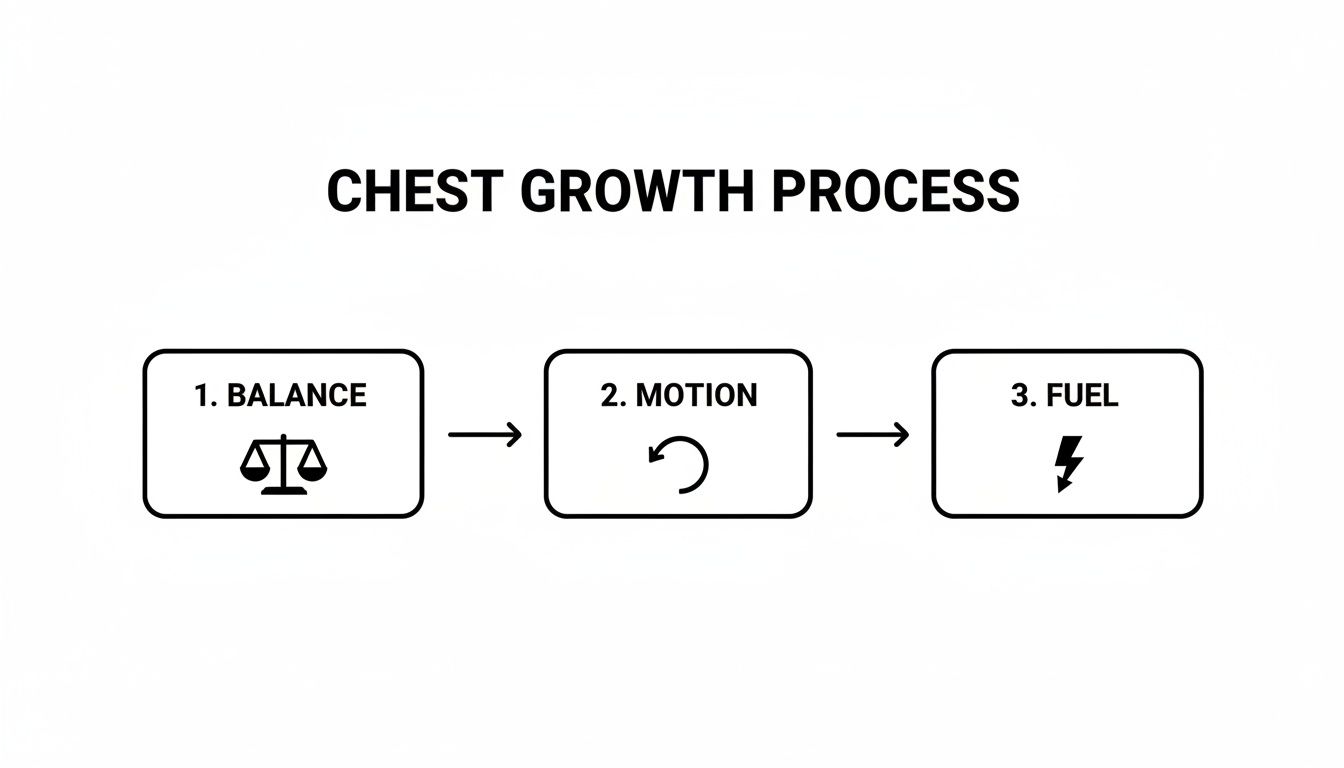
As you can see, just heaving weight around is pointless. Real growth is a connected process where every step builds on the last.
This is your mass-builder. Period. If you want raw thickness and power, the dumbbell bench press is non-negotiable. Using two independent weights forces your smaller stabilizer muscles to fire up, building more functional and balanced strength than a barbell ever could.
Let's nail the setup. Lie back on a flat bench, dumbbells resting on your thighs. Kick them up to your chest, one at a time. Now, plant your feet hard into the floor, squeeze your shoulder blades together like you're trying to hold a pencil between them, and create a slight arch in your lower back. You should feel locked in and powerful before you even move the weight.
Lower the dumbbells in a smooth arc until your elbows are at or just below the level of your chest. Here's a pro tip: keep your elbows tucked at about a 45-degree angle to your body. Flaring them out to 90 degrees is a one-way ticket to a shoulder injury. Explode back up, pressing the dumbbells in a slight arc until they nearly touch over your chest. Don't just lift; think about squeezing your pecs together at the top.
Ever wonder how guys get that full, "armor-plate" look? It's all in the upper chest, and nothing hits it better than the incline press. By setting the bench to a 30 to 45-degree angle, you laser-focus the tension onto the clavicular head of the pec major—that's the muscle that makes the top of your t-shirt look good.
The setup is almost the same as the flat press, but the path of the dumbbells changes. As you press up, the weights should travel in an arc that ends directly over your collarbone, not your mid-chest.
A huge mistake I see all the time is people turning this into a shoulder exercise. If your front delts are screaming more than your chest, you need a form check. Keep your chest high, pull your shoulders back and down, and drop the weight until you get it right.
This movement is essential for creating a balanced, well-rounded physique.
If presses build the slab of marble, flyes are the chisel that carves out the details. This is an isolation movement, meaning the goal is a massive stretch and a deep contraction, not lifting ego-crushing weight. It’s all about creating width and that deep line down the center of your chest.
Lie on a flat or incline bench, dumbbells pressed together over your chest with your palms facing each other. Now, lock a slight, constant bend in your elbows—imagine you're hugging a giant tree. Slowly open your arms out to the sides in a wide arc, feeling that incredible stretch across your pecs.
Go as deep as your shoulders comfortably allow, then use your chest muscles to reverse the motion and squeeze the dumbbells back to the start. Resist the urge to turn it into a press by bending your elbows too much. If you want to really get into the nitty-gritty of this, you can check out our guide on muscle isolation techniques and see how small tweaks make a huge difference.
The pullover is an old-school classic for a reason. It's one of the only exercises that stretches the chest from a completely unique angle while also roping in the lats and serratus muscles. The result? A wider, more powerful-looking torso.
Lie across a flat bench with only your upper back supported. Plant your feet firmly on the floor and keep your hips low. Hold a single dumbbell with both hands cupped under the top plate in a diamond grip.
Keeping your arms almost straight, lower the dumbbell behind your head in a slow, controlled arc. You should feel an intense stretch through your chest and ribcage. Use your pecs and lats to pull the weight back over your chest, stopping when it's directly over your sternum to keep constant tension on the muscle. It’s the perfect way to finish off your chest and ensure you’ve hit it from every conceivable angle.
Feeling stuck? Like you’re putting in the work, but your chest just isn’t responding? It happens to the best of us. You’ve mastered the fundamentals, your form is locked in, but the gains have slowed to a crawl.
This is where the real fun begins.
When you hit a plateau, it's not that your muscles are bored—they're just adapted. They need a new, compelling reason to grow. It’s time to introduce a little chaos into your routine with some old-school training principles designed to shock your pecs into new life.
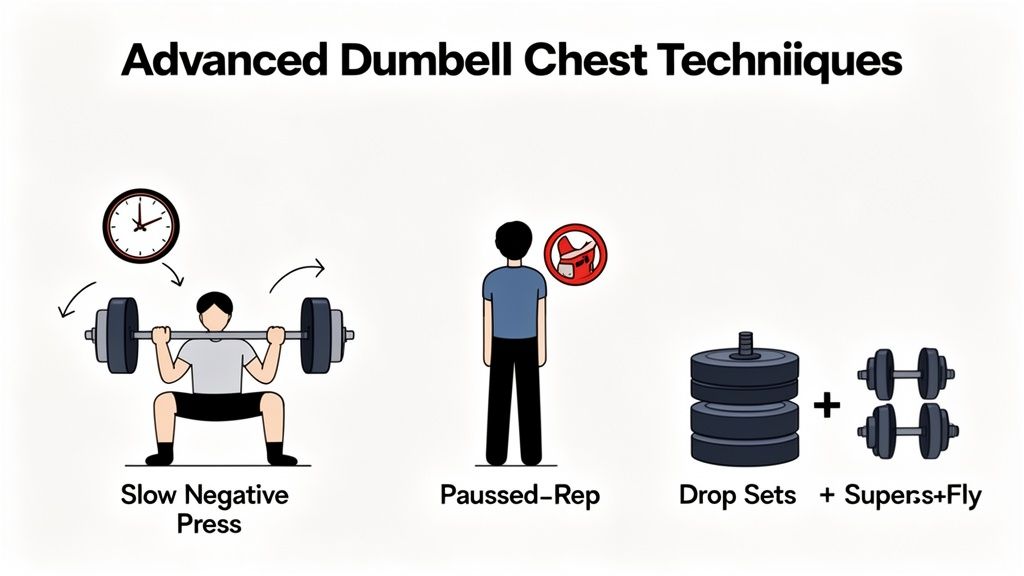
We're about to turn up the intensity dial so high, your chest will have no choice but to get bigger and stronger.
The simplest way to make a familiar dumbbell chest workout feel brutally new is to start messing with the tempo. Most lifters just hoist the weight up and let it drop. But the real magic, the secret sauce for growth, happens when you control every single inch of the movement.
This is where slow, controlled negatives come in. The "negative," or eccentric part of the lift, is when you're lowering the weight. Research has shown time and again this is where you create the most muscle damage—the critical trigger for growth.
So, instead of just letting the dumbbells fall, fight gravity on the way down. On your next set of incline presses, take a full three to four seconds to lower the weight. Really feel that tension building in your pecs. Then, explode back up to the top. This one change dramatically increases your time under tension, a non-negotiable for packing on size.
Another beastly but brilliant technique is the paused rep. It’s exactly what it sounds like. At the very bottom of your dumbbell press, right when the weight is at its deepest point, you pause. Just hang out there for a full one to two seconds before exploding back up.
So, what’s the point of this masochism?
A word of warning: you will need to drop the weight significantly when you first try paused reps. Leave your ego at the door. The humbling experience is worth the insane chest pump and strength it builds.
When you think your chest is completely fried and you can't possibly do another rep, that’s when it’s time to really go to work. Intensity boosters are designed to push your muscles past their normal point of failure, forcing them to adapt and grow.
Two of the absolute best for dumbbell chest workouts are drop sets and supersets.
Drop Sets: Let's say you're doing dumbbell flyes. You hit failure. Instead of stopping, you immediately rack the weight, grab a pair of dumbbells that are about 20-30% lighter, and immediately crank out as many more reps as you can with good form. This floods the muscle with blood and metabolic stress. It burns, but it works.
Supersets: This is where you pair two different exercises back-to-back with zero rest. The classic chest superset is a compound press followed by an isolation fly. For example, knock out a set of 8-10 reps of flat dumbbell press, and then immediately grab a lighter pair of dumbbells and do a set of 12-15 reps of dumbbell flyes. Your chest will be absolutely screaming.
This kind of intensity is incredibly demanding. To get through these workouts and recover properly, smart supplementation is a game-changer. Stacking our creatine for that explosive power with our BCAA tablets helps you fight off fatigue mid-set. This combo allows you to push past the pain barrier when your muscles are begging you to stop, ensuring you squeeze out every last growth-inducing rep.
Ready to arm yourself for your next plateau-busting session? Grab the supplements that will help you get there from our Amazon store.
Alright, let's ditch the guesswork. Just showing up and "winging it" is the fastest way to stay exactly where you are. If you actually want to build a bigger, stronger chest, you need a blueprint—a solid plan that tells you what to do, how to do it, and why the hell it works.
This is that blueprint.
Below, you'll find three distinct dumbbell chest workouts, each one engineered for a specific outcome. No more wandering around the gym wondering what to do next. Just pick your mission, get to work, and prepare to see some real results.
This one’s for anyone whose main goal is simple: pack on some serious size. We're talking about building thicker, fuller pecs from top to bottom. The entire focus is on hypertrophy, which means we're chasing that muscle-building trifecta of muscle damage, metabolic stress, and a skin-splitting pump.
We'll stick to a moderate rep range of 8-12 reps per set—the tried-and-true sweet spot for growth. You’ll keep your rest periods tight, just 60-90 seconds, to keep the blood flowing and the tension high.
Here's the logic: We kick things off with the incline press for a reason. Most guys have a lagging upper chest, so we hammer it first while you're fresh and strong. This is how you build that full, "armor plate" look everyone's chasing.
Forget the pump for a minute. If your goal is to develop raw, functional power—the kind that makes heavy weight feel like a toy—then this is your new playground. We're trading high reps for heavy-ass weight and flawless execution.
The name of the game here is intensity. We're dropping into the 4-6 rep range, which is where you train your central nervous system to fire on all cylinders and recruit every available muscle fiber. To pull this off, you need to give your body a chance to recover, so take longer rest periods of 3-5 minutes between sets.
This isn't just some bro-science theory; it's a proven method. Research consistently shows that free weights, like dumbbells, are superior to machines when it comes to building maximal strength. A classic strength routine looks a lot like this: 3-4 sets of 4-6 reps on your main lift, followed by key assistance work, with 3-5 minutes of rest to ensure you're giving every set your all.
Want to supercharge this? Adding a daily 5g dose of creatine has been shown to boost your one-rep max on the bench press by 5-15% in as little as eight weeks. That’s a serious edge. You can discover more insights about these workout structures and get stronger, faster.
No bench? No excuses. This workout is for anyone grinding it out at home with just a pair of dumbbells and some floor space. It proves you don't need a fancy gym membership to build a respectable chest.
Since you can't go super heavy, this routine gets clever. We use smart exercise selection and higher volume to create as much muscle tension and metabolic stress as possible with the tools you have.
Look, you can follow any of these programs, but none of them will work without the single most important principle in all of strength training: progressive overload.
It's the golden rule, and it's brutally simple. To grow, you must continually ask more of your muscles over time. It's a non-negotiable law of adaptation.
Here's how you do it:
Start tracking your workouts. Seriously. Write down what you lift, for how many reps and sets. The next time you walk into the gym, your only goal is to beat those numbers.
To consistently crush those demanding sessions, fueling your muscles with a top-tier creatine supplement ensures you have the explosive energy to break through plateaus. Stop guessing and start building with purpose. You can get everything you need from our official Amazon store.
You wouldn't try to build a mansion on a foundation of sand, would you? Of course not. So why are you trying to build a massive chest without giving your body the high-performance fuel it needs to actually grow?
Let's get real. All the perfect dumbbell presses and flyes in the world won't amount to much if your muscles are running on fumes. Smart supplementation isn't some optional extra for the hardcore elite; it's the critical piece of the puzzle that turns all that hard work into visible, powerful results.
I'm going to be blunt: if you're serious about your dumbbell chest workouts, creatine isn't a "maybe." It's a must. Specifically, our Three-Atine creatine is engineered to be your secret weapon in the gym. It's what delivers that quick-burst, explosive energy (ATP) your muscles are screaming for to power through those last two reps of an incline press—you know, the ones that actually signal your body to build more muscle.
It's not just about lifting heavier, either. It’s about recovering faster between your sets, which allows you to maintain a higher intensity throughout your entire workout. That means more quality volume, and volume is the undisputed king of muscle growth.
Just how effective are these dumbbell moves? One landmark study found that incline dumbbell flys can activate the pecs almost as much as the barbell bench press. But to squeeze every last drop of potential out of those flyes, creatine is essential. Separate research has shown it can boost upper-body strength by up to 20% during resistance training programs.
While creatine might be the star quarterback, a truly dominant chest day requires a full team. Think of these supplements as the specialists who ensure every part of your workout and recovery is locked in.
To get the absolute most out of these workouts, knowing which muscle building supplements to use and when can completely change the game.
To make it dead simple, here’s a look at how to time your supplements for maximum impact on chest day.
This is a simple guide to synergizing your supplements for the ultimate dumbbell chest workout performance and recovery.
| Supplement | Primary Benefit for Chest Day | When to Take |
|---|---|---|
| Three-Atine Creatine | Explosive power for presses & flyes, plus faster recovery between sets. | 30 minutes before your workout. |
| BCAA Tablets | Fights muscle fatigue during your workout so you can push through more reps. | Take during your workout, sipping between sets. |
| Glutamine | Speeds up muscle repair and reduces that "can't lift my arms" soreness. | Immediately after your workout. |
This stack is designed to cover all your bases, from pre-lift power to post-workout repair.
This is our way of telling you we get it. We know the grind. We know what it takes to push past your limits. That's why we've built the exact stack you need to stop just working out and start actually growing. If you want to dive deeper, you can also check out our guide on supplements for lean muscle mass.
Ready to arm yourself for your next chest day? Stop leaving gains on the table. Grab our game-changing Three-Atine creatine on Amazon and get to work.
Alright, let's get into the questions I hear all the time from guys in the gym. You've got the moves down, you've seen the sample workouts—now it's time to iron out the details that separate a decent chest from a legendary one.
No more guesswork. Just straight-up, practical answers to help you build a bigger, stronger chest with total confidence.
This is the big one, isn't it? The perfect weight isn't a number you pick out of thin air; it’s a feeling you chase.
For building that dense, muscular look (hypertrophy), you want a weight you can handle for 8-12 reps where the last two feel like a life-or-death struggle. Seriously. If you’re breezing past 12 reps, it’s time to level up. Go heavier.
But if pure, brute strength is your goal, the game changes. You'll want to grab heavier dumbbells and aim for that 4-6 rep range. The real secret sauce, though, is progressive overload. Your mission, every single workout, is to add 5 pounds or just one more rep than last time. Let your performance dictate the weight, not your ego.
One hundred percent. In fact, a lot of experienced lifters (myself included) will tell you dumbbells are actually better for building a truly impressive chest. Why? Because they don't let you cheat. Each side has to do its own work, which is a game-changer for building symmetry and fixing those annoying strength gaps.
Dumbbells also unlock a greater range of motion, letting you get a much deeper stretch at the bottom of a press or flye. That extra stretch creates more micro-tears in the muscle, and that's the key trigger for growth. So yes, with consistent intensity across your presses, flyes, and pullovers, you can build an absolutely massive chest without ever touching a barbell.
For most people, hitting chest with dumbbells once or twice a week is the sweet spot. This gives your muscles the signal they need to grow without running them into the ground. A good rule of thumb is to give yourself at least 48 hours of recovery time between chest days.
Ultimately, your body is the boss. If you're still walking around with crippling soreness from Monday's workout on Wednesday, take another day off. Learning to listen to your body is crucial, and we have some great tips on how to speed up muscle recovery if you need them.
First off, welcome to the club. Just about everyone has this issue. This is exactly why dumbbells are so fantastic—they shine a spotlight on these imbalances and then help you fix them. The solution is simple, but it takes discipline.
Here’s the game plan:
Stick with this, and over time, that lagging side will catch up. The result? A more balanced, powerful, and aesthetically awesome chest.
You've got the knowledge and the battle plan. Now, it's time to fuel the machine. The kind of intensity these workouts demand requires high-quality fuel, or you're just spinning your wheels. The supplements from Crazy Muscle are engineered to deliver the explosive energy and rapid recovery you need to turn all that effort into real, visible growth.
Don't leave your results up to chance. Arm yourself with the right tools for the job. Check out our full lineup on our Amazon store and start building with purpose.

Sign up and save 10% off your next order