
How to Bulk Without Gaining Fat a Smarter Way
Posted by Maximus
on

Tired of the old "eat big to get big" advice? Yeah, us too. That’s a one-way ticket to getting fluffy. If you’re trying to pack on lean, head-turning muscle without blurring out your abs, your secret weapon is a small, carefully managed calorie surplus. We're talking just 5-10% over what you need to maintain your weight. This gives your body just enough fuel to build new muscle without the unwanted padding.
Let's bust a huge myth right here and now. Bulking does not mean you have to say goodbye to your abs for half the year. The days of force-feeding yourself until you feel like a stuffed sausage are over. The modern, intelligent approach is all about making calculated, strategic gains. This isn't a guessing game; it's a science-backed plan for adding quality size that makes you look like a Greek god, not a sumo wrestler.
Building a killer physique this way boils down to three things: smart eating, hard training, and serious recovery. Think of it like walking a tightrope. You need to give your body just enough extra energy to synthesize new muscle tissue, but not so much that it panics and starts storing the excess as fat. It takes consistency and a sharp eye for detail, but the results are so worth it.
The real difference between a successful lean bulk and a sloppy "dirty bulk" is simply calorie control. Shoveling down thousands of extra calories doesn't magically build more muscle. Your body has a speed limit for how fast it can build muscle, and every calorie beyond that point is heading straight for your love handles. It really is that simple.
Think about it like this: trying to fill a small glass of water with a firehose is just going to make a huge mess. That's your body on a massive calorie surplus. A small, controlled surplus, on the other hand, is like using a steady, gentle stream to fill that glass. Every drop goes exactly where it's supposed to.
This isn't just gym-bro wisdom; the science backs it up. A groundbreaking 2023 study showed that lifters eating in a modest 5% calorie surplus gained just as much muscle as lifters on a massive 15% surplus. The kicker? The high-surplus group also packed on a significant amount of body fat, while the 5% group stayed impressively lean. You can read up on the study yourself over at Men's Health.
The goal is to feed the muscle, not the fat. A successful lean bulk leaves you bigger, stronger, and still defined—not just a larger, softer version of yourself.
This precise approach is the bedrock of a successful bulk. To really dig into the mechanics of building muscle, check out our complete guide on how to maximize muscle growth and set yourself up for some serious gains.
To make it crystal clear, let's break down the core pillars of a smart bulk versus the old-school approach that just leaves you feeling bloated and fluffy.
| Pillar | The Smart Lean Bulk Approach | The Old-School 'Dirty Bulk' Mistake |
|---|---|---|
| Calorie Surplus | Small & controlled (+5-10% over maintenance) | Massive & uncontrolled (+20% or more) |
| Food Choices | Nutrient-dense whole foods | "See-food" diet: pizza, ice cream, you name it |
| Mindset | Precise, patient, and data-driven | "Eat big to get big" at all costs |
| The Outcome | Quality muscle gain, minimal fat gain | Some muscle, but a whole lot of extra fat |
As you can see, the smart approach is all about quality over quantity. It requires a bit more thought, but the payoff is building a physique you're proud of year-round, not just a "work in progress" hidden under a baggy hoodie.
Alright, let’s get down to the brass tacks. The absolute engine of your lean bulk isn't what you do in the gym—it’s what you do in the kitchen. You can train like an absolute beast, but if your diet is a hot mess, you're just spinning your wheels and getting fluffy.
That old saying "abs are made in the kitchen" is a cliché for a reason. It's the stone-cold truth. Learning how to bulk without gaining fat is easily 80% a nutrition game.
We’re done with the old-school "see-food" diets where you'd shovel down everything in sight. That's a one-way ticket to gaining a gut. Our goal here is surgical. We need to give your body just enough extra fuel to build new muscle, without any of it spilling over into your fat stores. This is where we separate the pros from the amateurs.
First things first, you need to know your starting line. Before you can add calories, you have to figure out your maintenance calories—that's the magic number you need to eat daily just to stay the same weight. No need for a fancy lab coat and a clipboard; a tried-and-true formula will get you right in the ballpark.
Time to do some quick math:
Got that number? Good. Now, we just have to account for how much you move around. Multiply your result by the right activity factor:
The number you're looking at now is your estimated maintenance. Now for the secret sauce of a clean bulk: the 5% rule. We’re only adding a tiny 5-10% surplus to this number. If your maintenance is 2,500 calories, that’s just an extra 125-250 calories per day. I know it feels small, but trust us, this is the controlled dose of fuel your muscles need to grow without your body panicking and storing the rest as fat.
This simple flow is what makes all the difference.
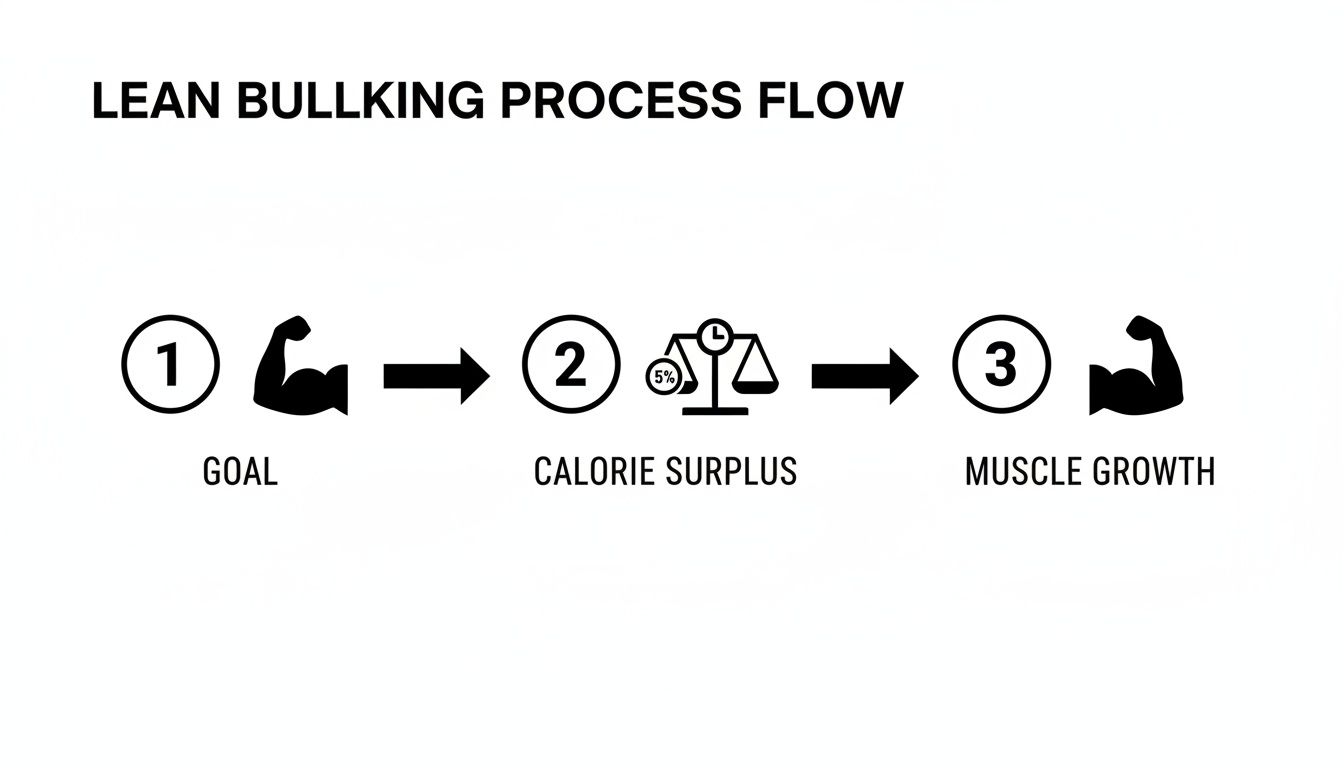
As you can see, a clear goal plus a tiny, precise calorie surplus is the straightest path to pure muscle growth.
With your calories locked in, let's talk macros. When you’re trying to build muscle, protein isn't just important—it's everything. Protein provides the amino acids that act as the raw materials your body uses to repair and rebuild muscle fibers bigger and stronger. Skimping on protein during a bulk is like trying to build a brick house without any bricks. It just doesn't work.
You need to hit a specific target, and it’s probably more than you're used to. Aim for 1.6 to 2.2 grams of protein per kilogram of body weight every single day. That isn't just a number we pulled out of a hat; it's the scientifically-backed range for maximizing muscle protein synthesis. Go lower, and you're leaving gains on the table. Go higher, and you're mostly just getting diminishing returns.
In a lean bulk, hitting your protein target is your best defense against gaining fat. It’s highly satiating, has a higher thermic effect of feeding (your body burns more calories digesting it), and is the literal foundation of new muscle.
Science has confirmed just how powerful a high-protein approach is. A huge 2021 meta-analysis found that for every extra 0.1g/kg of protein someone ate daily, they boosted their lean body mass gains. One wild study even showed that athletes on a high-calorie, high-protein diet gained strength just like lower-calorie groups but with a shockingly low 3% fat gain compared to 15% for the lower-protein group. You can dig into the fascinating findings about protein and lean mass on your own time.
While protein builds the muscle, carbs and fats are what fuel the work. Think of carbs as your body's high-octane gasoline, powering you through those tough, growth-spurring workouts. They also restock your muscle glycogen stores, which is critical for recovery and being ready to go hard again in your next session.
Stick with the good stuff—complex, slow-digesting carbs like:
And don't you dare fear the fats. Healthy fats are non-negotiable. They play a massive role in producing key muscle-building hormones like testosterone. They also help keep inflammation in check and support your overall health.
Make sure you're getting plenty of these:
A solid starting point for your macro split is 40% carbs, 30% protein, and 30% fats. But this isn't set in stone. Track how you look, feel, and perform for a few weeks, and don't be afraid to tweak things. Feeling sluggish in the gym? You might need a few more carbs. Recovery feels slow? A little bump in protein could be the answer.
It's a constant conversation with your body. By using this nutritional framework, you're not just eating more—you're eating smarter. You're setting the stage for some serious, high-quality muscle gains. For even more tools to help you on your journey, check out the full range of performance supplements over at Crazy Muscle on Amazon.
You can’t just eat your way into a bigger, leaner physique. All that food needs a mission. Without the right marching orders from your training, your body will happily take those extra calories and store them as fluff around your waistline.
That’s where intelligent, hard training comes in. It’s the signal that tells your body, “Hey! We’re building something here! Send those nutrients to the muscles, stat!”
Forget about spending endless hours in the gym, grinding yourself into dust. That’s an old-school myth that leads straight to burnout, not growth. The real key to a successful lean bulk is training smarter, not just longer. We’re going to build a plan that forces muscle growth with brutal efficiency.
More is not better. It’s just more. Your muscles don't grow based on the time you clock in at the gym; they grow from a specific dose of high-quality, challenging work. Anything beyond that is what we call "junk volume"—wasted sets that crank up fatigue but do absolutely nothing for building new muscle.
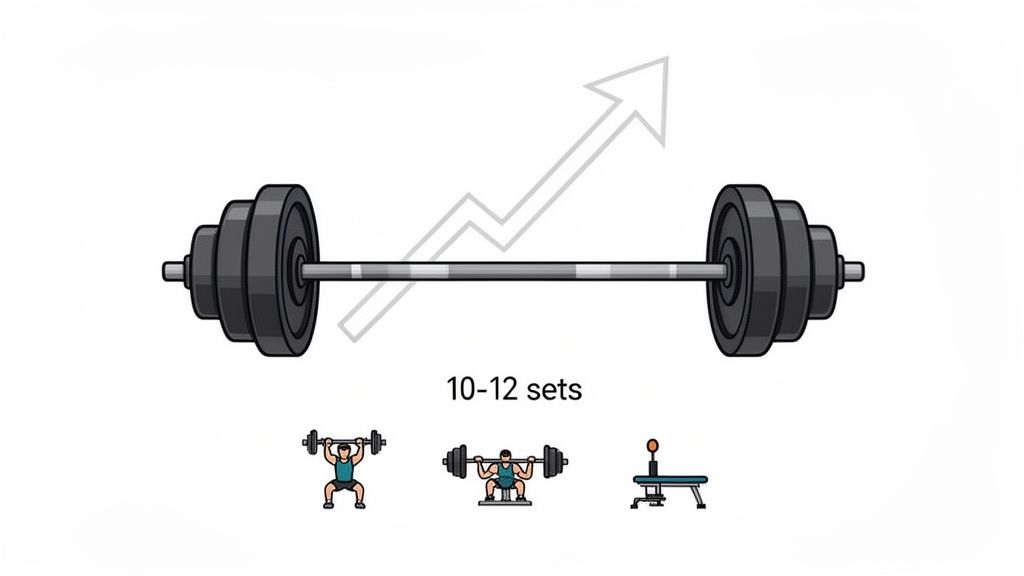
The sweet spot you’re looking for is 'Minimal Effective Volume.' Think of it as the least amount of work you need to do to get the biggest muscle-building bang for your buck. For most lifters, that magic number is somewhere around 10-12 hard sets per muscle group, per week. A “hard set” means you’re pushing it close to failure, leaving only 1-2 good reps in the tank.
Think of your training volume like a prescription. Too little, and nothing happens. Too much, and you get nasty side effects like overtraining and stalled progress. Hitting that 10-12 set range is the perfect dose for pure muscle.
The science backs this up. Recent analyses have shown that the muscle-building response pretty much flatlines after about 11 sets per muscle in a single session, while fatigue can skyrocket by 30-50% if you push past that point. By staying in this efficient zone, you get all the gains with none of the wasted effort. You can read more about training smarter for muscle gain and see how this ‘less is more’ approach is changing the game.
If you remember only one thing from this entire section, make it this: you must get stronger over time. This is the unbreakable law of progressive overload, and it's the engine of all muscle growth. It simply means you have to constantly ask your muscles to do more than they’re comfortable with.
Think about it. If you go to the gym and lift the same weight for the same reps, week after week, why would your body change? It has no reason to. It’s already adapted to that challenge. To force it to grow, you have to give it a new challenge.
Applying progressive overload is simple:
Track every workout like a hawk in a notebook or an app. Your mission for every single session should be to beat your last performance, even if it's just by one extra rep. That’s how you keep the gains coming.
Want the most bang for your buck? Then your training plan needs to be built around the big, heavy compound movements. These are the multi-joint exercises that recruit tons of muscle all at once, creating a massive hormonal response that’s perfect for building overall size and strength.
Sure, bicep curls have their place—they’re the icing on the cake. But the foundation of your physique will be built with these heavy hitters:
By making these lifts the cornerstone of your workouts, you’re working more muscle in less time and turning your body into an anabolic machine, primed and ready to use those extra calories for what you really want: rock-solid muscle.
Here’s a hard truth most people ignore: you don’t actually build muscle in the gym. Let that sink in for a second. The gym is where you create the stimulus for growth by breaking down muscle fibers. The real magic—the part where you actually get bigger and stronger—happens when you’re out of the gym, resting.
This is the part everyone messes up. They track every last calorie and live and die by their training log, but they treat recovery like it’s optional. Big mistake. If you’re serious about how to bulk without gaining a bunch of fat, you have to become a recovery fanatic. It’s the secret ingredient that turns hard work into a lean, powerful physique.

Think of sleep as your body's personal construction crew, working the night shift. While you’re out cold, your system is busy repairing those muscles you hammered earlier. Better yet, this is prime time for your body to release growth hormone and testosterone—the very hormones that signal it to build new muscle tissue.
Cut your sleep short, and you're not just groggy; you're actively shooting your bulk in the foot. A sleep-deprived body dials down testosterone production and cranks up cortisol, the infamous stress hormone. Cortisol is the ultimate gains goblin. It can trigger muscle breakdown and tells your body to hang onto fat, especially around the stomach.
Trying to lean bulk on 5 hours of sleep is like flooring the gas in your car with the parking brake on. You’re just creating a ton of friction and getting nowhere fast.
Making 7-9 hours of quality sleep a nightly priority is non-negotiable. It's not lazy; it's strategic. Getting a handle on good sleep hygiene practices is one of the smartest things you can do to maximize your results.
Speaking of cortisol, let's talk about stress. Whether it’s from your job, your personal life, or even just training too hard for too long, chronic stress is a killer for a lean bulk. It puts your body in a constant state of "fight or flight," which keeps cortisol levels high around the clock. This makes building muscle incredibly difficult and storing fat ridiculously easy.
You have to actively manage your stress. This isn't some fluffy, feel-good advice—it's a physiological requirement for anyone who wants to change their body.
Here are a few game-changing recovery tactics to get you started:
Recovery is a huge topic, and we've only scratched the surface. To really dig in, check out our guide on how to speed up muscle recovery—it’s loaded with more tips to keep you growing. When you start taking sleep and stress management as seriously as you take your deadlift, you create the perfect internal environment for lean, sustainable growth.
Alright, let's talk about turning your body into a high-performance engine. You've got your nutrition dialed in and you're hitting the gym with a purpose. That's the foundation. Now, it's time to add the high-octane fuel to the fire.
Think of smart supplementation as the turbocharger for your lean bulk—it takes an already solid system and makes it brutally efficient. We're not talking about magic pills here. This is about using science-backed tools to squeeze every last drop of potential out of the hard work you’re already putting in.
If you only take one supplement to build muscle, make it creatine. Seriously. It’s one of the most studied, proven, and effective performance enhancers on the planet. For a lean bulk, it’s a no-brainer.
So how does this stuff work? In simple terms, creatine helps your body crank out more ATP (adenosine triphosphate), the high-energy molecule your muscles burn for fuel during explosive lifts. More ATP means you can bang out an extra rep or two, add another 5 pounds to the bar, and push your sets just that little bit further.
This ties directly into the progressive overload we've been hammering on. By making you stronger and letting you handle more volume, creatine becomes a direct catalyst for growth. It’s not just for a temporary "pump"—it’s a legitimate tool that makes you stronger. Period. That’s exactly why we developed Three-Atine, a blend of three powerful forms of creatine designed to maximize absorption and power, so you can own every single workout.
When you're carefully managing a calorie surplus, every single gram of muscle is precious. You absolutely don't want your body breaking down that hard-earned tissue for energy. This is where Branched-Chain Amino Acids (BCAAs) step in.
Think of BCAAs as your personal security team for muscle fibers. They help reduce muscle soreness and fight catabolism (muscle breakdown), especially during and after a gut-busting training session. The result? You recover faster and stay in a more anabolic, muscle-building state.
Smart supplementation isn’t a crutch for bad nutrition or lazy training. It’s about creating the perfect internal environment for muscle growth, making every calorie and every rep count.
Sipping on a BCAA supplement, like our hassle-free BCAA Tablets, gives your muscles a constant stream of the building blocks they need to repair and grow. Want to dive deeper into building your supplement stack? Check out our complete guide on the best supplements for lean muscle mass.
Beyond the big two, a few other key players can seriously upgrade your lean bulk.
Glutamine: This is the most plentiful amino acid in your muscles. It’s a beast for recovery and immune support. Intense training can drain your glutamine levels, so topping them off helps you bounce back quicker and keeps you from getting run down.
Testosterone Support: Let's be real, healthy hormone levels are crucial for building muscle. Ingredients found in products like our Test-1 Boost can help support your body's own natural testosterone production, which is a game-changer for maximizing protein synthesis, strength, and overall drive.
When you're putting together your game plan, it pays to see what all your options are. To really enhance your lean bulk and support your training, exploring various supplement options can give you that extra edge.
At the end of the day, the right supplements transform your body into an incredibly efficient muscle-building machine. By starting with a powerhouse like Crazy Muscle's Three-Atine, available right on Amazon, you're directly investing in your strength and performance—the perfect foundation for a truly killer lean bulk.
Even with the best plan laid out, you're going to have questions. That's just part of the process. A proper lean bulk is all about listening to your body, making tiny tweaks, and staying the course. Let's dig into some of the most common questions that pop up when you're trying to pack on muscle without the unwanted fluff.
Think of this as your field guide for navigating the real-world problems that can trip you up. Getting these things right is what separates a successful bulk from a "dirty bulk" that just leaves you fat and frustrated.
A lean bulk is a marathon, not a sprint. The whole point is to gain quality muscle over time, not just see the scale shoot up as fast as possible.
A good rule of thumb is to keep your lean bulk going for about 12-16 weeks. Once you hit that mark, it's time to take an honest look in the mirror. If you feel like your body fat is getting a bit higher than you'd like (usually around 15-18% for most guys), it's the perfect time to switch gears.
This is what the pros do. They don't just bulk forever. They cycle their phases to maximize muscle gain while staying lean all year. It's a game of strategy.
After that 12-16 week bulking phase, plan on a "mini-cut" for about 4-6 weeks. This is a short, focused fat-loss phase to peel off the small amount of fat you might have gained. It also resets your body's sensitivity to nutrients, priming you for another successful round of gaining pure muscle. This is the secret to making progress year after year.
First things first: don't freak out. If the scale is climbing a little too eagerly and your waistline is expanding faster than your biceps, it's a simple fix. Nine times out of ten, it just means your calorie surplus is a tad too high.
The immediate fix is a small, surgical adjustment. Knock your daily calories down by 100-150, taking them mostly from your carbs or fats. Do not touch your protein. That's your muscle-building foundation, and it's non-negotiable.
Stick with this new, lower calorie number for two solid weeks and see what happens. Is the scale still ticking up slowly? Are you still getting stronger in the gym? If so, you've found your new sweet spot. The key is to make small, smart changes, not massive, panicked ones.
Absolutely! In fact, you should. Smart cardio isn't a "gainz goblin"; it's one of the most powerful tools you have for a successful lean bulk.
Think about it: better cardio means better blood flow, which helps deliver nutrients to your muscles and clear out waste products so you can recover faster. It also improves your insulin sensitivity, which helps your body use carbs for energy and muscle glycogen instead of just storing them as fat.
The trick is to be smart about it.
Cardio is your insurance policy. It helps you stay lean, healthy, and primed to grow.
At Crazy Muscle, we know that building a great physique is about working smarter, not just harder. A successful lean bulk comes down to a solid plan and the right fuel in your tank. From creatine to recovery formulas, we have the tools you need to build quality muscle, minus the fluff.
Find the perfect supplements for your goals on our Crazy Muscle Amazon store.

Sign up and save 10% off your next order