
How to Reduce Muscle Soreness So You Can Actually Walk Again
Posted by Maximus
on

So, you want to know the secret to taming that post-workout muscle ache? It boils down to a holy trinity of smart fuel, gentle movement, and targeted supplements. We're talking protein-packed meals to patch up those glorious muscle fibers, a light walk to get the blood flowing, and a little magic dust called creatine to speed the whole thing along.
Ah, the post-workout penguin waddle. We’ve all been there. If you've ever found yourself shuffling down the stairs sideways after a truly epic workout, you've come to the right place. We're about to demystify that all-too-familiar ache, technically known as Delayed Onset Muscle Soreness (DOMS), but don't worry—we're ditching the boring science lecture.
That "good pain" you're feeling is actually a badge of honor. It means you’ve successfully created tiny, microscopic tears in your muscle fibers—the essential first step to building them back bigger and stronger. But here's a little secret the gym veterans don't always broadcast: you don't have to suffer for three days straight just to prove you went hard. You can actually be smart about it.
Delayed Onset Muscle Soreness is exactly what it says on the tin: it’s that gnawing ache that decides to show up 24 to 48 hours after you've left the gym. This happens because your body kickstarts an inflammatory response, sending fluid and repair crews to fix those little muscle tears. This isn't a bad thing at all—it’s the very process that makes you stronger and more resilient.
The real trick is learning to manage this process so you can get back to your next session without feeling like you’ve been run over by a truck. If you want to dodge the kind of soreness that makes sitting down a high-stakes adventure, it's a great idea to build some proven injury prevention strategies into your routine.
We’ve all experienced this moment of pure, unadulterated leg-day regret.
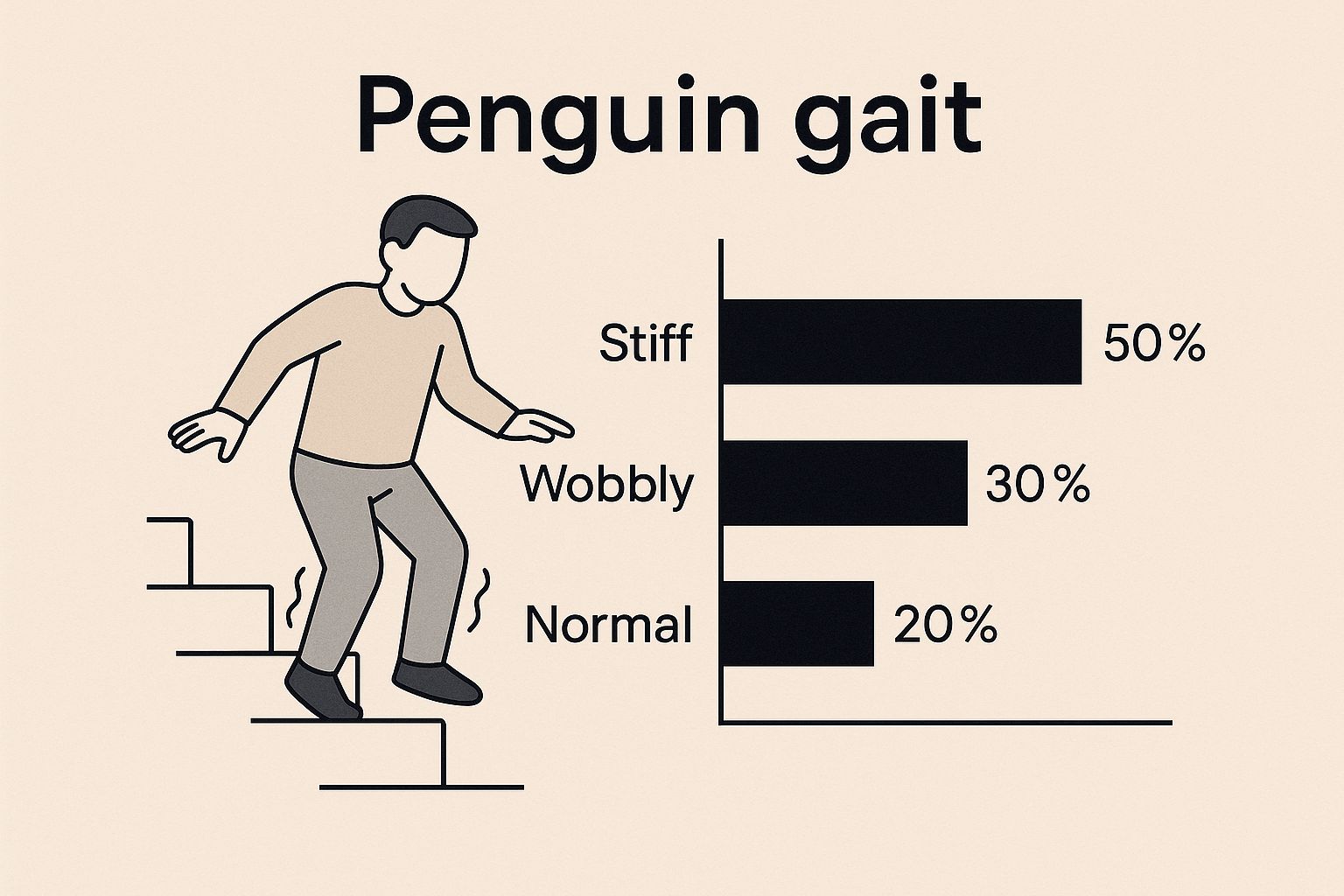
This picture is a perfect snapshot of the stiffness and awkwardness DOMS brings, turning simple daily tasks into a monumental challenge.
If you feel like you’re the only one hobbling around the office, you're dead wrong. The search for real, effective ways to beat muscle soreness is a huge deal. The global market for treating muscle pain was valued at a whopping USD 4.9 billion, and it’s on track to nearly double to around USD 9.9 billion by 2033. That explosive growth tells you one thing: a lot of people are desperate for recovery solutions that actually work.
Here's the bottom line: soreness signals growth, but crippling soreness signals that your recovery isn't keeping up with your training.
Think of this guide as your roadmap to closing that gap. We're going to dive into what truly moves the needle—from simple nutrition hacks to supplements like creatine—so you can bounce back faster and stronger, instead of just gritting your teeth and waiting for the pain to pass.
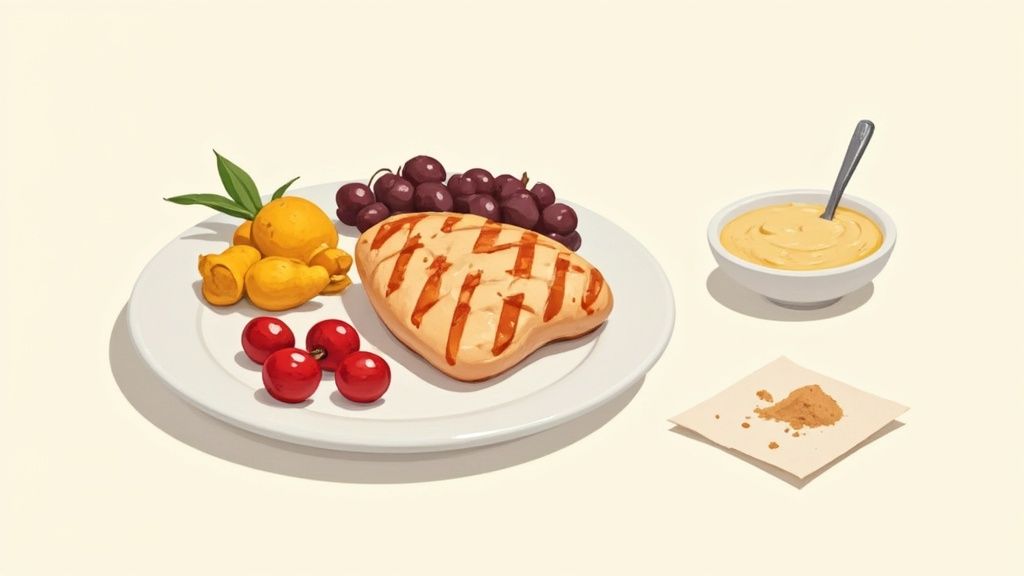
Think of your muscles after a killer workout as a construction site. You’ve just finished demolition, and now it’s time to rebuild everything bigger and better. What happens if you give your crew subpar materials? You get a shaky structure that’s prone to collapse.
Your nutrition is the five-star catering service and the premium building supply delivery for that crew. It’s not just about shoveling down protein and hoping for the best. To really kickstart recovery and tell that deep-seated ache to take a hike, you need to be strategic about what and when you eat.
Timing is everything. Your muscles are screaming for help right after you train, and that post-workout window—say, within an hour or two—is prime time. Getting a solid dose of protein then is like having a fresh shipment of high-quality lumber arrive the second the framing crew is ready to work. It gives your muscles the immediate amino acids they need to start patching things up.
Beyond just rebuilding, we need to put out the inflammatory fire that causes all that nagging pain. Certain foods are absolute all-stars at this. Think of them as your body's natural fire department.
To make it easy, here’s a quick-reference shopping list to load up your cart with soreness-fighting goodness.
| Food Group | Top Choices | Why It Works |
|---|---|---|
| Protein Powerhouses | Chicken, Greek Yogurt, Eggs, Tofu | Provides the essential amino acids (building blocks) needed for muscle fiber repair. |
| Omega-3 Fats | Salmon, Walnuts, Chia Seeds, Flaxseed | These healthy fats are champs at calming down the body's inflammatory response. |
| Antioxidant-Rich Fruits | Tart Cherries, Blueberries, Pomegranate | Packed with compounds like anthocyanins that actively fight inflammation and soreness. |
| Spices & Roots | Turmeric, Ginger | Curcumin (in turmeric) and gingerol (in ginger) are potent natural anti-inflammatories. |
| Leafy Greens | Spinach, Kale, Swiss Chard | Loaded with vitamins and minerals that support the entire recovery process. |
This isn't just about feeding your muscles; it’s about actively soothing them. Combining high-quality protein with these anti-inflammatory powerhouses is the one-two punch that tackles soreness from every angle.
Okay, let's talk about the ace up your sleeve: creatine. A lot of people think of it purely for performance, but it’s an absolute beast for recovery.
Here’s the deal: your muscle cells run on an energy currency called adenosine triphosphate (ATP). A tough workout completely drains that ATP bank account. Creatine is like an express deposit system, helping your body regenerate ATP at a ridiculously fast rate.
This means your muscle cells get the energy they need to jumpstart the repair process almost instantly. It’s the difference between your construction crew having fully charged power tools versus having to build everything by hand.
There's a reason the muscle recovery supplement market is projected to hit USD 695 million in 2025. People are realizing that smart supplementation works. By pairing your protein with creatine and other key amino acids, like the ones in our premium glutamine supplement, you’re giving your body the ultimate support crew to bounce back faster and stronger than ever before.

I get it. After a killer leg day, when every muscle fiber below your waist is staging a full-scale protest, your brain has one simple command: become one with the couch. It feels like the only sane response to that deep, throbbing ache.
But here’s the tough love your sofa won’t give you: planting yourself on it and staying perfectly still is one of the worst things you can do for muscle soreness.
Enter active recovery, your new best friend in the fight against DOMS. It’s the simple art of using gentle movement to coax your muscles back to life. This isn't about powering through another brutal workout; it’s about giving your body's natural healing process a serious kickstart.
Think of your sore muscles as a massive traffic jam of metabolic junk. All that lactic acid and cellular waste is clogging up the highways, and the good stuff—fresh, nutrient-rich blood—can't get through. Active recovery is like sending in the tow trucks to clear the wreckage.
Gentle movement—like a light walk, a chill swim, or some easy cycling—is magic for boosting circulation. This increased blood flow acts as a delivery service and a cleanup crew all in one. It rushes oxygen and nutrients to your trashed muscle fibers while simultaneously flushing out the metabolic gunk that’s making you so stiff and sore.
Active recovery isn't about pushing through agonizing pain. It’s about gently encouraging your body's own repair systems to get the job done faster and better.
This simple act of getting up and moving can slash the time you spend wincing and hobbling around. You’re not just masking the pain; you’re tackling the problem at a cellular level. It’s the difference between waiting for a spill to evaporate and actually wiping it up.
Sometimes, though, even a light walk feels like a marathon. That's when you need to get a little more strategic.
Ah, the foam roller. Your best friend and your worst enemy, all rolled into one beautiful, cylindrical piece of torture. It's a cheap and ridiculously effective tool for giving yourself a deep-tissue massage, breaking up those gnarly knots and releasing tension.
Just breathe through it and spend about 60-90 seconds on each of these major muscle groups.
This routine does more than just improve blood flow; it helps get your full range of motion back so you don't walk like a robot for three days.
Remember, recovery is just as vital as the workout itself. For anyone serious about building a rock-solid training plan, understanding when and how to take off weeks from training is a non-negotiable piece of the puzzle. When you combine smart training with smart recovery, that’s when you start making real, lasting progress.
https://www.youtube.com/embed/0MQzTLZkIdo
Alright, let's talk tech. Your Instagram feed is probably a minefield of futuristic-looking gadgets that all promise to magically erase muscle soreness and supercharge your recovery overnight. But in a world overflowing with shiny new toys, which ones are genuine game-changers and which are just expensive paperweights?
The truth is, technology has seriously leveled up the recovery game, bringing tools once reserved for pro athletes right into our living rooms. This isn't just some niche trend; it's a massive shift. The market for body recovery tools in the U.S. is on track to explode from USD 1.5 billion in 2025 to a whopping USD 3.5 billion by 2035. That boom is being driven by everyday fitness folks like us who are just plain tired of hobbling around after a tough workout.
Of course, navigating all these options can feel like a full-time job, especially when every new device is hyped as the next big thing. It's easy to get lost in the noise, which is why it pays to know the difference between a fleeting gimmick and a legitimate fitness breakthrough. We've got a whole guide on what to trust when it comes to fitness fads and trends that can help you cut through the static.
First up, the mighty percussive massage gun. I like to think of it as a personal jackhammer for your muscle knots. These things use rapid, concentrated bursts of pressure to dive deep into muscle tissue, shattering adhesions and cranking up blood flow like nothing else.
They are absolutely fantastic for zeroing in on those specific, nagging sore spots. For instance, spending just 90-120 seconds methodically working over a tight quad or a grumpy hamstring can bring almost instant relief and noticeably improve your range of motion. If you're new to them, learning how to relieve muscle pain at home with a massage gun is a great starting point.
Then you have compression boots. They look like something straight out of a sci-fi movie, and honestly, the feeling isn't far off. You just slide your legs in, and they use compressed air to systematically squeeze and release your muscles, working their way up from your feet. This process is incredible for flushing out metabolic waste and kicking that heavy, swollen feeling you get in your legs after a brutal session. It's like a high-tech, automated massage that pushes all the gunk out and pulls fresh, oxygenated blood in.
Don't get caught up in having the most expensive gadget. Even simple tools like hot and cold packs, when used correctly, can be incredibly effective. Alternating between a hot pack for 15 minutes (to increase blood flow) and a cold pack for 15 minutes (to reduce inflammation) is a classic, cheap, and powerful recovery method.
You can chug all the protein shakes you want, spend an hour glued to a foam roller, and invest in a massage gun that sounds like a power tool, but it's all just spinning your wheels if your sleep and stress are a mess. Seriously, it's like trying to build a house in the middle of an earthquake.
Let's get real about the two most powerful (and totally free) recovery tools you've got.
It’s easy to get so caught up in the post-workout ritual that you forget your body does its best repair work while you're dead to the world. When you finally hit that deep sleep, your body unleashes its internal construction crew. Production of human growth hormone (HGH)—the MVP of rebuilding torn-up muscle fibers—goes into overdrive.
Cutting your sleep short is like telling that crew to clock out mid-shift. The job just doesn't get done right.
Alright, let's tackle stress. I'm not just talking about the "big presentation tomorrow" jitters. I mean that low-grade, simmering stress that's become a permanent background noise for so many of us. When you're constantly on edge, your body is marinating in a hormone called cortisol.
Think of cortisol as the ultimate villain in your fitness story. It's catabolic, which is a fancy way of saying it actively breaks down muscle tissue. Yeah, the exact opposite of what you’re working so hard for. To make matters worse, sky-high cortisol torpedoes your sleep quality, kicking off a brutal cycle: you're too stressed to sleep well, and too tired to handle the stress.
It's a harsh truth: If your mind isn't recovering, your muscles can't either. Chronic stress essentially puts your body in permanent survival mode, not muscle-building mode.
So, what's the game plan? Forget vague advice like "sleep more" or "stress less." Here are some things you can actually do tonight to start feeling and recovering better.
This isn't just fluffy wellness talk; these are non-negotiable recovery tactics. Get your sleep and stress dialed in, and you’ll create the perfect environment for your body to heal, rebuild, and come back stronger than ever.
Alright, we’ve talked training, nutrition, and recovery tactics until we're blue in the face. But I know there are still some questions rattling around in your head. Let's clear the air with some straight talk so you can get back to what matters: getting stronger.
We’ve all been there. That "oh-no-what-have-I-done" feeling that creeps in after a killer workout. This is your classic case of Delayed Onset Muscle Soreness, or DOMS.
Typically, you'll start to feel it kick in about 12 to 24 hours after your session. It really comes to a head somewhere between 24 and 72 hours post-training. After day three, you should feel it starting to fade away, leaving you ready for the next battle.
Now, if you're dealing with a sharp, stabbing pain in a specific spot, or the soreness just won't quit after a week, that’s your body waving a red flag. Don't be a hero. It’s time to listen to your body and maybe get it checked out by a professional.
Ah, the million-dollar question. The short answer? It really depends on how sore you are.
If it's just a low-level, dull ache—a friendly reminder of the hard work you put in—then some light activity is actually a fantastic idea. Think of it as active recovery. A brisk walk, a gentle spin on the bike, or some dynamic stretches can get the blood flowing to those tired muscles and actually speed up the healing process.
But if you're hobbling around like you just finished a marathon you didn't train for, that's a hard pass. Pushing through intense soreness is just asking for an injury and will only dig you into a deeper recovery hole. Give that muscle group a break. If your chest is wrecked, go hit some squats. Work around it, not through it.
People love to overcomplicate this one. The truth is, with creatine, consistency is king, not timing.
The real benefit comes from keeping your muscles fully saturated with the stuff, and that happens by taking it every single day. This is what ensures your internal energy batteries are always topped off, ready for both performance and recovery.
Sure, some folks like to take it with their post-workout shake, hoping the insulin spike from carbs helps shuttle it into the muscles faster. There's some logic there, but honestly, it’s not a deal-breaker. Just find a time that works for you and stick with it. Morning, noon, or night—just get it in.
This is a big one, and learning the difference is crucial for your long-term health in the gym.
Think of it this way: Good soreness (DOMS) is a general, achy feeling deep within the belly of the muscle. It’s that dull, throbbing sensation you feel when you move. Bad pain, on the other hand, is usually sharp, sudden, and localized, often feeling like it’s near a joint or a tendon.
If the pain is severe even when you're resting, or if you heard or felt a "pop" or "snap" during an exercise, stop what you're doing immediately. Those are not signals to be ignored. Good soreness is a sign of adaptation and growth; bad pain is a signal to stop and seek help.
Ready to stop letting soreness dictate your training schedule? The key isn't a single magic bullet—it's the synergy of smart training, dialed-in nutrition, and powerful recovery. At Crazy Muscle, we’ve engineered our entire product line, from our beastly Threeatine to our essential aminos, to give your body the exact tools it needs to repair, rebuild, and come back bigger and better than before.
Stop just surviving your workouts and start dominating your recovery today at crazymuscle.com!

Sign up and save 10% off your next order