
Should I Cycle Off Creatine? The Final Word on a Myth That Just Won't Die
Posted by Maximus
on

Alright, let's cut through the gym-floor garbage and settle this creatine cycling debate once and for all. The short, sweet, and scientifically-backed answer? You absolutely do not need to cycle off creatine. For pretty much everyone chasing gains, the whole idea of taking a break is an old-school myth that’s more "bro-science" than actual science. The real strategy for keeping your muscles juiced for peak performance is dead simple: continuous, daily use.
You've heard it from that guy on the leg press who's been lifting since the 80s, or read some confusing forum post from 2005 that left you wondering, "should I cycle off creatine?" It’s one of the most stubborn questions in fitness, but the answer is way simpler than you've been led to believe. If you want consistent, long-term gains in strength and muscle, staying on creatine is the undisputed championship move.
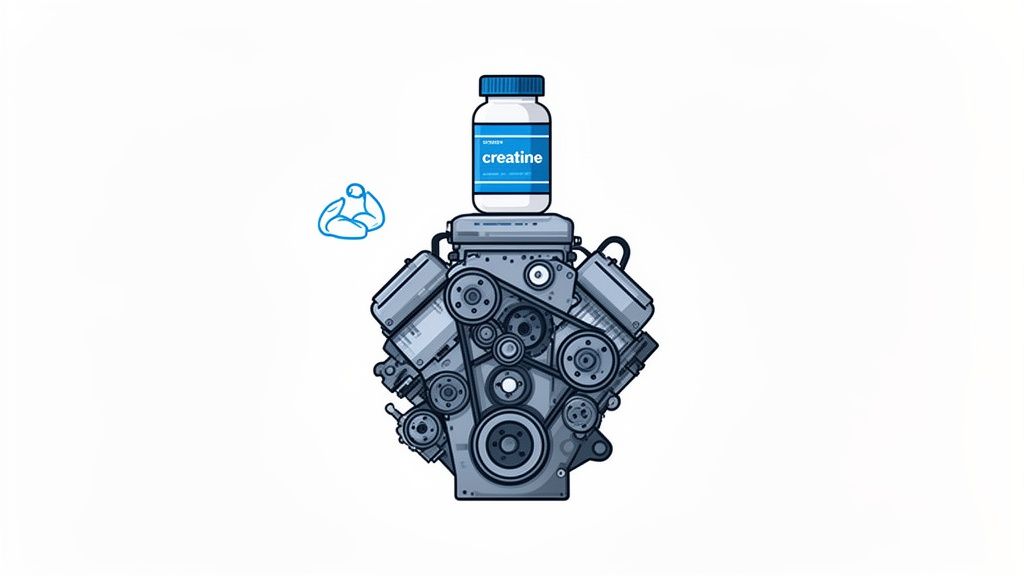
Think of your muscles as a high-performance V8 engine. Creatine is the high-octane rocket fuel that lets you redline it without blowing a gasket. Cycling off is like deciding to drain your fuel tank every month just… because. It’s pointless, sabotages your performance, and frankly, it's just a pain in the ass.
The whole damn point of taking creatine is to hit and maintain what's called muscle saturation. This isn't some complex scientific mumbo-jumbo. It just means keeping your muscle cells fully stocked with phosphocreatine—the stuff that powers short, explosive movements like that next PR attempt or a brutal set of box jumps.
A steady daily dose keeps that "fuel tank" perpetually topped off. When your muscles are swimming in this stuff, you're able to:
When you stop taking it, you’re basically letting that tank run dry. Your creatine levels will slowly bleed back to your normal baseline over a few weeks, and that performance edge you worked so hard for goes right down the drain with it. Why would you ever intentionally sabotage your own progress? It makes zero sense.
The science couldn't be clearer: the best way to use creatine is to keep your muscle stores consistently full. Intentionally emptying them by cycling off is completely counterproductive to your strength and physique goals. You're just spinning your wheels.
Don’t just take our word for it—the research overwhelmingly supports sticking with your supplement. We're talking more than 25 years of studies that all point to the same bone-simple conclusion: there’s simply no physiological reason to take a break.
A daily maintenance dose of 3-5 grams has been proven time and again to keep muscle creatine levels at their peak without any downsides. This consistent saturation is what helps lifters see strength gains of 8-14% in some studies. Classic research has shown that your phosphocreatine levels stay elevated with ongoing use, meaning your body doesn't "get used to it" and you don't need to "wash out" to keep reaping the benefits. You can dive into the massive body of research on creatine's safety and effectiveness yourself to see why continuous use is the standard.
This table breaks it down, showing why sticking with creatine is the no-brainer choice for anyone serious about their training.
| Factor | Continuous Use (Recommended) | Cycling On and Off |
|---|---|---|
| Performance | Consistently high. Your muscles are always saturated and ready to go. | Inconsistent. You lose your performance edge during the "off" cycle. |
| Muscle Growth | Maximized. You're always able to train harder and stimulate more growth. | Slower progress. You're basically hitting the pause button on your gains. |
| Simplicity | Easy. Take your 3-5g daily and forget about it. No calendars needed. | Complicated. You have to track "on" weeks and "off" weeks. Who needs that? |
| Scientific Support | Overwhelmingly positive. Backed by decades of solid research. | Lacks evidence. Mostly based on outdated myths and gym-floor rumors. |
The takeaway is simple: keeping things consistent is the key.
This is exactly why a straightforward daily maintenance dose with a solid product like Crazy Muscle’s Three-Atine is the smartest way to go. It takes all the guesswork out of the equation and guarantees your engine is always primed for relentless progress. That way, you can focus on what really matters: getting freakishly strong in the gym.
So if cycling off creatine is old news, where did the idea even start? It wasn't just pulled out of thin air. The myth’s origins trace back to the early, wild-west days of sports supplements—a time when new products were often misunderstood and all lumped together.
The heart of the issue was a classic case of mistaken identity. Back when lifters were first discovering the power of supplements, creatine burst onto the scene. It worked so damn well for building strength and size that people naturally filed it away with the only other powerful muscle-builders they knew about: anabolic steroids.
And that was the crucial, boneheaded mistake.
Anabolic steroids absolutely must be cycled. Using them non-stop screws with your body's natural hormone production, which can cause some pretty serious health problems. So, the fitness community of the time applied that same logic to creatine. They figured anything this effective must need a similar on-again, off-again approach to give the body a break.
Based on this faulty comparison, the "classic" creatine cycle was born. You might still hear whispers of this protocol in locker rooms today, and it usually looked something like this:
The theory was that your body might get lazy and stop making its own creatine, or maybe the receptors that shuttle creatine into your muscles would get burned out and become less sensitive. It was a complete guess—a hypothesis based on how other compounds worked, not on how creatine actually works.
It's like being told you need to let your smartphone battery die completely once a month to "preserve its health." We all know that’s a myth based on ancient battery technology. The same goes for creatine; the advice to cycle it is based on outdated and flat-out wrong assumptions.
Thankfully, sports science didn't stay in the dark ages. As researchers churned out hundreds of studies over the following decades, a much clearer picture emerged. They found that taking creatine doesn't really affect your body's natural production in any meaningful way, even over the long haul.
Even more importantly, the creatine transporters in your muscles don't get lazy or "downregulate." They keep on working just fine.
The science made it crystal clear: keeping your muscles consistently saturated with creatine is the best way to get all the benefits. That "off" cycle wasn't giving your body a much-needed rest. It was just voluntarily draining your performance fuel tank and forcing you to start building it back up from zero every few months.
Today, armed with a mountain of evidence, the fitness world has largely moved on. The verdict is in: for consistent, reliable gains, a simple daily dose of a high-quality creatine supplement is the scientifically-backed gold standard. You can skip the confusing calendars and pointless cycles—just stick with what actually works.
To keep things simple and effective, find a reliable source you can count on, like the creatine blends available on our Crazy Muscle Amazon store.
Alright, let's cut through the noise and talk real science—no boring textbook lectures, I promise. You’re here because you want to know why staying on creatine is the best play for building muscle. The answer completely torpedoes one of the oldest myths floating around the gym floor: the idea that your body gets "lazy" if you don't take a break.
The old theory went something like this: if you take creatine every single day, the special pathways that shuttle it into your muscles (called creatine transporters) will get overworked and basically shut down. This is a process known as downregulation. But here’s the thing—modern science has put this idea under a microscope, and it just doesn’t hold water.
Think of your muscle cells as exclusive nightclubs and creatine transporters as the bouncers working the velvet rope. The myth suggests that if the line of creatine waiting to get in is always long, the bouncers will eventually get tired and go home, leaving your gains stuck outside.
In reality, these bouncers are workaholics. They don't clock out. Solid research shows that even with long-term, daily creatine use, these transporters just keep on doing their job efficiently. Your body doesn’t "get used to it" or become less sensitive. It simply uses the steady supply you provide to keep the party inside your muscles going strong.
The bottom line is your body's creatine transport system is incredibly robust. It's built for consistency, not for the on-again, off-again confusion that cycling introduces.
This is exactly why a daily 3-5 gram maintenance dose is the sweet spot. It’s just enough to keep those VIP parking spots in your muscles full without overwhelming the system. Cycling off is like firing your entire security team for a month—it’s a totally unnecessary disruption that only tanks your performance. To really get how this all works, check out our guide on how creatine actually works inside your body.
Look, you don't have to just take our word for it. The world's leading sports science organizations have been studying this for decades, and their verdict is overwhelmingly in favor of continuous use.
The International Society of Sports Nutrition (ISSN), one of the most respected names in the game, has a crystal-clear position based on over 25 years of research. They confirm that daily creatine monohydrate use is not only safe but consistently effective. Their findings show it can boost high-intensity performance by a staggering 15-20% in short, explosive efforts like heavy lifts and sprints. Even better, long-term clinical data reveals absolutely no evidence of harm to the kidneys, muscles, or your body's temperature regulation when taken at recommended doses. Go ahead and read the full research about these long-term findings to see the mountain of evidence for yourself.
This expert consensus blows the myth of cycling completely out of the water.
The real magic of creatine lies in accumulation. It’s not a stimulant that hits you instantly; it’s a fuel source you build up in your muscles over time. Consistent, daily supplementation ensures your phosphocreatine stores are always topped off, giving you the power to push harder and spark more muscle growth in every single workout.
Cycling is a direct interruption of this beautiful process. When you stop, your levels gradually drop over 4-6 weeks, and that performance edge just vanishes. You're left with less power, less endurance, and slower progress. For a deeper dive into how creatine stacks up with other effective aids, explore this a practical guide to muscle building supplements.
Ultimately, the science is settled. If your goal is to get stronger and build muscle as efficiently as possible, a steady, daily dose from a premium source like our Three-Atine Creatine on Amazon is the smartest, most effective path forward. Don’t sabotage your own gains—stay consistent and keep growing.
So, you’re thinking about hitting the pause button on your creatine. Maybe you’re just curious, maybe the tub is empty, or maybe you’ve heard some old-school gym lore about needing to cycle off. Whatever the reason, let's pull back the curtain on what actually goes down.
The good news? Nothing terrible is going to happen. The bad news? You're basically choosing to put the brakes on your own progress.
When you stop taking creatine, those super-saturated muscle stores don't just disappear overnight. Picture it like a tire with a slow leak. It’s not a sudden blowout; it’s a gradual, steady loss of pressure. Over about four to six weeks, your muscles will slowly drift back to their normal, un-supplemented baseline.
This whole process is why consistency is everything. You work to get your muscles fully saturated, and the goal is to keep them that way.
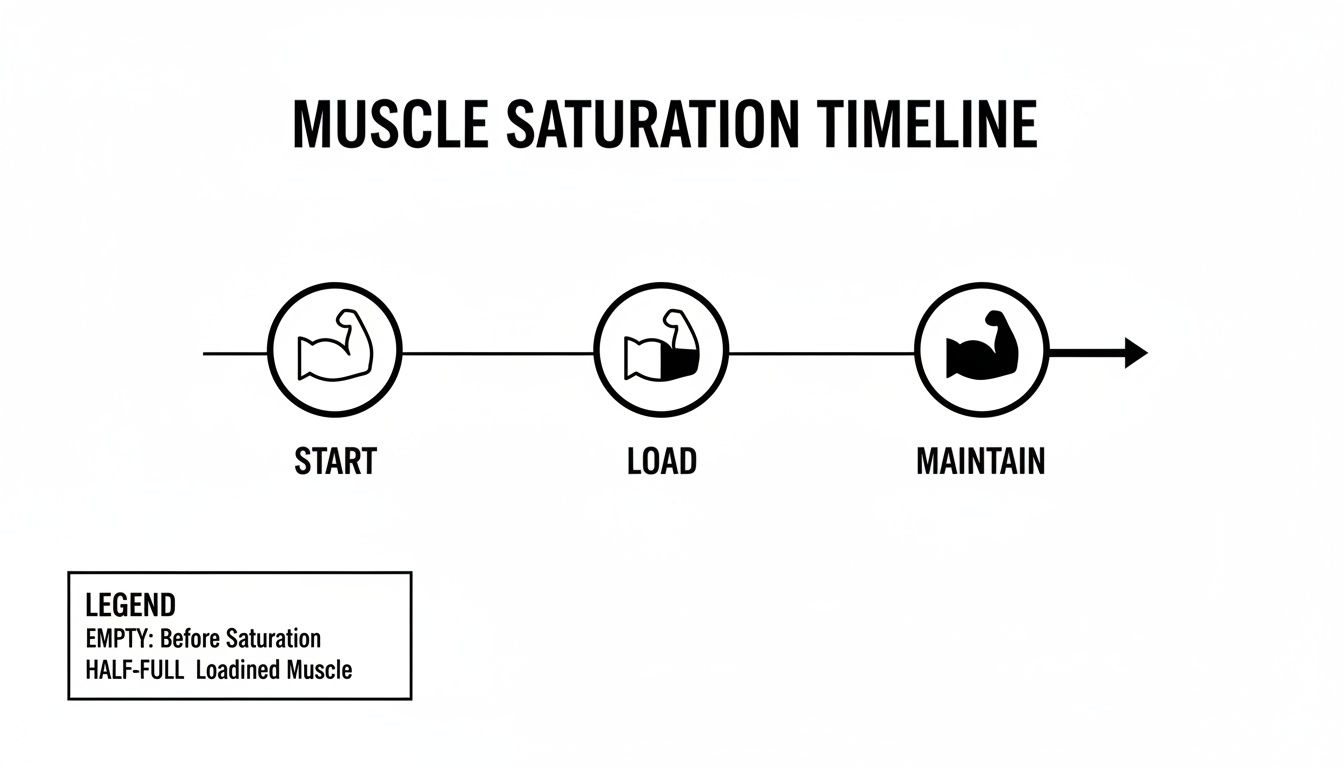
As the visual shows, you want to get to that "Maintain" stage and live there. That's where the magic happens.
During this four-to-six-week "washout" period, you're going to feel the change during your workouts. That extra gear you had for your toughest sets? It might start to feel like it's gone missing. And no, it's not just in your head. With less phosphocreatine on tap, your body simply has less immediate fuel for those powerful, all-out efforts.
Here’s what that feels like in the real world:
This is the direct result of your muscle creatine levels heading back to square one. To see how this works in reverse, check out our guide on how long creatine takes to work to understand the saturation timeline from the start.
One of the first things you'll notice is the number on the scale dropping by a few pounds. Before you freak out, let's be clear: you are not losing muscle. This is almost entirely water.
Specifically, it’s intracellular water—the water that creatine pulls inside your muscle cells. This is a good thing! It hydrates the muscle, gives you that full, pumped look, and even helps with the muscle-building process. When creatine levels fall, so does the water it holds onto.
This is the key takeaway: You're losing water from inside the muscle, not the muscle tissue itself. Your gains are safe, but your performance and that full-muscle look will take a temporary vacation.
To give you a clearer picture, here’s a breakdown of what that washout period looks like week by week.
This table illustrates the gradual decline in muscle creatine saturation and its potential effects on performance after you stop supplementation.
| Time After Stopping | Muscle Creatine Levels | Potential Performance Impact |
|---|---|---|
| Week 1 | Starting to decline, but still well above baseline. | You might not notice much of a difference yet. Maybe a slight drop in your final reps. |
| Week 2 | Roughly 20-30% decrease from full saturation. | The effects become more noticeable. Strength might feel a little "off." |
| Week 3-4 | Approaching a 50% decrease or more. | This is where the performance dip really kicks in. Reps drop, and power output is reduced. |
| Week 4-6+ | Back to your body's natural, un-supplemented levels. | Your performance in the gym is now fully back to your pre-creatine baseline. |
As you can see, the process is gradual but definitive.
Ultimately, stopping creatine isn’t dangerous, but it is a step backward. You’re willingly giving up a scientifically proven edge that helps you train harder, recover faster, and see better results. It really makes the case for keeping your supply locked and loaded, so you never have to interrupt that progress.
Alright, so we've established that for 99% of us, staying on creatine is the undisputed champ for building strength and muscle. The science is crystal clear, and the logic is simple: keep the tank full. But what about that other 1%? Are there any scenarios where hitting the pause button is actually part of the strategy?
You bet. But let's be clear—these situations are incredibly niche and specific. We're not talking about your average person trying to get stronger and look better. The exceptions to the "never cycle" rule are reserved for elite athletes playing a very different game, one where a single ounce on the scale can make or break their entire career.
Let's dive into the two most common situations where an athlete might intentionally drop creatine from their supplement stack.
Competitive Bodybuilding: Picture a bodybuilder just days out from a competition. Their entire focus is on looking as lean, dry, and "shredded" as humanly possible under those bright stage lights. Since creatine’s job is to pull water into the muscle cells (which is fantastic for performance and a full look the other 360 days of the year), they might stop taking it to shed that last bit of water for razor-sharp muscle definition.
Combat Sports & Weight-Class Athletes: Now think about a wrestler, a boxer, or an MMA fighter. These athletes have to hit a very precise number on the scale to even be allowed to compete. That extra couple of pounds of water weight from creatine saturation could be the difference between making weight and being disqualified. For them, cycling off a few weeks before a weigh-in is a calculated move to hit their target.
The key takeaway here is that for both of these groups, the decision to stop is purely temporary and strategic. It has zero to do with health or long-term performance. It's a short-term sacrifice for a very specific competitive or aesthetic outcome.
It's like a race car driver using super-soft tires for a single qualifying lap. They provide incredible grip for that one moment, but they'd fall apart in the actual race. Cycling off creatine is the same—it's the right tool for a very niche job, but a terrible strategy for the long haul.
So, should you be cycling off creatine? If you don't have a posing routine to practice and you're not trying to make the 155-pound weight class, the answer is a loud and clear no.
Your goal is consistent, long-term progress. You want to be stronger next month than you are today. You're building real, sustainable muscle, not just manipulating water weight for a fleeting moment. For the Crazy Muscle community, the path forward is simple: consistent daily use is what builds the foundation for continuous gains.
The minor side effects are a non-issue for most, and as you can learn in our guide on creatine monohydrate side effects, the benefits blow them out of the water.
So, unless you've got a weigh-in on the calendar, stick with your daily dose. Keep that engine humming at full capacity and let the gains roll in, uninterrupted.
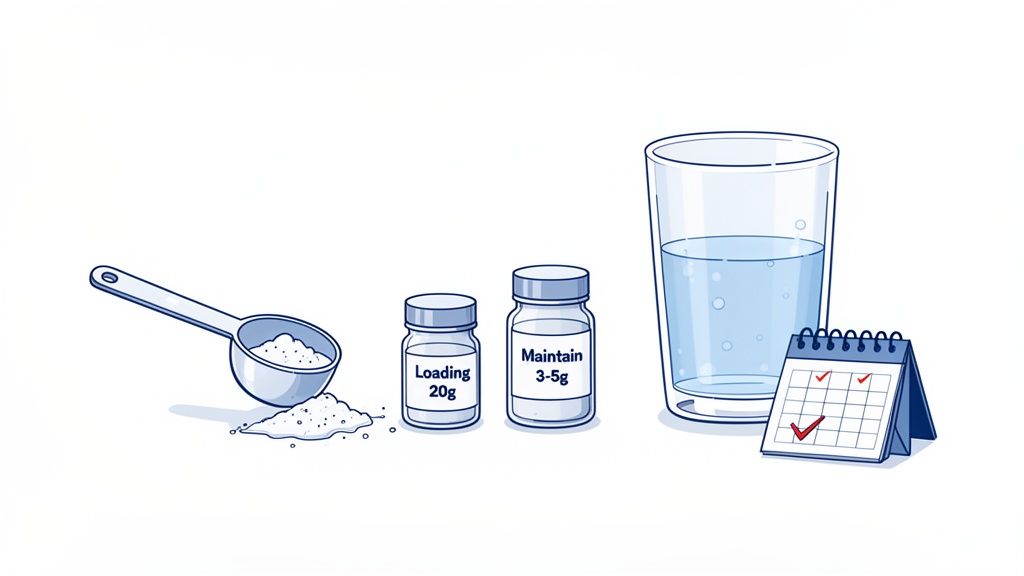
Alright, enough of the internet myths and "I heard from a guy at the gym" advice. Let's get down to brass tacks and build your personal action plan for getting the absolute most out of your creatine.
This isn't rocket science. It's about smart, simple consistency that delivers powerful results. Forget all the noise about complicated cycling schedules. The scientifically-backed blueprint for success is way easier and hangs on one core principle: keep your muscles saturated. Here’s exactly how to do it.
Think of this as the express lane to full muscle power. The loading phase is for those who are itching to see results and want to feel that performance edge as fast as humanly possible. It’s completely optional, but man, is it effective.
If you skip the loading phase, no sweat. You'll get to the exact same destination; it'll just take a bit longer—about three to four weeks of daily maintenance doses to top off the tanks.
This is the main event. It's the non-negotiable, long-term foundation of your success with creatine. After you’ve loaded up (or if you’re skipping the load), you’ll shift to a simple daily dose to keep your muscle tanks perpetually full.
Your daily maintenance dose is the most important part of the equation. This is the habit that locks in your strength, power, and muscle fullness for the long haul. Consistency here is everything.
The sweet spot for most people is a simple 3-5 grams per day. This is where a product like our Crazy Muscle Three-Atine on Amazon really shines. Our convenient capsules take all the guesswork and messy powder out of the equation, delivering the perfect, precise dose every single time. Just grab and go.
Once you’ve nailed your daily dose, a few simple tweaks can help you squeeze every last drop of potential out of your supplementation.
For you endurance folks, continuous use has shown some massive benefits. One study on cyclists found it boosted power in the final, agonizing sprint of a grueling 120km time trial. It also significantly improved peak power in repeated sprints, which is a dream for anyone doing HIIT-style training. In fact, some research shows it can even boost muscle glycogen storage—pure fuel for your muscles. You can discover more insights about these performance findings on Bicycling.com.
This entire blueprint is about removing friction and making consistency effortless. That’s why setting up a Crazy Muscle subscription is the ultimate pro move. It’s more than just a delivery; it's your automated system for guaranteeing you never miss a dose and your gains never, ever stop climbing.
Even with all the science laid out, a few common questions always seem to surface. Let's tackle them head-on with some quick, no-nonsense answers so you can get back to training with confidence.
Yep, 100%. If there’s one supplement that’s been put under the microscope more than any other, it’s creatine. The verdict from decades of research is crystal clear: for healthy people, daily long-term use is perfectly safe.
Study after study has failed to find any credible link between daily creatine use and kidney or liver damage in folks who don't already have health issues. The only real rule? Drink plenty of water.
Need to? Nope. Want to? Well, that depends on how patient you are. A loading phase is basically the express lane to full muscle saturation.
Think of it like filling a bucket. You can use a fire hose (the 20-gram loading phase) and have it overflowing in under a week, or you can use a garden hose (the 3-5 gram maintenance dose) and get it full in about three or four weeks. Both get you to the same place, so if you're not in a rush, a steady daily dose works just fine.
Absolutely nothing. Don't sweat it for a second.
Your muscles hold onto creatine like a reservoir, not an on/off switch. Missing a single dose won't cause your levels to suddenly plummet. Just pick back up the next day with your normal 3-5 gram dose. Whatever you do, don't double up to "make up for it." Consistency over the long haul is what builds results, not daily perfection.
Go for it! Creatine and BCAAs are a great team. They work on totally different things in your body, so there’s no competition between them. In fact, they can work together to support your training.
Tossing them both in your shaker is a solid move. You get the power for the workout and the building blocks for repair afterward. There's zero evidence that mixing them causes any problems or makes either one less effective.
At the end of the day, consistency is king. The best way to keep your muscles primed for growth is to make your supplement routine automatic, something you don't even have to think about. Crazy Muscle makes that dead simple with our powerful creatine formulas, like the ridiculously convenient Three-Atine capsules.
Ready to lock in your gains and eliminate the guesswork? Check out our Three-Atine Creatine on Amazon and set up a subscription so you never run out.

Sign up and save 10% off your next order