
Vegetarian Sources of Creatine: Why Your Salad is Betraying Your Biceps
Posted by Maximus
on

Let's be brutally honest for a second: if you're hunting for natural, whole-food vegetarian sources of creatine, you're on a wild goose chase. Scouring the produce aisle for a creatine-packed super-veggie is, unfortunately, a complete and total waste of your precious time.
This isn't a dead end for your fitness goals—not by a long shot. But it’s a crucial reality check we need to blast out of the way right now so we can get to the good stuff.
Think of your muscle creatine stores like your phone's battery. The average meat-eater starts their day with a battery pretty much topped off at 100%, thanks to a steady trickle-charge from things like beef and salmon. It’s an unfair advantage, but it’s just how biology works.
But if you're vegetarian or vegan, you're working with a factory defect. Your diet provides zilch, zero, nada of that external power source. Your body is left to its own devices, relying solely on its ridiculously inefficient internal production. This means your battery is often hovering around a pathetic 70-80% capacity before you even think about crushing it in the gym.
This isn't a knock on your diet—it's a biological screw-up. This "creatine gap" is precisely why chowing down on more lentils or almonds won't move the needle one inch. Those foods are champions for protein, but when it comes to filling your creatine tank, they're useless bystanders.
The difference in creatine content between animal and plant foods isn't just small; it's a Grand Canyon-sized chasm. This is the core reason vegetarians and vegans have about 20-30% lower muscle creatine stores than their steak-eating gym buddies.
Creatine is the undisputed king of explosive energy, but plants just don't make it. You're looking at less than 0.1 grams of creatine per kilogram in plant foods, while a kilogram of beef can pack up to 5 grams. The numbers don't lie, and frankly, they’re insulting.
This chart drives the point home better than I ever could.
As you can see, relying on plants for a meaningful dose of creatine is like trying to put out a forest fire with a squirt gun. It's just not going to happen.
To really put this into perspective, let's look at what it would take to get a standard 5-gram daily dose of creatine from different food sources.
| Food Source | Typical Creatine Content (g per kg) | Feasibility for 5g Daily Dose |
|---|---|---|
| Beef | 2.5 - 5.0 g | Feasible, but you'd need to eat a ton of red meat daily (1-2 kg). Gross. |
| Salmon | 1.5 - 4.5 g | Possible, but requires eating over a kilogram of salmon every single day. |
| Spinach | <0.1 g | You would have to eat over 50 kilograms of spinach. Physically impossible and frankly, a horrible way to live. |
| Nuts/Seeds | <0.1 g | Don't even think about it. You’d need to consume an amount that would bankrupt a small nation. |
The table makes it painfully obvious: for anyone following a plant-based diet, getting enough creatine from food isn't just impractical—it's a scientific impossibility.
So, what's a plant-powered warrior to do? The solution is beautifully, gloriously simple: supplementation.
For vegetarians and vegans, supplementing with creatine isn't just a handy shortcut; it's the only proven, bulletproof strategy to get your muscular battery to a full 100% charge. It’s how you slam that 20-30% gap shut, level the playing field, and give your muscles the high-octane rocket fuel they need to perform at their absolute peak.
Of course, finding the right supplements is part of a bigger picture of maintaining a healthy, plant-based lifestyle, which often includes looking for other vegetarian-friendly products to support your goals.
The big takeaway here is simple: Stop searching for a mythical, creatine-rich vegetable. Your time is far better spent focusing on the one method that delivers insane, measurable results for plant-based athletes—a high-quality, vegan-friendly creatine supplement.
Picture this: your muscles are a high-performance engine. For everyday driving, regular fuel (i.e., carbs and fats) does the job just fine. But when you need to redline it—for that gut-wrenching final rep of a heavy squat or an all-out sprint—you need a shot of pure, unadulterated nitro.
In your body, creatine is that nitro. It’s the undisputed king of fast-twitch, explosive energy.
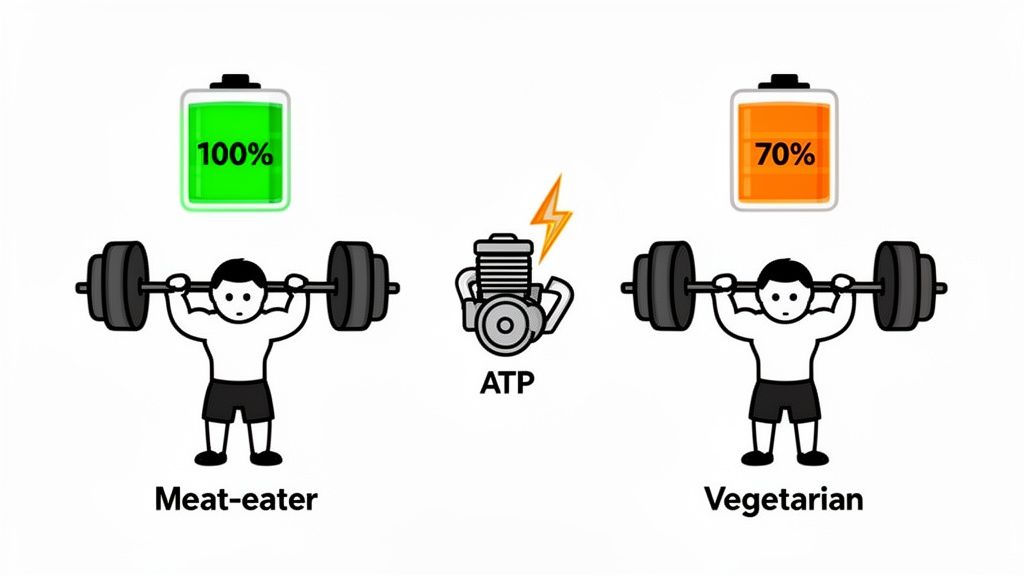
Let's skip the boring biology lecture and get straight to the action. Your muscles run on a high-octane energy currency called ATP (adenosine triphosphate). When you lift heavy, sprint hard, or jump high, you spend your ATP, and it instantly turns into a useless, "spent" version called ADP (adenosine diphosphate).
This is where creatine—or more specifically, its stored form phosphocreatine—swoops in like a superhero. It slaps a phosphate molecule back onto that useless ADP, instantly recharging it into powerful, ready-to-use ATP. It's like having an emergency power bank that refuels your muscles in seconds for another all-out effort.
If you want to geek out on the nitty-gritty science, you can explore our full guide on how creatine works in your body. It’s the secret sauce behind all things strength and power.
Let's put this into a real-world gym scenario. Meet Alex, our omnivore, and Ben, our dedicated vegetarian. They hit the same workouts with the same fire and intensity. The only difference? Alex walks in with his creatine "nitro tank" topped off at 100%, thanks to his diet. Ben, eating only plants, starts his session with his tank sitting around 70-80% full.
It’s squat day. The first couple of sets feel great for both of them. But then comes the money set—the heavy, top set where real progress is forged.
That’s the creatine gap, plain and simple. It has nothing to do with heart or hustle; it’s a fuel supply disaster. Ben’s muscles are screaming for the energy they need to finish strong, but the tank is on empty. This is exactly why finding reliable vegetarian sources of creatine isn't just a small tweak—it's a total game-changer.
For a vegetarian, having lower baseline creatine levels is like showing up to a drag race with less fuel than your competitor. You might have the better engine, but you'll run out of gas before you even cross the finish line.
This isn't just a tiny handicap. Over time, it's the difference between smashing through plateaus and getting stuck in a rut. You’re leaving potential strength and muscle on the table, every single workout. And who wants that?
Alright, so we've established that scouring the produce aisle for vegetarian sources of creatine is a fool's errand. Since plants have betrayed you, let's talk about the strategy that works every single time: smart supplementation.
The undisputed champion here is pure, synthetic, vegan-friendly creatine monohydrate. Don't worry, it's not made from some secret animal byproduct. It's built from the ground up in a lab using simple, non-animal ingredients, making it the perfect weapon for your plant-based arsenal. This means you can fuel your performance without bending your principles.
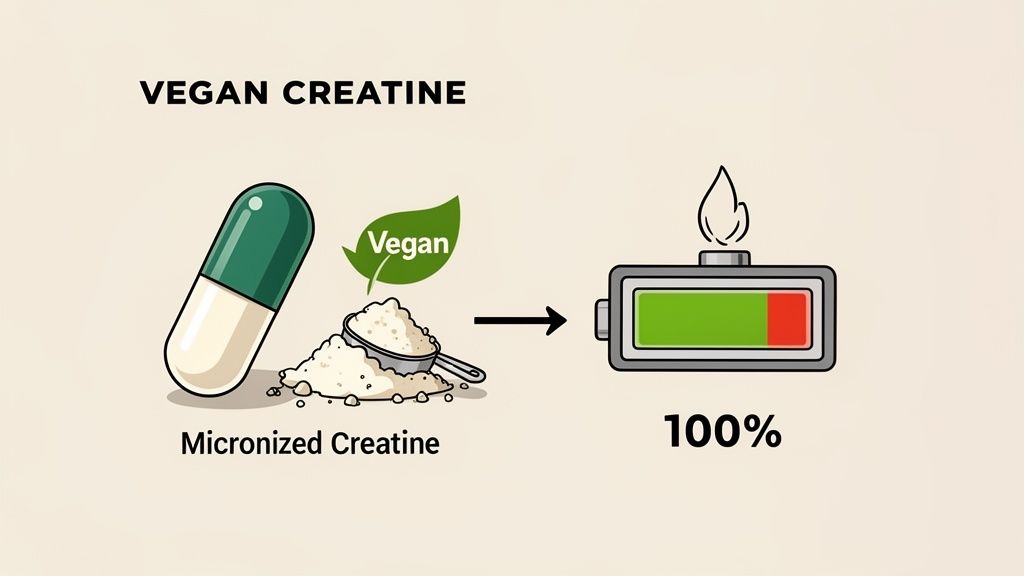
Now, your body can technically make its own creatine from amino acid building blocks like arginine and glycine, which you get from plants. But trying to rely on that internal process to power your workouts? It’s like trying to fill a swimming pool with a leaky garden hose.
It’s painfully slow, incredibly inefficient, and will never get you to the optimal levels needed to truly crush it in the gym. Your internal production line is built for basic survival, not for smashing personal records. This is precisely why supplementation isn't just an option—it's the only direct and reliable way to close that creatine gap.
And you're not alone in figuring this out. The market for plant-based creatine is blowing up, signaling a massive shift for vegetarian athletes everywhere. With North America holding a 39.4% share of the $1.11 billion global creatine market in 2024, it's crystal clear that cruelty-free performance is the future. This explosive growth is driven by athletes who get it: plants offer next to zero creatine, leaving their muscles running at just 70-80% of their full potential. You can dive deeper into these market trends and what they mean for athletes right here.
To really unlock your strength, you need a way to bypass your body’s sluggish manufacturing process and deliver pure, high-octane fuel straight to your muscles. This is where a high-quality, convenient supplement becomes your greatest ally.
Think of it like this:
This isn't about finding a "hack" or a shortcut. For a vegetarian athlete, supplementation is the fundamental solution to a biological problem. It’s the most logical and effective way to level the playing field.
By choosing a high-quality creatine supplement, you take the driver's seat. You’re no longer held back by what your diet lacks. Instead, you're armed with the exact tool you need to build more strength, push for more reps, and see the results your hard work actually deserves. Convenient and potent options like Crazy Muscle’s Three-Atine are engineered for exactly this—to make closing that performance gap completely effortless. Go check it out and see what real power feels like.
So, you've got your vegan creatine and you're ready to unleash the beast. Now what?
Let's cut through the noise. The fitness world loves to make things sound way more complicated than they need to be, but getting your creatine strategy dialed in is ridiculously simple. You don't need a complex spreadsheet or a perfectly timed schedule.
Your path to fully charged muscles really just boils down to two options. Think of it like choosing to sprint or jog to the finish line—both get you there, just at a different pace.
This is the classic approach for anyone who's impatient and wants to feel the gains ASAP. You're basically force-feeding your muscles to get them topped off in record time.
This method will get your muscle creatine stores completely full in about a week. It’s fast, it’s effective, and it’s for people who want results yesterday.
This is my favorite approach for most people because it’s so easy it's almost cheating. You skip the initial high-dose week and just start with the long-term maintenance dose from day one. It’s the ultimate "set it and forget it" method.
So, which one is better? Honestly, neither. The "best" plan is the one you'll actually stick with. The real secret to making creatine work isn't how you start, but that you never stop.
The most important thing to know about creatine is this: Consistency trumps everything. Whether you load or not, the real magic happens when you make that 3-5 gram dose a non-negotiable part of your daily routine, just like brushing your teeth.
And what about timing? Don't overthink it. While a little bit of research suggests taking it post-workout with some carbs might give it a tiny absorption edge, the difference is so small you'll never notice it. The most crucial factor is simply taking it at some point during the day.
Find a time that’s easy to remember—blended into your morning smoothie, mixed with your post-workout shake, or just stirred into a glass of water with dinner—and make it a habit.
For a super deep dive into all the nuances, check out our complete creatine dosage guide. We break down every little detail to help you build a bulletproof plan.
Alright, you get it. The mission isn't to find creatine hiding in your salad bowl; it's to supplement smartly. But walking down the supplement aisle—virtual or otherwise—can feel like the Wild West. Every bottle screams bold promises, so how do you tell the high-octane fuel from the snake oil?
It’s way simpler than it looks. You just need to know the three golden rules for picking a creatine that delivers real results, without any of the junk.
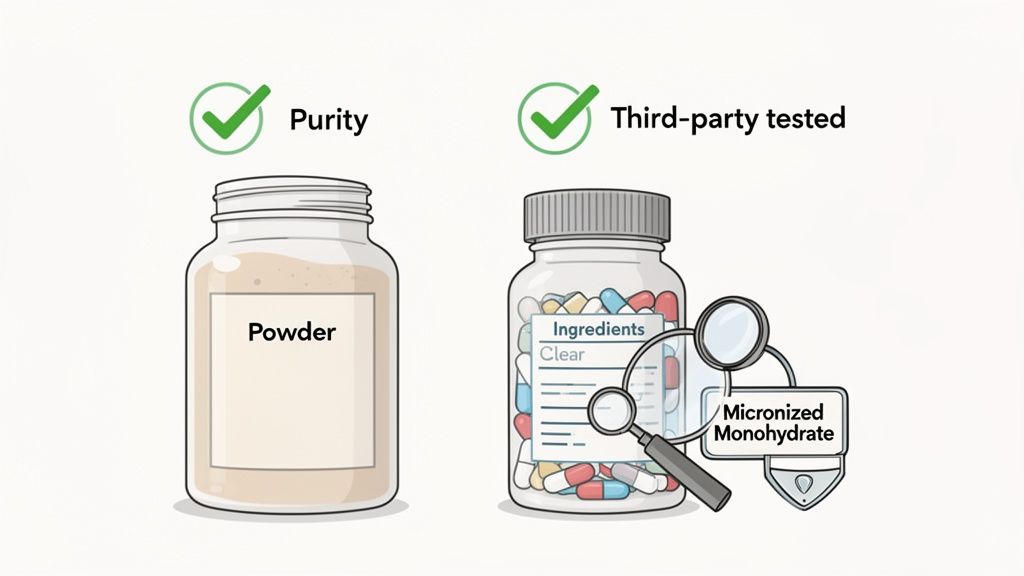
First up, flip that bottle around and read the ingredients. The undisputed champion for purity and effectiveness is creatine monohydrate. It's the most researched, proven, and trusted form on the entire planet. If you see micronized creatine monohydrate, even better—that just means it's been milled into smaller particles, so it mixes easier and is gentler on your stomach.
A trustworthy brand will be loud and proud about what’s in their product. If the label is vague or hides behind a "proprietary blend" of mystery ingredients, that's a giant red flag. Put it down and walk away. You deserve to know exactly what you're putting into your body.
This one is a deal-breaker. Seriously. Anyone can slap a cool-looking label on a tub of white powder, but independent verification is what separates the real pros from the pretenders. To choose a top-tier vegan creatine with confidence, only go for brands that prove their quality through independent third-party supplement testing.
This process guarantees that what the label says is actually what's in the bottle—no contaminants, no useless fillers, just pure, potent creatine. Here at Crazy Muscle, that’s not an extra feature; it’s our absolute baseline. We don’t just say our stuff is the best, we prove it. For a deeper dive into what separates the good from the great, check out our guide on choosing the best creatine monohydrate.
Finally, be realistic. The age-old debate in the creatine world is powders versus capsules.
We designed our Three-Atine capsules specifically for the busy athlete who values efficiency as much as results. It's the ultimate no-fuss, zero-mess way to get your daily creatine in without derailing your day.
Choosing the right creatine isn’t just about buying a supplement; it’s about investing in a tool that respects your goals and your time. It’s about demanding purity, verifying it with testing, and picking a format that makes consistency effortless.
When you focus on these key pillars, you’re not just buying a product. You're making a smart, empowered choice for your performance.
Alright, let's tackle some of the most common questions that pop up. Consider this your personal myth-busting session, designed to clear up any confusion and get you on the path to gains with total confidence.
That's the million-dollar question, isn't it? And I've got great news for you: The overwhelming majority of creatine on the market today is, in fact, 100% vegan.
Gone are the days of weird sourcing from animal parts. Modern creatine is synthesized in a lab from non-animal starting materials. It’s a clean, high-tech process that doesn't involve animals at any stage. At Crazy Muscle, we pride ourselves on making sure our creatine is a perfect match for a plant-based diet, so you can power up your performance without bending your principles.
Ah, the great creatine bloat myth. Let's kill this one for good. When you first start supplementing, creatine’s main job is to pull water directly into your muscle cells. This process, called cell volumization, is actually one of the key signals that kickstarts muscle growth!
So yes, you might see the number on the scale tick up slightly, but this isn't the uncomfortable, puffy stomach bloating you're thinking of. It's functional water weight locked inside your muscles, giving them a fuller, more pumped look. Most people who stick to a quality micronized creatine find that any initial water retention is minimal and quickly balances out.
Think of it like this: creatine isn't making you bloated; it's making your muscles super-hydrated and ready for war. That extra water is a sign it's working exactly as intended.
Nope, not at all. The whole "loading phase" concept—where you slam 20 grams a day for a week—is mostly an old-school marketing trick to get you to buy more, faster. It works, sure, by saturating your muscles more quickly, but it’s totally unnecessary.
You'll get to the exact same place by simply taking a steady 3-5 gram dose every day. It might take about three weeks to fully top off your muscle stores instead of one, but the end result is identical. The best plan is the one you can stick to consistently, and a simple daily dose is as easy as it gets.
In theory, yes. Your body has its own little creatine factory that can assemble it from amino acids like glycine and arginine found in plants. The problem? That factory is incredibly lazy and inefficient.
Trying to rely on your body’s natural production for performance gains is like trying to fill a swimming pool with a leaky bucket. It just can't keep up with the demands of serious training. To see the real-deal strength and power benefits, supplementing with at least 3-5 grams of creatine daily is the only game in town for a dedicated vegetarian athlete.
Ready to stop leaving your hard-earned gains on the table? It’s time to give your muscles the high-performance fuel they’ve been craving. The answer is simple, proven, and fits your plant-based lifestyle perfectly. Grab your supply of premium, vegan-friendly creatine from Crazy Muscle and experience what 100% power feels like.
Check out our top-rated creatine options on our Amazon store and start your transformation today. Seriously, click the link and let's get you those gains.

Sign up and save 10% off your next order