
What Does Creatine Do for Your Muscles? Your Ultimate Guide to Unleashing Beast Mode
Posted by Maximus
on

Let's cut the crap. You’re in the gym, pushing, pulling, grinding. You want results. You want to know what that white powder everyone’s talking about really does. So, what does creatine do for your muscles?
Here’s the simple, no-BS truth: Creatine is basically high-octane rocket fuel for your muscles. It works by rapidly refilling your body's main energy tank, a molecule called adenosine triphosphate (ATP). This lets you crank out more reps, lift heavier, and push harder during those intense, short-burst sets that actually build muscle. More power and endurance ultimately mean more gains. Simple as that.
Ever hit a wall mid-set? You know the feeling. One second you're a powerhouse pushing iron, the next your arms feel like overcooked spaghetti. That frustrating moment is your energy tank hitting empty. But what if you had a rapid-refueling system built right into your muscle cells?
Think of your muscles as a high-performance engine. The gasoline that makes it roar is a molecule called ATP (adenosine triphosphate). It’s the direct, explosive energy source for every single muscle contraction, from a world-record deadlift to just blinking your eyes.
The catch? Your body is stingy. It only keeps a tiny bit of ATP on hand—just enough for a few seconds of all-out effort. Once that's gone, your power drops off a cliff. This is where creatine strolls onto the scene like the undisputed hero of your workout, ready to save the day.
Creatine is your personal pit crew, working at lightning speed to get your engine back in the race. When you use ATP for energy, it loses a phosphate group and becomes a "spent," useless molecule called ADP (adenosine diphosphate). Creatine, which has been storing its own phosphate like a squirrel hoarding nuts for winter, swoops in, hands one over, and instantly recycles that lazy ADP back into powerful, ready-to-use ATP.
This rapid-fire energy regeneration is the core of what creatine does for your muscles. It means you can push harder, for longer.
The Bottom Line: Creatine doesn't magically build muscle for you. It supercharges your ability to do the hard work that forces your muscles to adapt, rebuild, and grow. More energy means more reps and heavier lifts—the true foundation of a stronger physique.
This diagram shows exactly how creatine acts as that critical link between your stored energy and your explosive power output.
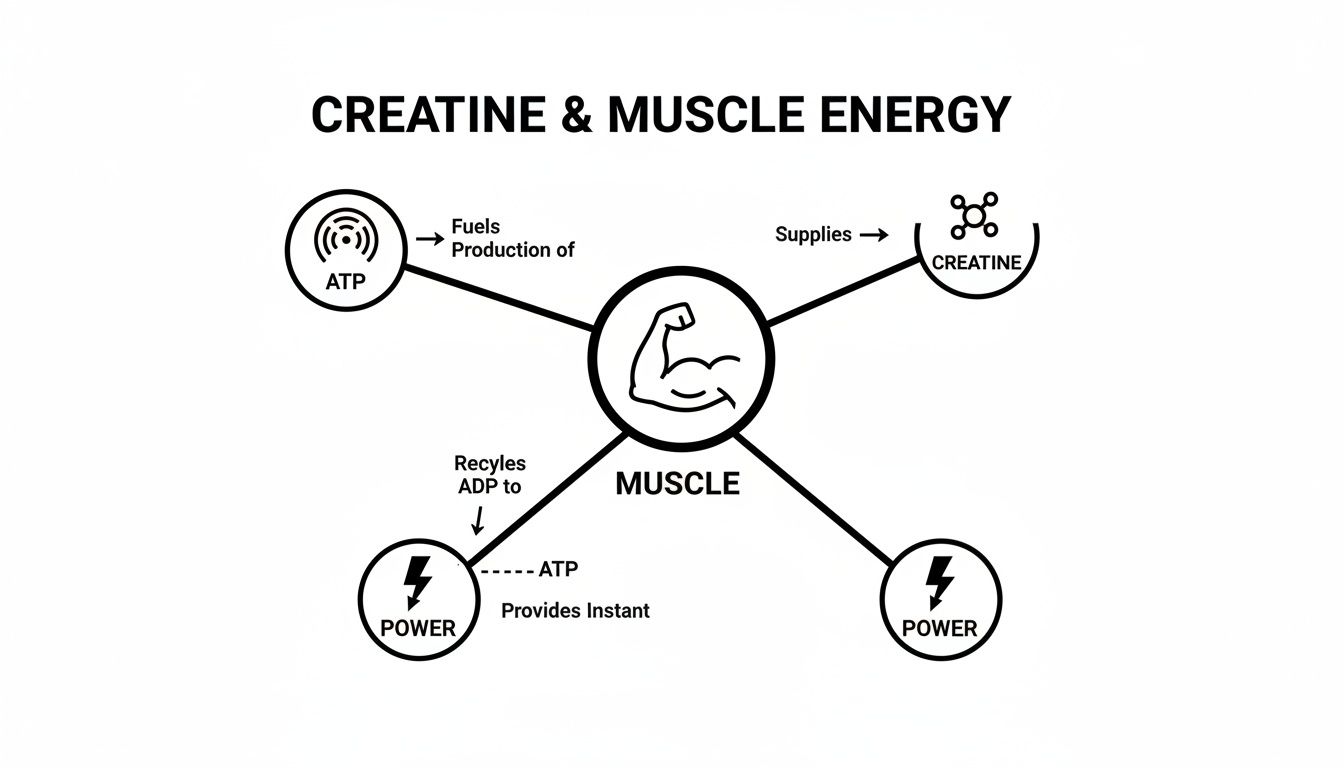
As you can see, creatine is the crucial middleman, ensuring your ATP supply is constantly topped off for peak performance. Without this system, your workouts would be a series of short, sputtering efforts. By supplementing, you're essentially upgrading this natural engine to its maximum potential.
Here’s a quick look at how creatine supplementation transforms your muscle energy and performance potential during high-intensity training.
| Performance Metric | Without Creatine Supplementation | With Creatine Supplementation |
|---|---|---|
| Max Effort Duration | ~2-3 seconds of peak power (pathetic, right?) | ~8-10 seconds of peak power (hello, beast mode) |
| Reps to Failure | You might hit 8 reps on a tough set. | You can push for 10-12 reps with the same weight. |
| Recovery Between Sets | Slower ATP replenishment; longer rest needed. | Faster ATP regeneration; ready for the next set sooner. |
| Overall Work Volume | Limited by rapid energy depletion. | Increased total sets and reps per workout. |
The difference is night and day. You're not just getting one or two extra reps; you're fundamentally increasing your capacity for the kind of work that builds serious muscle.
Ready to feel that difference for yourself? You can explore top-tier creatine options on the Crazy Muscle Amazon store and start fueling your best workouts today.
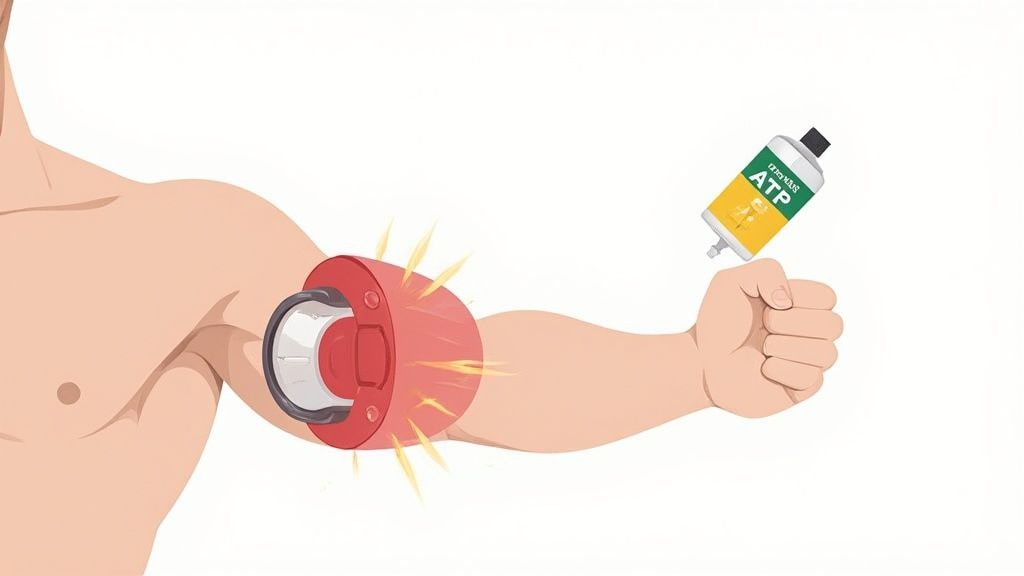
Alright, so you’ve basically upgraded your muscle’s energy system from a sputtering scooter to a roaring V8 engine. That’s great. But how does all that extra horsepower actually translate into bigger, stronger muscles?
This is where the real magic happens. It’s not some gym-bro myth—it’s pure, beautiful science. That extra ATP energy doesn't just feel good; it directly fuels the three key pillars of muscle growth. Let's dig into how creatine takes you from just "going through the motions" to actively building a more powerful physique.
The single most important signal you can send your muscles to grow is progressive overload. In plain English, you have to consistently challenge them with more than they’re used to. Creatine is your ultimate wingman for this mission.
Picture this: you're on the bench press, aiming for 8 reps. Without that extra fuel, you might hit a wall on the last one, your form getting sloppy. But with your creatine stores topped off, you power through rep 8, crush rep 9, and maybe even grind out a tenth.
That extra rep is everything. It’s the one that screams at your body, "Hey, we need to build bigger, stronger muscle fibers to handle this stress next time!"
This improved work capacity is the main driver of hypertrophy (the fancy term for muscle growth). By letting you lift heavier weights for more reps, creatine directly kicks off the muscle-building process. You're not just finishing your sets; you're dominating them.
Ever notice how your muscles look and feel way fuller after a killer workout? That's the "pump," and with creatine, it's more than just a temporary ego boost.
Creatine is an osmolyte, a cool science-y word that just means it pulls water into your muscle cells. This process is called cell volumization.
Think of your muscle cells like tiny water balloons. Creatine sucks fluid inside, making them swell up. This has a couple of awesome effects:
So yeah, that satisfying pump isn’t just for show—it’s an active part of the growth machine that creatine puts into overdrive.
Let's get one thing straight: your muscles don't grow during your workout; they grow while you recover. Hard training creates tiny micro-tears in your muscle fibers, and it's the repair process that makes them stronger. Creatine plays a huge supporting role here, too.
By helping you maintain energy and reducing metabolic stress during your workout, creatine can actually lessen the overall damage done to your muscles. This means your body can spend more of its resources on rebuilding and less on just patching things up.
This entire system runs on keeping your muscle's creatine tanks full. The average person's muscles are only about 60-80% saturated with creatine from their diet. Supplementing can boost those stores by 20-40%, giving you the surplus fuel needed to unlock this chain reaction of strength and growth.
Research has definitively shown that oral creatine supplementation effectively raises muscle creatine levels, laying the groundwork for these performance gains. If you want to dive into the nitty-gritty, you can explore the foundational science behind muscle creatine saturation in this detailed analysis.
Ultimately, creatine creates the perfect storm for growth. It gives you the power to train harder, hydrates your muscle cells to send growth signals, and helps you recover faster. Ready to create that storm in your own muscles? Find the perfect creatine to fuel your journey on the Crazy Muscle Amazon store.
Alright, you get it. Creatine works. You're ready to start chasing that extra strength and size. But now for the big question: how much should you actually be taking?
Hang around any gym locker room long enough and you'll hear all sorts of conflicting "bro-science" about loading, cycling, and secret dosing strategies. Let's cut through all that noise and get straight to what actually works.
The goal with creatine is incredibly simple. You’re just trying to fill up your muscles' creatine "gas tanks" and then keep them topped off. That's it. There are two common ways people go about this.
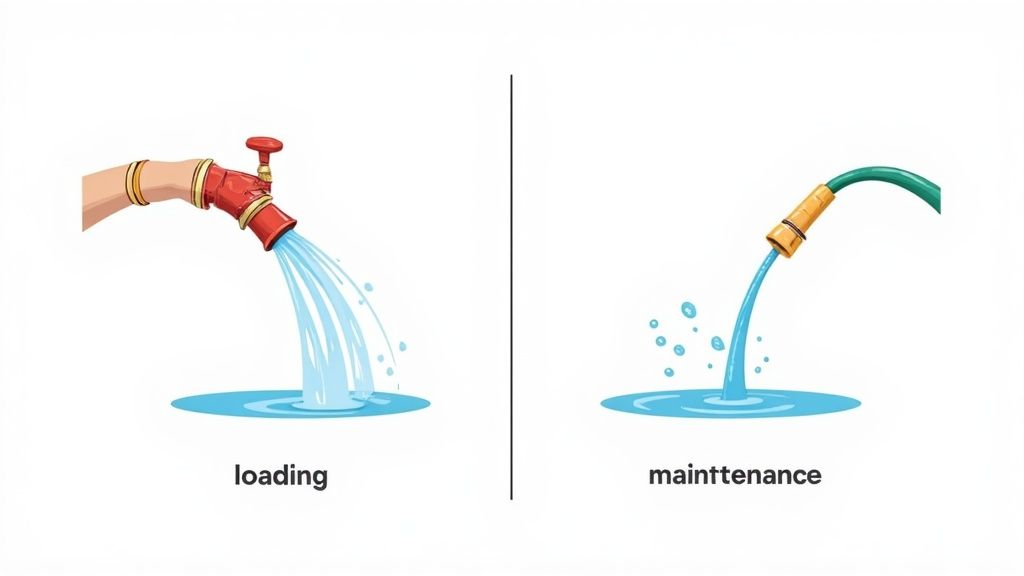
Think of it like filling a swimming pool. You can grab a firehose and blast it full in a day, or you can use a garden hose and fill it steadily over a few weeks. Both methods get the pool full—it just comes down to how quickly you want to start swimming.
The Firehose Method (The Loading Phase): This is the fast track. You’ll take a higher dose, usually 20 grams per day, for about 5-7 days. People typically split this into four 5-gram servings to avoid an upset stomach. The whole point is to saturate your muscles with creatine as fast as humanly possible.
The Garden Hose Method (The Maintenance Dose): This is the slow-and-steady approach. You just skip the high-dose week and start with a standard 3-5 grams per day. Your muscles will eventually reach full saturation, but it’ll take a bit longer, maybe three or four weeks.
So, which way is better? Honestly, it doesn't really matter in the long run.
The loading phase gets you to peak levels faster, so you might notice the benefits a couple of weeks sooner. But some people find the higher dose causes a bit of bloating or stomach discomfort. The maintenance route is gentler and gets you to the exact same destination, just without the rush.
The Verdict: The "loading phase" isn't a myth, but it's definitely not a requirement. It’s all about personal preference. If you’re not in a hurry, sticking to a straight 3-5 grams daily is the easiest and most sustainable strategy.
Once your muscles are saturated—whether you loaded or not—the mission is just to keep them that way. For the vast majority of us, a daily dose of 3-5 grams is the perfect amount to keep those creatine stores full and your energy systems primed for every single workout.
Don't overthink the timing, either. The single most important factor is consistency. Take it every single day. Whether you mix it in your morning protein shake or your post-workout water, just make it a habit. Consistency is what keeps those fuel tanks full.
If you want to get even more granular on this, our guide on how much creatine you should take breaks it all down.
Of course, your dose is only as good as your body's ability to absorb it. Standard creatine monohydrate is a proven winner, but what if you could ensure even more of it gets where it needs to go? That's where a smarter formula comes into play.
Our Crazy Muscle Three-Atine was engineered for exactly that. By blending three different forms of creatine, we designed it for superior absorption. This helps ensure that more of what you take actually gets into your muscle cells to do its job, making your simple 3-5 gram daily dose work that much harder for you.
Alright, let's cut through the noise. You’ve heard the whispers in the locker room, right? "Creatine makes you bloated!" "It'll make your hair fall out!" "Dude, what about your kidneys?" It's time to bust these myths once and for all.
Consider this your official fact-checking zone. After literally decades of research, creatine monohydrate stands as one of the most studied and safest performance supplements on the entire planet. The secret is simple: use it the right way and pick a high-quality product.
We're going to tackle every common concern head-on with solid science. No fluff, no fear-mongering—just the facts so you can feel confident about what you’re putting in your body.
This is probably the #1 misconception out there. Yes, creatine makes you hold water, but the location of that water is the all-important detail.
Creatine masterfully pulls water directly inside your muscle cells, a cool process known as cell volumization. Think of it as super-hydrating your muscles from within. This is a huge win! Not only does this give you a fuller, more defined look, but it also kicks off anabolic (muscle-building) signals.
That dreaded "bloat" people complain about? That’s usually discomfort in your gut or a soft layer of water under the skin. This typically only happens if you go too hard on a loading phase or use a cheap, gritty creatine that doesn't dissolve well.
Stick with a standard 3-5 gram daily dose and choose a premium, easy-to-mix formula. You'll get all the muscle-pumping benefits without feeling like a water balloon.
Let's clear the air and put a few more myths to rest for good. You've heard them, now let's debunk them.
Myth 1: Creatine Wrecks Your Kidneys
This one has been shot down by science time and time again. For healthy people, countless long-term studies show that taking creatine at recommended doses does absolutely nothing to harm kidney function. Now, if you have a pre-existing kidney condition, you should definitely chat with your doctor first. But for the vast majority of us, your kidneys are perfectly safe.
Myth 2: Creatine Causes Hair Loss
This entire rumor mill started from a single, small study way back in 2009 that didn't even measure hair loss. It just saw a bump in DHT, a hormone sometimes linked to baldness. Since then, follow-up research has failed to find any real connection between taking creatine and losing your hair.
Myth 3: Creatine Leads to Dehydration and Cramps
This is actually the exact opposite of what happens. Since creatine draws water into your muscles, it genuinely improves your body's overall hydration. In fact, studies on athletes show it can even help reduce cramping and dehydration during tough workouts.
The scientific verdict is in: Creatine is remarkably safe for most people. The key to dodging minor issues like an upset stomach boils down to proper dosing and, most importantly, the quality of the product you choose.
Knowing How to Read Supplement Labels Without a Science Degree is a game-changer for making smart choices. And for a much deeper dive into the science behind the rumors, check out our full guide on creatine side effects.
At the end of the day, picking a high-quality product from a brand you trust is your best move. When you invest in a premium formula, you're not just buying creatine—you're buying peace of mind. Find a product you can trust on the Crazy Muscle Amazon store.
Think of creatine like a high-octane fuel additive for a race car. It’s an incredible performance booster, but it’s completely useless if the car just sits in the garage. To get that explosive power off the line, you have to stomp on the gas pedal.
Your training is that gas pedal.
Taking creatine without a solid workout plan is like finding a treasure map and never going on the hunt. The real, jaw-dropping results only happen when you pair creatine's energy-boosting power with the muscle-building signal from intense, smart training.
This is your playbook for making that happen.
Creatine really shows its stuff during short, explosive, high-intensity efforts. It's the go-to fuel for powerful bursts, not a slow-and-steady marathon. To truly cash in on what creatine does for your muscles, you’ve got to focus on training that demands that kind of all-out energy.
These are the heavy hitters:
See the common thread? Intensity. Creatine gets your muscles ready for battle; it’s up to you to bring the fight.
You wouldn't put cheap gas in a Ferrari, would you? The same logic applies to your body. To get the most out of creatine, you have to pair it with consistent, goal-oriented nutrition. A lot of athletes use specialized bodybuilding meal prep services to make sure they stay on track without the stress.
Proper nutrition, especially getting enough protein, provides the actual building blocks your body needs to repair and build new muscle after your creatine-powered workouts. Think of creatine as the foreman on a construction site, pushing the crew to work harder and faster. Protein is the brick and mortar they use to build the skyscraper.
Key Takeaway: Creatine and protein are the ultimate power couple. Creatine gives you the strength to break down muscle in the gym, and protein gives you the raw materials to rebuild it bigger and stronger than before.
Remember how creatine works its magic by pulling water into your muscle cells? This is an amazing benefit, but it also means you have to supply that water in the first place.
Staying well-hydrated is absolutely essential for creatine to work effectively and for you to feel your best. Getting dehydrated can lead to cramps, poor performance, and fatigue—the exact opposite of what you're after.
Make it a simple rule: if you're taking creatine, drink more water. Your muscles, and your performance, will thank you. For a deeper dive into the mechanics, check out our guide on how to use creatine effectively.
The science on this is crystal clear. Mixing creatine with resistance training consistently leads to bigger muscles and greater strength gains. In fact, one study on resistance-trained men showed that pairing creatine with their workouts led to a 7.1% increase in upper body lean mass. This happens because of a cascade of positive changes, from better cell hydration to boosted growth factors. This isn't a tiny bump; it’s a real, measurable advantage that adds up, workout after workout.
Alright, so you're sold on creatine. You get how it works—more power in the tank for those tough reps, faster growth, and better recovery. The science is undeniable. Now for the million-dollar question: which creatine are you going to trust to actually get the job done?
Let's be honest, the market is flooded with cheap, gritty creatine that feels like you're drinking a cup of sand. That's the kind of stuff that clumps up, sits in your stomach, and never quite makes it to your muscles where it belongs. What a waste of time, money, and potential gains.
This is the exact problem we set out to solve with Three-Atine. We didn't want to just slap our label on another generic tub of monohydrate. We wanted to build something better from the ground up.
Instead of settling for just one form of creatine, we went all in. We combined three premium forms—Creatine Monohydrate, Creatine Alphaketoglutarate (AKG), and Creatine Pyruvate—into a single, powerful formula.
Why the triple-threat? Simple. Each type has a slightly different pathway for absorption. By combining them, we created more "lanes" for creatine to travel into your muscles, leading to faster and more complete saturation.
This isn't just marketing fluff; it's a smarter approach to supplementation. Here’s what our unique blend means for your training:
You've done the research on what creatine does. Now you know there’s a much more effective way to take it. Stop settling for powders that under-deliver and disrespect your hard work in the gym.
Your journey to a stronger, more powerful physique deserves the best fuel possible. It’s time to make the smart choice.
Ready to feel the difference? Get Your Crazy Muscle Three-Atine on Amazon Now!
Alright, you've waded through the science and the strategy, but a few questions might still be bouncing around in your head. That's perfectly normal. Let's tackle them head-on so you can move forward with total confidence.
Think of this as our rapid-fire round to clear up the common myths and curiosities about one of the best supplements on the planet.
This is the big one, isn't it? Let’s put this myth to bed for good: creatine does not make you gain fat. Period.
It does make your muscles hold onto more water, but this is a very good thing. We’re not talking about the soft, puffy bloating you get under your skin. This is a process called cell volumization, where water is pulled directly into the muscle cell. It makes your muscles look fuller, harder, and more pumped. Plus, this hydrated state actually sends anabolic signals that can help spark even more growth. It's a "good" weight that works for you.
Back in the old days, the "on/off" cycle was standard advice for almost every supplement. But for creatine, the science has evolved, and the verdict is in: cycling is totally unnecessary.
Study after study has shown that creatine monohydrate is incredibly safe for continuous, long-term use. Once you've saturated your muscles (either with a loading phase or just a few weeks of consistent use), a simple 3-5 gram maintenance dose per day is all it takes to keep those levels peaked. No fuss, no complicated schedules. Just consistent results.
Not only can they, they probably should! Creatine is one of the most effective and safest supplements a newcomer can add to their stack. It gives you a noticeable bump in strength right out of the gate, which is a massive confidence booster when you're just getting started.
Those first few months in the gym are famous for "newbie gains," and creatine helps you squeeze every last drop of progress out of that magical window. You'll be able to handle heavier weights with good form sooner, building a rock-solid foundation for years to come.
What happens if I stop taking creatine? If you decide to stop, don't sweat it. Your muscle creatine stores will just gradually return to their normal baseline over a few weeks. You won't lose the actual muscle you worked so hard to build. You might, however, feel a small drop in your explosive power and lose that last rep or two on your heaviest sets as your quick-energy system goes back to its default setting.
Now you're armed with the facts, free from the myths. The only thing left is to put all this knowledge to work with a product you can trust. At Crazy Muscle, we live and breathe this stuff, and we're dedicated to giving you the fuel you need to crush your goals.
Ready to feel the difference for yourself? You can grab all our top-tier supplements, including our fan-favorite creatine, right on our Crazy Muscle Amazon store.

Sign up and save 10% off your next order