
The Ultimate Guide to Creatine Monohydrate for Athletes
Posted by Maximus
on

Ever had one of those days where you feel like a superhero? You're smashing new PRs, leaving your rivals in the dust, or squeezing out that one last rep you swore was impossible. That's the feeling athletes live for, and it’s exactly what creatine monohydrate for athletes can help you find, like, way more often. This isn’t some over-hyped magic dust; it's one of the most battle-tested, scientifically-proven tools in the entire sports nutrition playbook for unlocking raw, beast-mode performance.

Let’s ditch the boring scientific jargon for a second. You’re not here for a lecture; you're here for an edge. You want more power, more gas in the tank, and a bigger return on all the blood, sweat, and tears you pour into your training.
Think of your muscles as having tiny, super-fast-charging batteries inside. These batteries are your ATP (adenosine triphosphate), the high-octane fuel for immediate, explosive energy—the kind you need for heavy squats, 50-meter sprints, and launching yourself onto a box jump. The catch? These little batteries burn out after just a few seconds of all-out war with the weights. That’s when fatigue crashes the party and tells you to pack it in.
This is exactly where creatine monohydrate rolls in like the hero of the story. It’s basically a high-speed charging station for those muscle batteries.
Taking creatine is like flooding your body with the raw materials needed to rapidly recharge those ATP batteries. When your creatine stores are topped off, you can regenerate that explosive energy much faster, right in the middle of your workout.
"Creatine is one of the most widely researched and scientifically supported sports supplements for improving strength, power, and recovery. It plays a key role in ATP production, the body's primary energy source for short bursts of high-intensity activity."
This isn't some weird voodoo. It’s pure energy economics. By keeping your internal power reserves maxed out, you’re giving your body the fuel it needs to perform at a higher level for longer. You can push harder and go further before hitting that soul-crushing wall.
So, what does that actually feel like in the gym or on the field?
This isn't a deep dive into biochemistry. It's the simple, powerful reason why creatine monohydrate for athletes is such a massive game-changer. It’s the tool that helps you turn your hard work into cold, hard, measurable results. Now that you've got the battery analogy down, let's get into the specifics of how it makes you an absolute powerhouse.
Alright, so we've established that creatine is a power pack for your muscles. But what does that really mean when you’re in the trenches—when the barbell feels heavy, the finish line seems miles away, or you need to find one more rep from the depths of your soul? Let's get into the nitty-gritty of how creatine monohydrate takes you from a dedicated athlete to a dominant force of nature.
This isn’t about some vague feeling of being "better." We're talking about real, measurable gains in the numbers that define your success.
Picture a point guard exploding to the rim for a layup, a sprinter bursting from the starting blocks, or a weightlifter driving a new PR clean off the floor. What do they all have in common? They need a massive surge of immediate, all-out power. This is creatine's absolute sweet spot.
By keeping your ATP reserves topped off, creatine ensures you have that high-octane fuel ready for short, violent bursts of effort. You can simply generate more force, faster. It’s like swapping out your car's V6 for a supercharged V8—the raw horsepower just isn't in the same league.
It's simple math: more explosive power naturally leads to greater overall strength. When you can consistently push more weight or grind out an extra rep in your workouts, your muscles have no choice but to adapt by getting bigger and stronger. Creatine is the spark that ignites this entire cycle of progress.
It’s the key that unlocks that bench press plateau you've been stuck on for months. By arming you to handle heavier loads and greater training volume, creatine monohydrate is a direct contributor to your long-term strength gains. And as your muscle mass increases, so does your athletic potential. Gaining a better grasp of understanding why body composition is important and what it entails helps connect the dots between these physical changes and peak performance.
Think of it like this: If your training is the construction crew, creatine is the daily delivery of premium steel and concrete. Without those top-tier materials, the crew can’t build a skyscraper.
While creatine is famous for raw power, its impact on high-intensity endurance is a game-changer that often flies under the radar. We're not talking about running a marathon here. We're talking about your ability to go hard, recover in seconds, and go hard again, over and over, with way less drop-off.
Just think about it in these real-world scenarios:
This incredible work capacity comes directly from faster ATP regeneration. Instead of your performance taking a nosedive after a few all-out efforts, you can sustain a much higher output for much longer. To really get into the weeds on this, check out our deep dive into how creatine actually works inside your muscles.
Don't just take my word for it—the science is crystal clear. Massive reviews of athletic research have shown that creatine supplementation consistently improves max power, strength, and work during repeated sprints by a whopping 5% to 15%. Even single-effort sprints see a boost, typically around 1% to 5%, which can easily be the difference between a gold medal and going home empty-handed.
To put it all together, here’s a quick look at the kind of performance boost you can realistically expect from adding creatine to your routine.
This table breaks down the scientifically-backed improvements athletes often see with consistent creatine monohydrate supplementation. These aren't just theories; they're the results seen in labs and on the field.
| Performance Metric | Typical Improvement Range | Best For These Activities |
|---|---|---|
| Maximal Strength | 5% – 15% | Weightlifting, Powerlifting, Strongman |
| Explosive Power | 5% – 15% | Sprinting, Jumping, Olympic Lifts |
| Repeated Sprint Ability | 5% – 15% | Soccer, Football, Hockey, HIIT |
| Single Sprint Speed | 1% – 5% | Track & Field, Swimming |
| Total Work Volume | 10% – 15% | CrossFit, Circuit Training, Bodybuilding |
At the end of the day, creatine monohydrate isn't magic. It's a tool that translates proven science into tangible results, giving dedicated athletes a clear and decisive edge over the competition.
Alright, let's get down to business. Knowing creatine is awesome is one thing, but knowing exactly how to use it is where you turn potential into power. Getting the dosing and timing right is the difference between just taking a supplement and truly becoming a force to be reckoned with.
Don't sweat it, this isn't rocket science. It’s a simple game plan, and I’m going to break it down so you can start with total confidence.
Think of it like this: you have two main strategies to fill up your muscle's creatine fuel tanks. You can take the "sprint" approach to get there fast, or you can take the "marathon" approach for a steady, gradual build-up. Let's dig into both.
The loading phase is for the athlete who wants results, and wants them yesterday. This method is all about saturating your muscles with creatine as quickly as humanly possible to max out those internal power reserves. It’s an aggressive, short-term strategy designed to fast-track your gains.
Here’s the simple playbook:
After this initial blitz, you drop down to a smaller daily dose to keep your tanks full. The biggest pro? You'll likely feel the performance benefits—that extra rep, that added pop in your step—within the first week. The only potential downside is that some people might get minor stomach grumbles from the higher dose, but splitting it up usually solves that.

As you can see, the benefits start stacking up quickly, giving you that immediate energy kick before evolving into peak strength and enhanced endurance. It’s a snowball effect of pure awesomeness.
Not in a huge rush? The maintenance-only approach is your ticket. This method is the steady, patient route to full muscle saturation. It’s simpler, easier on the stomach, and gets you to the exact same place in the long run. You'll reach the finish line; it'll just take about three to four weeks instead of one.
The Protocol: Take a consistent 3-5 grams of creatine monohydrate every single day. That's it. No loading, no complicated cycling, just unwavering consistency.
Most of us walk around with our muscle creatine stores about 60%–80% full. This simple daily dose tops them off by an extra 20%–40% over several weeks. Even the military and other official bodies confirm that doses as low as 3 grams per day are both safe and incredibly effective. You can discover more insights on these creatine protocols from the experts in sports science.
So, which path should you choose? Honestly, both work perfectly. If you have a competition coming up or you're just impatient for results, load up. If you prefer a simple, set-it-and-forget-it routine, the steady maintenance dose is your best friend.
Now for the million-dollar question: when is the perfect time to take creatine? Before your workout? After? With breakfast?
Here’s the refreshingly simple truth: it really doesn’t matter.
Seriously. The most critical factor for creatine success isn't timing; it's consistency. The whole point is to keep your muscle's creatine stores saturated. As long as you take your daily dose, those stores will stay topped off and ready for action whenever you decide to hit the gym.
To build a rock-solid habit, just "stack" it with something you already do every day.
The best time to take creatine is whenever you will remember to take it. Period. Pick a time, stick with it, and let the results do the talking. Now that you've got the game plan, it's time to execute. If you're looking for a high-quality creatine to get started, you can find our full range of performance supplements here.
Let's be real for a second. The locker room is a goldmine for terrible advice and wild rumors, and creatine is usually public enemy number one. You’ve probably heard it all: it'll make you bloated, wreck your kidneys, and some guys even whisper that it's basically a steroid.
It's time to call shenanigans on all that noise.
We’re here to set the record straight with cold, hard facts, because understanding the truth is the first step to unlocking your best performance. Let's tackle these myths one by one so you can supplement with total confidence.
This is probably the biggest myth of them all, and it’s a classic case of a half-truth causing total confusion. Yes, creatine monohydrate draws water into your body. But here’s the crucial part: it pulls that water inside your muscle cells, not under your skin where it would make you look soft.
This process is actually called intramuscular water retention, and it's a good thing. A very good thing.
The "bloat" some people complain about usually happens when they take huge loading doses without drinking enough water, or when they use a low-quality, gritty product. Stick to a standard 3-5 gram daily dose, stay hydrated, and you’ll get all the muscle-building benefits without the discomfort.
The bottom line: Creatine helps your muscles hold onto the water they need to perform and grow. It's not the same as the subcutaneous water retention that makes you look and feel soft.
This one sounds scary, but for healthy individuals, it's been debunked again and again by years of solid research. The myth got its start because taking creatine can slightly increase blood levels of creatinine, which is a waste product that doctors use to check kidney function.
However, in this context, the small increase is just a normal, harmless byproduct of breaking down extra creatine—it’s not a sign that your kidneys are in trouble. Think of it like this: revving your car's engine makes the exhaust hotter, but that doesn't mean the engine is broken. It's just working harder.
Countless long-term studies have confirmed that taking creatine at recommended doses does not harm kidney function in healthy people. Of course, if you have a pre-existing kidney condition, you should always talk to your doctor first. But for the vast majority of us, your kidneys are perfectly safe. For a deeper dive, check out our guide on the most common creatine side effects.
Let's be crystal clear about this: Creatine is NOT a steroid. It’s not even in the same universe.
Anabolic steroids are synthetic hormones that directly manipulate your body's endocrine system. Creatine, on the other hand, is a completely natural compound your body already makes from amino acids. You also get it from eating foods like red meat and fish.
All you're doing with a supplement is topping off your natural stores to maximize their effect. It has zero impact on your hormone levels. It’s one of the most researched supplements on the planet and is permitted by every major sports organization, from the NCAA to the International Olympic Committee.
It's just fuel, plain and simple.
Alright, you're sold. You see the power creatine brings to the table and you're ready to get started. But a quick search online throws a hundred different tubs at you, all with flashy labels and bold claims.
It’s tempting to think, "creatine is creatine, right?" Not even close. The gap between a top-shelf product and some cheap, gritty powder from a bargain bin can make or break your results.
When you're an athlete who treats their body like a high-performance machine, what you put into it is everything. This is no time for mystery ingredients or sketchy manufacturing. You need purity, quality, and a formula designed to work as hard as you do.
There's a reason scientists and pro athletes keep coming back to one form above all others: creatine monohydrate.
Sure, new and supposedly "advanced" versions are always popping up, but monohydrate is the undisputed champion. It's backed by literally decades of relentless research.
Since the late 1990s, creatine monohydrate has been one of the most intensely studied supplements in sports science history. Study after study has confirmed its ability to boost strength and sprint performance by 5%–15%, cementing its place as the gold standard. To see just how deep the research goes, you can learn more about its 25-year history of efficacy.
It’s the most proven, reliable, and effective form on the market. Period. Wondering how it stacks up against other forms? Check out our guide comparing creatine HCL vs monohydrate.
Choosing creatine monohydrate isn't just a safe bet; it's the smartest bet. You're investing in a supplement with an unmatched track record for delivering real, measurable results for athletes.
So, we've settled it: monohydrate is king. But even within that category, the quality can be all over the place.
Ever tried mixing a cheap creatine powder that just sinks to the bottom of your shaker like wet sand? That’s not just annoying—it’s a huge red flag for poor absorption. If it won't even dissolve in your drink, how well do you think your body is going to use it?
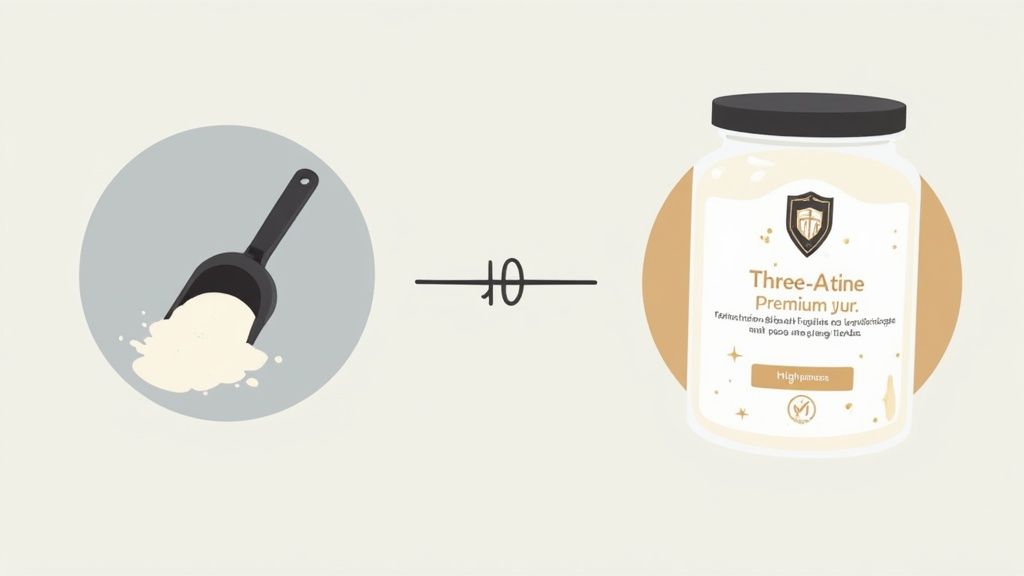
A premium formula like our Three-Atine is engineered completely differently. We use micronized creatine monohydrate, which means the powder particles are milled to be incredibly fine. This isn't just for show; it radically improves how well it dissolves.
Here’s why that’s a total game-changer for you:
You wouldn't pour dirty, low-octane fuel into a Ferrari, so why would you do it to your body? Your ambition deserves a supplement that matches your dedication. This isn't just another product on the shelf; it's the key to unlocking that next level of performance you've been chasing.
Ready to feel the difference a premium formula makes? It’s time to stop guessing and start gaining.
Fuel your ambition and get your supply of Crazy Muscle Three-Atine on Amazon today!
Alright, you've got the full playbook. We've walked through the science, looked at the hard evidence, and laid out the exact game plan. The myths are officially busted, and the road to real, noticeable results is wide open. The only thing left? It's your turn to step up to the plate.
Think of this less as a summary and more as your official call to action. We've talked about the incredible, science-backed benefits that creatine monohydrate brings to the table for dedicated athletes. Picture it for a second: more explosive force behind every single lift, the ability to grind out those extra few reps that really count, and a recovery process that gets you back to 100% faster. That’s not just talk; it's what happens when you give your muscles the high-octane fuel they've been waiting for.
Adding creatine monohydrate into your daily lineup is easily one of the simplest, safest, and most effective moves you can make to seriously level up your performance. It's time to stop wondering what your ceiling is and start shattering it.
Look, you’re already grinding it out in the gym. You've got the dedication and the drive. Now, it's about arming yourself with a tool that makes every ounce of that sweat and effort count for more. You'll be joining the legions of athletes who are already blowing past their old personal records and discovering what they’re truly capable of. And remember, hitting peak performance is a total-package deal—it goes beyond supplements and includes everything from your diet to selecting appropriate high-performance gym wear.
That next level of performance isn't some far-off destination you hope to reach someday. It's a decision you can make today. One simple scoop is the first step toward unleashing the absolute beast you were meant to be.
Stop waiting on the sidelines and start winning. The power, strength, and endurance you've been chasing are right there for the taking. Your peak self is literally a click away.
Don't let one more workout pass you by without giving it everything you've got.
Grab Your Supply of Crazy Muscle Three-Atine and Unleash Your True Potential!
Alright, let's tackle the big questions. When it comes to creatine, there's a mountain of "bro science" and conflicting advice out there. I'm here to cut through the noise and give you the straight-up, evidence-backed truth so you can use it with total confidence.
Let's put this old gym myth to rest, once and for all. The whole idea of "cycling"—taking creatine for a few weeks, then taking a break—is based on outdated thinking. The latest science makes it clear: for most athletes, taking it consistently is not only safe, but it's also way more effective.
Think of it this way: your goal is to keep your muscle's creatine tank topped off so you're always primed to perform. When you take a break, you're just letting that tank run dry. All that hard work to get it full goes to waste, and your performance drops right back to where you started. Stick with a daily 3-5 gram dose. That’s the real secret to long-term results.
Absolutely! In fact, this is probably the easiest and most popular way to do it. Tossing your creatine in with your post-workout protein shake is a genius move because it's a habit you already have.
We call this "habit stacking." You're piggybacking a new habit (taking creatine) onto an existing one (drinking your shake). It makes staying consistent almost foolproof. Better yet, the carbs and protein in your shake can actually help shuttle that creatine into your muscles a bit more efficiently.
This is a huge fear for a lot of people, but it’s mostly a misunderstanding of how creatine works. Let me be clear: if you stop taking creatine, you are not going to lose the actual muscle and strength you busted your butt in the gym to build. That’s yours, you earned it.
What you will notice is a drop in that extra gear you had. The water and energy stored in your muscles will decrease, so you might lose a rep or two on your big lifts, and that full, pumped look might fade a bit. Your muscles are just returning to their baseline creatine levels. Honestly, it's the best motivation to just stay on it!
This is a really important question, and it deserves a careful answer. The bulk of current research suggests that when used responsibly and at the right doses, creatine is generally safe for teenage athletes. But, and this is a big but, I’m not your doctor.
My advice here is simple and non-negotiable: if you're a teenager, or the parent of one, the very first step before even thinking about buying creatine is to talk to a doctor or a certified sports nutritionist. They can give you advice tailored to the individual's health, their sport, and their specific goals. It's the only way to ensure you're doing things safely and effectively.
Now that we've cleared the air, you're ready to put this knowledge into action. Crazy Muscle delivers pure, no-nonsense creatine monohydrate built for athletes who refuse to settle.

Sign up and save 10% off your next order